컨텐츠 내용을 수정할 수 있습니다
For pediatric respiratory and infection questions, the key isn't spending a long time comparing diagnoses. Instead, you first need to look for signs of airway and respiratory failure, connect the location of sounds with the child's age and how fast things are progressing, and then simultaneously start the necessary isolation precautions and emergency actions.
Core Goal: Make your judgments in this order: Appearance & Consciousness → Airway Sounds & Speaking → Work of Breathing & Oxygenation → Immediate Support → Cause-Specific Treatment → Transmission-Based Isolation → Reassessment.
In local feedback materials, we've consistently seen recurring themes like meningitis, infant fever, post-tonsillectomy care, asthma medications, and exanthematous infectious diseases with isolation. The questions, answers, options, tables, and images haven't been reproduced here; this content is newly written based on current public guidelines from the CDC, AAP, NHLBI, AAO-HNS, CPS, and FDA. Remember that patient-specific drug dosages, oxygen targets, tests, and discontinuation criteria will vary depending on the child's age, illness, and your institution's protocols.
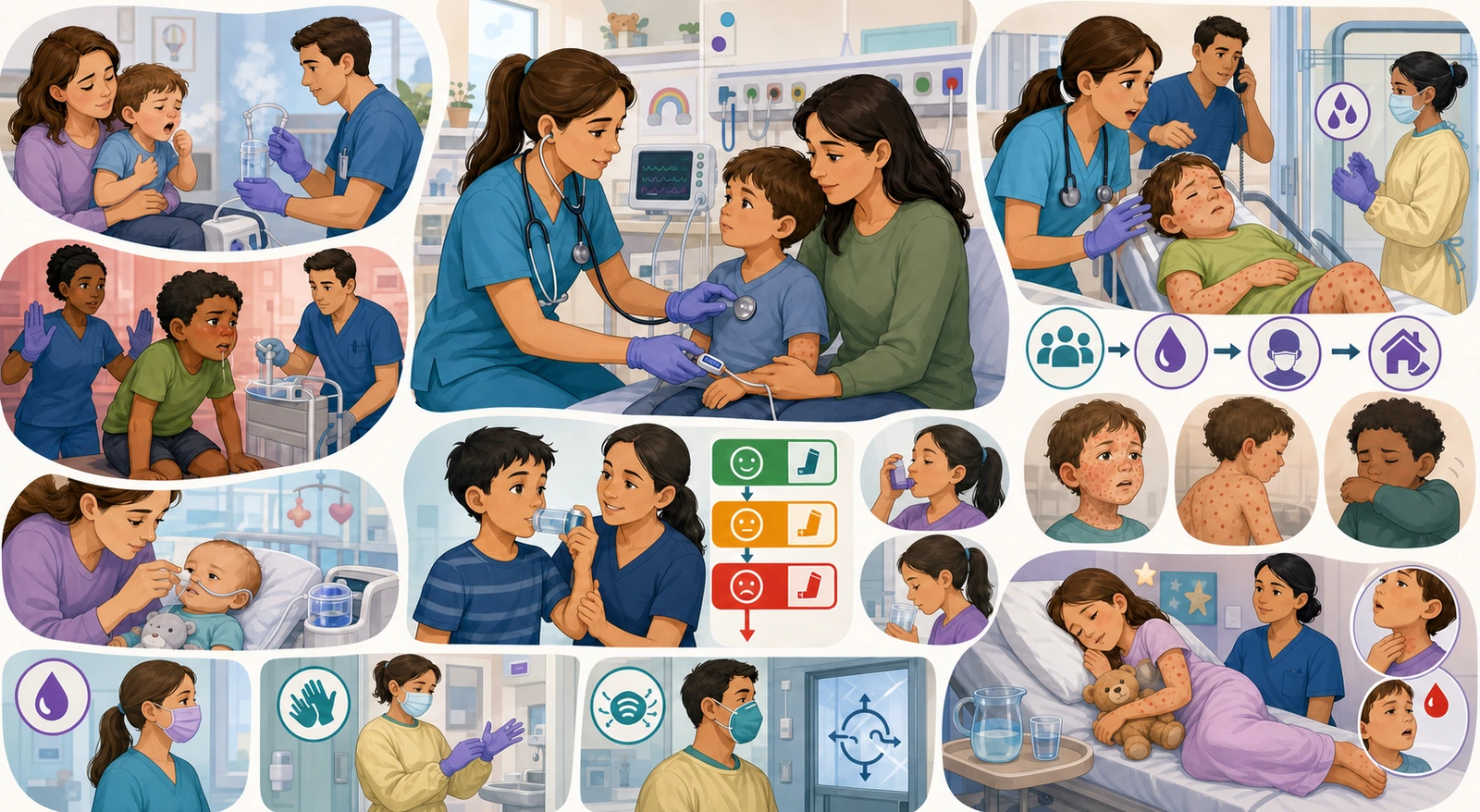
Check for eye contact, cry/speech, muscle tone, and interaction with the caregiver. Limpness, a change from anxious to listless, decreased responsiveness, and inconsolable irritability can be late signs of hypoxia, hypercapnia, or shock.
Listen for snoring, a hoarse voice, drooling, inspiratory stridor, wheezing, and grunting. Rather than just noting if a sound is getting louder, check if it's becoming quieter because air entry is decreasing.
Look at the age-appropriate respiratory rate, nasal flaring, sternal/intercostal/supraclavicular retractions, head bobbing, abdominal breathing, grunting, and chest wall movement and fatigue on both sides. In infants, apnea can appear before coughing does.
Look at the skin color, lips, peripheral perfusion, heart rate, and pulse oximetry trends together. Remember that cold hands, movement, or a misplaced sensor can give you inaccurate readings, so always confirm the waveform and correlate it with the clinical picture.
Infants have a hard time coordinating breathing and feeding at the same time. Check their feeding volume, wet diapers, oral mucosa, tears, vomiting, and fatigue. Don't force them to feed while their work of breathing is high.
| Sound/Finding | Main Location & Possibility | Priority Judgment |
|---|---|---|
| Inspiratory stridor | Upper airway narrowing (larynx, subglottis, etc.) | Check if it's present at rest, and look for drooling, difficulty swallowing, a toxic appearance, or a sudden choking event. |
| Expiratory wheeze | Lower small airway narrowing | Consider the context of asthma, bronchiolitis, foreign body, or anaphylaxis, and check if it's bilateral, assess air entry, and monitor the response to treatment. |
| Crackles | Secretions or alveolar process | Connect this with fever, hypoxia, whether it's localized, and decreased intake, but don't use the sound alone to confirm if it's viral or bacterial. |
| Grunting | A compensatory mechanism to self-maintain end-expiratory pressure | This suggests the possibility of pneumonia, pulmonary edema, or severe respiratory distress and requires an urgent evaluation. |
| Silent chest | Very little air movement | Don't misinterpret this as an improvement where the wheeze has disappeared. Respond to it as impending respiratory failure. |
| Decreased breath sounds on one side | Foreign body, pneumothorax, atelectasis, positioning issue, etc. | Connect this with a sudden onset, any history of trauma, or procedures and evaluate the cause immediately. |
Even the same degree of mucosal edema greatly increases airway resistance in infants and young children. Minimize unnecessary crying and repeat exams, and keep them in a comfortable position.
Children have a high metabolic rate and oxygen demand, so their reserve is limited. If bradycardia, apnea, or decreased responsiveness follows tachypnea and tachycardia, that's a late sign of deterioration.
For young infants, even just nasal secretions can make feeding and breathing difficult. Gentle nasal suctioning before feeds can be really helpful.
Fever, tachypnea, and poor intake all stack up. Track their fluid status and urine output, and if oral intake isn't safe, review the prescribed NG or IV fluids.
For well-appearing, full-term infants 8–60 days old with a rectal temp ≥38.0°C, there are AAP age-based pathways. You don't manage the 8–21 day, 22–28 day, and 29–60 day groups the same way, and preterm infants, ill-appearing infants, or those with underlying conditions fall outside these pathways. A fever in a young infant needs prompt evaluation — don't just wait it out with home antipyretics.
Regardless of age or how high the temperature is, decreased responsiveness, respiratory distress, nuchal rigidity, non-blanching purpura, seizures, poor perfusion, and severe dehydration all need emergency evaluation first.
The goal of fever management is relieving discomfort and maintaining hydration — not forcing a normal temperature. Don't strip off too many clothes or use ice, alcohol rubs, or cold baths.
For acetaminophen and ibuprofen, always check the age, weight, product concentration, contraindications, and orders. If a caregiver alternates them on their own, the risk of overlap and overdose goes way up. Infants, dehydration, kidney disease, and varicella all need extra checks.
| Situation | Clues | First action |
|---|---|---|
| Typical croup | Barky cough, hoarse voice, inspiratory stridor, worse at night | Keep them comfortable in a caregiver's arms and assess severity; give prescribed dexamethasone, and for moderate to severe cases, nebulized epinephrine with enough observation time |
| Suspected epiglottitis | Sudden high fever, drooling, difficulty swallowing, muffled voice, toxic appearance, leaning forward and sitting up, no barky cough | Don't lay them flat or force the mouth open — call the airway team, anesthesia, and ENT; prepare for a controlled airway and antibiotics |
| Bacterial tracheitis | High fever, toxic appearance, severe airway obstruction, poor response to nebulized epinephrine | Escalate immediately to a setting where advanced airway management and IV antibiotics are available |
| Foreign body / anaphylaxis | Sudden choking, unilateral decreased breath sounds, or urticaria, facial swelling, hypotension | Don't assume it's croup — follow the emergency pathway for foreign body or anaphylaxis, respectively |
The CPS recommends considering corticosteroids for all severities of typical croup, and nebulized epinephrine for moderate to severe cases. Epinephrine works fast but can wear off, so don't send them home right after they improve. Humidified air, antibiotics, and beta-agonists are not routine treatments for typical croup.
Young infants may present with fussiness, decreased activity, poor feeding, and apnea rather than cough and wheezing. Preterm infants, those with cardiopulmonary disease, immunocompromise, or neuromuscular disease are at higher risk for severe illness.
Clear nasal secretions that interfere with breathing and feeding using saline and gentle superficial suctioning. Repeated deep suctioning can increase mucosal injury, edema, and distress.
Provide oxygen based on the clinical picture and your institution's criteria. Offer small, frequent feeds, but if aspiration risk or fatigue is significant, stop oral intake and consider an alternative fluid route.
Don't routinely use albuterol, epinephrine, systemic steroids, antibiotics, chest physiotherapy, or chest imaging for typical bronchiolitis. Judge these separately when there's evidence of an alternative diagnosis or bacterial coinfection.
Check whether the child can speak a full sentence, needs to sit up to breathe, and look for chest retractions, air entry, wheezing, oxygenation, consciousness, and any history of ICU stays or intubation. A silent chest, cyanosis, fatigue, or altered mental status are all critical signs.
If hypoxic, give oxygen and rapidly administer the prescribed inhaled SABA via spacer or nebulizer. For severe cases, prepare ipratropium and systemic corticosteroids, and be ready for repeated or continuous treatments and advanced airway support according to your protocol.
Don't just count the number of doses given. Look again at respiratory rate, retractions, speech, air entry, wheezing, oxygen requirement, heart rate, and anxiety. If there's no improvement or the effect is short-lived, escalate immediately.
Identify viruses, allergens, exercise, smoke or e-cigarettes, missed medications, poor technique, and over-reliance on SABA. Once the acute episode is stabilized, connect this to a relapse prevention plan.
| Category | Role | Nursing points |
|---|---|---|
| SABA | A rescue medication that quickly relieves acute bronchoconstriction | Observe the response and watch for tachycardia and tremors; if use becomes frequent, assess it as a sign of poor control |
| Inhaled corticosteroid (ICS) | A key controller medication that reduces airway inflammation | Use as planned even on symptom-free days; teach spacer use and mouth rinsing after administration, and track growth and oral health |
| ICS-formoterol strategy | Used for both control and relief in certain ages and severities | Not all inhalers are used the same way — confirm the specific prescription, device, and age-appropriate plan |
| LABA | Long-acting bronchodilation | Never use alone in asthma; always use as part of a plan that includes an ICS |
| Leukotriene modifiers, etc. | Alternatives or add-ons based on individual phenotype and comorbidities | Provide prescription-specific education, including warnings about neuropsychiatric adverse effects and expected benefits |
Watch the child use the inhaler directly and correct the steps: shaking, sealing, actuation with a slow inhale, breath-holding, and the interval between puffs. A written action plan to share with caregivers and the school should include the daily controller medication, signs of worsening, rescue medication use, criteria for contacting a healthcare provider, and emergency signals.
Hypoxia, grunting, marked retractions, apnea, cyanosis, dehydration or inability to take fluids, decreased responsiveness, poor perfusion, and underlying conditions all raise the likelihood of needing admission or a higher level of care.
Look at age-appropriate respiratory rate and trends, bilateral air entry, fever, chest or abdominal pain, cough, oxygen requirement, and hydration and urine output. Imaging and blood tests are chosen based on severity and diagnostic uncertainty.
Oxygen, fluids, antipyretics, and secretion management may be needed. If bacterial infection is likely, consider cultures but don't unnecessarily delay antibiotics in an unstable child.
Don't give leftover antibiotics or adult cough medicine on your own. Teach the discharge criteria to watch for: respiratory distress, lip color changes, difficulty to wake, decreased urine output, and inability to take fluids.
In the early post-anesthesia recovery phase, position the child on their side or in an airway-safe position so secretions can drain, and monitor breath sounds, oxygenation, and sedation level. Unnecessary deep oral or pharyngeal suctioning can damage the surgical site.
Repeated swallowing, throat clearing, tachycardia, pallor, restlessness, hematemesis, or bright red blood are all signs of bleeding. If you suspect bleeding, don't leave the child alone — call the surgical or emergency team and prepare for airway management, IV access, and a return to surgery.
Once the child is fully awake and swallowing is safe, offer small, frequent amounts of cool or comfortable fluids according to your institution's and surgical team's guidelines. Assess and manage pain proactively so the child can drink, which helps reduce dehydration.
The AAO-HNS does not recommend routine perioperative antibiotics and advises using ibuprofen, acetaminophen, or both. Do not use codeine or tramadol after pediatric tonsil or adenoid surgery. Check for individual bleeding, renal, and hepatic risks and verify the specific prescription.
| Age & condition | Possible presentation | How to interpret the risk |
|---|---|---|
| Newborns & young infants | Temperature instability, poor feeding, irritability or floppiness, vomiting, apnea, seizures, bulging fontanelle | Don’t rule it out just because there’s no neck stiffness |
| Older infants & children | Fever, severe headache, neck stiffness, photophobia, vomiting, altered consciousness | Don’t wait until all three classic signs appear |
| Possible meningococcemia | Non-blanching petechiae or purpura, limb pain, cold and mottled skin, poor perfusion, rapid deterioration | Risk of septic shock and DIC — start antibiotics and resuscitation pathway immediately |
| Increased intracranial pressure | Repeated vomiting, decreasing consciousness, focal neurological signs, irregular breathing, changes in pulse and blood pressure | If unstable, don’t rush into a lumbar puncture first — prioritize airway, circulation, imaging, and specialist evaluation |
If you suspect Hib or meningococcal meningitis, start standard and droplet precautions immediately. The CDC guideline is to continue for 24 hours after effective treatment begins, but always check the causative organism and your facility’s policy.
Whenever possible, get blood cultures first — but in shock or rapid deterioration, don’t delay empiric IV antibiotics just to obtain specimens or perform a lumbar puncture. Choose the drug based on age, local resistance patterns, and immune status.
Track level of consciousness, pupils, seizures, perfusion, urine output, skin lesions, and fluid/electrolyte balance. Treat seizures, shock, and respiratory failure simultaneously.
Don’t automatically prescribe the same medication to every family member. The scope of close contacts for Hib or meningococcal exposure, as well as chemoprophylaxis and vaccination, is determined by public health and infection control teams based on the specific organism and degree of exposure.
| Precaution | Key barriers & environment | Examples to remember in children |
|---|---|---|
| Standard precautions | Hand hygiene for every patient; gloves, gown, eye/face protection based on exposure risk; safe injection practices and respiratory etiquette | This is the foundation for all illnesses; additional precautions don’t replace standard precautions |
| Contact precautions | Gloves and gown upon entering the room; dedicated or disinfected equipment; manage environmental surfaces | Varicella is airborne + contact; gastroenteritis in diapered children; some RSV/bronchiolitis pathways per facility policy |
| Droplet precautions | Surgical mask; eye protection if close mucosal exposure is likely; minimize transport and have the patient wear a mask | Pertussis, mumps, rubella, Hib epiglottitis/meningitis; each has a different discontinuation period |
| Airborne precautions | Negative-pressure isolation room; fitted respiratory protection; keep the door closed; minimize transport | Measles; varicella is airborne + contact |
Choose personal protective equipment based on the anticipated contact and transmission route, not by memorizing disease names. Even with the same ‘rash,’ measles calls for airborne precautions, rubella for droplet precautions, and varicella for airborne plus contact precautions — so don’t cohort patients in the same room just because the rash looks similar.
If you suspect measles — high fever, cough, coryza, conjunctivitis followed by Koplik spots and a rash spreading from the head downward — place the patient in a negative-pressure isolation room with airborne precautions immediately and notify public health and infection control. Generally, isolate until 4 days after the rash appears; it may be longer for immunocompromised patients.
If you suspect varicella — a generalized rash with papules, vesicles, and crusts in different stages all at once — start airborne plus contact precautions. Maintain them until all lesions are dry and crusted over, or, for vaccinated cases where crusts don’t form, until 24 hours with no new lesions.
Check their immune status and follow the post-exposure pathway outlined by infection control and public health. Exposure in susceptible pregnant individuals or immunocompromised persons requires urgent evaluation.
| Infection | Key clues | CDC healthcare facility precaution duration |
|---|---|---|
| Mumps | Fever and headache followed by painful parotid swelling; orchitis and meningitis are possible | Standard + droplet, until 5 days after onset of gland swelling |
| Rubella | Mild fever, postauricular and occipital lymphadenopathy, fine rash; exposure during pregnancy is especially dangerous | Standard + droplet, until 7 days after rash onset |
| Pertussis | Paroxysmal coughing, inspiratory whoop, post-tussive vomiting; infants may only present with apnea and cyanosis | Standard + droplet, until 5 days after starting effective antibiotic therapy |
For infants with pertussis (whooping cough), you need to watch for apnea, bradycardia, and cyanosis — even when the cough isn't obvious. Evaluate close contacts for post-exposure chemoprophylaxis and vaccination status according to public health guidelines. And remember, starting antibiotics won't make the severe coughing that's already happening disappear right away.
| Situation | What to check first | Isolation & safety |
|---|---|---|
| Pharyngeal diphtheria | Grayish-white pseudomembrane, sore throat, neck swelling, toxic appearance; risk of bleeding if you try to forcibly remove the membrane | Standard + droplet precautions; don't delay antitoxin, antibiotics, and airway assessment — discontinue precautions based on treatment completion and negative repeat cultures |
| Streptococcal pharyngitis / Scarlet fever | Sore throat, strawberry tongue, sandpaper-like rash; test to distinguish from viral infections | Apply standard + droplet precautions per facility guidelines; complete prescribed antibiotics to prevent rheumatic fever |
| Fifth disease (parvovirus B19) | Slapped cheek rash and reticular rash; watch for transient aplastic crisis in sickle cell disease, and exposure concerns during pregnancy or immunosuppression | By the time the rash appears, the person is usually no longer contagious — but aplastic crisis and persistent infection in immunocompromised patients require additional droplet precautions |
| Roseola (exanthem subitum) | Trunk rash appearing after several days of high fever subsides; possible febrile seizures | Standard precautions; seizures, dehydration, or altered consciousness need separate emergency evaluation |
Combination cold medicines, stomach remedies, and pain relievers can contain overlapping ingredients. Always verify the active ingredients and concentrations — acetaminophen, ibuprofen, salicylates, antihistamines, and antitussives.
Don't use over-the-counter cough and cold medicines in young children without a healthcare provider's instruction. There are age restrictions and risks of serious adverse reactions.
Check age-specific contraindications in children and the contraindication after tonsillectomy and adenoidectomy. Excessive drowsiness, confusion, or slow or difficult breathing are immediate emergency response signals.
Don't guess the dose based on age alone — confirm using recent weight, units, concentration, maximum dose, dosing interval, measuring device, and liver/kidney status.
Even if you wore gloves, hand hygiene is required before and after. In situations involving diarrhea, contamination, or spore-forming bacteria, check whether soap and water are needed per facility guidelines.
Obtain necessary cultures and PCRs from the correct site at the right time, and follow labeling and transport protocols. However, don't wait for all specimens to be collected before starting antibiotics in unstable sepsis or meningitis.
Don't automatically use them for viral infections. If it's a bacterial infection, adjust to the narrowest spectrum, appropriate dose, and duration possible. Reassess based on clinical response and culture results.
Don't give a single rule like "can return to daycare after fever subsides." Confirm return criteria based on the causative pathogen, antibiotic course, rash or cough onset date, immune status, and public health guidelines.
After severe retractions, the wheezing decreased and speech became weak. Don't document this as improvement — recognize it as decreased air entry and fatigue, and immediately initiate the advanced respiratory support pathway.
Keep the child calm in the caregiver's arms and assess oxygenation, retractions, and consciousness. After prescribed dexamethasone and nebulized epinephrine, observe thoroughly for an adequate period — don't leave them alone in a mist tent.
Don't lay them down or insert a tongue depressor to look at the throat. Call the airway team and prepare for controlled airway management while keeping the child in their preferred position.
Don't give an antipyretic and send them home just because they appear to be feeding well. Rapidly evaluate using the young infant fever pathway and proceed with age-appropriate infection workup, treatment, and observation.
Stop the feeding and assess the airway, breathing, and oxygenation. Prioritize secretion management, oxygen, and fluid support — don't expect routine albuterol or steroid orders to be prescribed automatically.
Don’t dismiss this as normal sore throat — suspect bleeding. Check vitals, look for oral bleeding and hematemesis, and quickly coordinate with the surgical team to prepare the airway, IV access, and OR.
Don’t wait for lab results in the general waiting room. Mask the patient if possible, and immediately initiate placement in a negative-pressure isolation room, use respiratory protection, and start the public health notification pathway.
Don’t observe this as a simple viral rash. With possible meningococcemia and septic shock, start droplet precautions, cultures, empiric antibiotics, and resuscitation in parallel.
This is a study summary and does not replace individual pediatric diagnosis and treatment, medication prescribing, infection control and public health guidelines, institutional protocols, or specialist clinical judgment. The original feedback PDF only confirmed the presence of exam topics; questions, answers, answer choices, tables, and images were not reproduced.
다음 이론을 계속 학습하려면 로그인하세요.
로그인하고 계속 학습필기노트, 하이라이터, 메모는 잘 쓰고 있어?
내보내줘운영진이 검토할게요!
마이페이지에서 차단한 회원을 관리할 수 있어요.