컨텐츠 내용을 수정할 수 있습니다
Instead of memorizing drug names in isolation, we’ll link consciousness, breathing, temperature, muscle tone, Na, kidney function, ANC, and the risks of rash and seizure to set your priorities for holding, reporting, and emergency response.
Core Goal: We’ll make decisions in this order: Airway, Breathing & Consciousness → Temperature, Rigidity & Autonomic Signs → Na, Kidney, CBC & Drug Levels → Last Dose, Discontinuation & Interactions → Post-Administration Reassessment.
We’ll avoid simple rules like “If there’s an antidote, give it first,” “All tremors are normal,” or “Psychiatric drugs take time to work, so just wait out the side effects too.” Instead, we’ll look at the patient’s symptoms, how long they’ve been on the drug, other medications they’re taking, lab trends, and the specific orders and facility protocols.
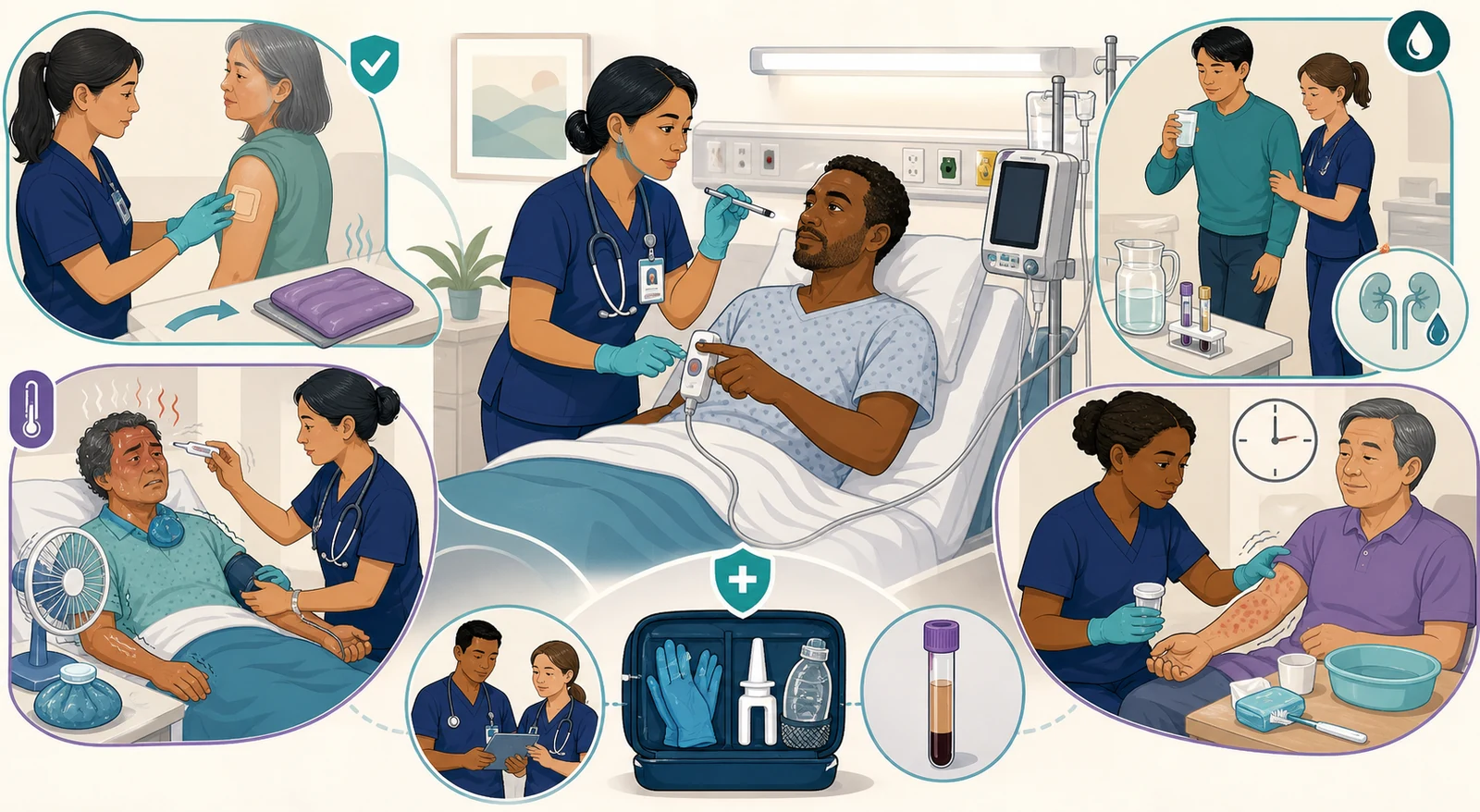
Opioids, benzodiazepines, and sedating antipsychotics can cause shallow breathing, excessive sedation, and a decreased ability to protect the airway.
High fever, rigidity, clonus, hyperreflexia, diaphoresis, and changes in pulse and blood pressure are clues that point to serious drug syndromes.
Na, kidney and liver function, CBC with ANC, platelets, and drug levels can change the risk for drug accumulation, arrhythmias, bleeding, infection, and seizures.
A new rash, blisters, lesions on mucous membranes, or facial swelling can be a warning sign with drugs like lamotrigine or phenytoin that you shouldn’t wait on.
Check the last dose, any recent dose increases, missed doses, rapid tapers, and whether the drug was stopped abruptly.
Whether other CNS depressants, serotonergic drugs, NSAIDs, or diuretics are on board, and the possibility of a mixed overdose, will change your actions.
8 Questions to Ask Before Giving an Analgesic
| Drug Class | Main Benefit | Risk to Watch First | Nursing Connection |
|---|---|---|---|
| Acetaminophen | Reduces fever and mild-to-moderate pain; relatively less effect on platelets | Hidden in multiple combination products and cumulative dose, liver disease, heavy alcohol use, fasting or nutritional status | Add up the acetaminophen from all products and check the daily limit that’s right for the patient, the product, and the order |
| NSAIDs | Reduce pain, inflammation, and fever | GI bleeding, worsening kidney function, fluid retention and blood pressure, cardiovascular risk | Connect melena, hematemesis, creatinine, urine output, and concurrent use of anticoagulants or steroids |
| Opioids | Relieve moderate-to-severe pain and, in specific situations, dyspnea | Sedation, respiratory depression, hypotension, constipation, urinary retention, nausea, falls | Don’t increase the dose based on the pain score alone; reassess sedation, breathing, and function together |
| Adjuvants like gabapentinoids | Provide an added benefit for neuropathic pain and other conditions | Drowsiness, dizziness, ataxia, and a synergistic effect with other sedatives | Prevent falls, verify the dose is right for the patient’s kidney function, and avoid stopping the drug abruptly |
Don’t memorize a rule like “Adults can always take the same maximum dose of acetaminophen.”
The product, combination formulations, liver disease, alcohol use, nutritional status, and the specific order all make a difference. Add up the acetaminophen from every product, including hidden sources, and check the label for that specific product and the prescribed limit.
Call the patient's name and apply a stimulus — see if they respond and can maintain their own airway.
Look beyond the respiratory rate: evaluate depth, regularity, effort, chest wall movement, and oxygenation together.
If you see concerning signs, hold the opioid administration or infusion, call for help, and start airway, ventilation, and oxygen support.
Use naloxone according to the prescription or emergency protocol, but remember — it does not replace ventilation and emergency response.
Even after the patient responds, monitor for re-sedation and recurrent respiratory depression. Repeat doses per protocol if needed.
A normal SpO₂ does not rule out opioid-induced respiratory depression.
While the patient is on supplemental oxygen, hypoventilation can progress quietly. New-onset easy drowsiness, difficulty to arouse, and slow, shallow, or irregular breathing are signals to reassess immediately. If breathing stops or the patient is unresponsive, calling a code and supporting ventilation come first.
PCA by proxy: When someone other than the patient presses the button, the built-in safety net — "if you're too sleepy, you can't push it" — disappears, which greatly increases the risk of oversedation and respiratory depression.
| Check item | Safe practice | Risky behavior |
|---|---|---|
| Indication | Verify the prescription — is it for an opioid-tolerant patient who needs continuous opioid therapy? | Routinely applying it for acute or intermittent pain in an opioid-naive patient |
| Heat | Check for fever and exposure to external heat sources; consult the prescriber immediately if present | Applying a heating pad, electric blanket, or exposing the patch to a sauna or hot tub |
| Dosage form | Apply an intact patch as directed, and first check for and remove any old patch | Cutting the patch, using a damaged patch, or applying a new one while an old patch is still on |
| Exposure | Check adhesion, skin condition, level of consciousness, and breathing; prevent contact with children and others | Leaving a loose patch unattended or ignoring one that has stuck to another person's skin |
| Disposal | Fold the patch with the adhesive sides together and dispose of it safely right away, following the product label and facility/local guidelines | Throwing an exposed patch into a trash can, bedding, or leaving it on the floor |
Heat increases fentanyl absorption and can lead to a fatal overdose.
Even after you remove the patch, the drug can keep being absorbed from the skin depot. So if you see decreased consciousness or respiratory depression, don't just remove the patch and stop there. Link it to emergency response, ventilation support, naloxone, and continuous monitoring.
| Drug | Primary target | Core action | Critical limitation |
|---|---|---|---|
| Naloxone | Respiratory and CNS depression from suspected opioid overdose | Call a code, support airway and ventilation, and administer according to the route- and product-specific protocol | Its duration of action can be shorter than the opioid's, so you must monitor for recurrent respiratory depression and may need to give repeat doses |
| Flumazenil | Reversal of benzodiazepine sedation in selected situations | Secure airway, ventilation, and circulation first; then weigh the risks and benefits on an individual basis | Can trigger seizures in patients with chronic dependence, those on seizure treatment, those with a seizure risk, or in mixed overdoses involving cyclic antidepressants |
Don’t reflexively choose “flumazenil for benzodiazepine overdose.”
If you don’t know the full ingestion history or suspect a mixed overdose, support the airway, breathing, and circulation first. Flumazenil doesn’t replace supportive care, and in high-risk patients, the risk of seizures from reversing sedation may outweigh any benefit.
| Drug Class | Key Adverse Effects | Education & Monitoring |
|---|---|---|
| SSRI·SNRI | Nausea, insomnia·drowsiness, sexual changes, hyponatremia, bleeding risk, serotonin syndrome, discontinuation symptoms | At initiation and dose changes, watch for suicidal ideation and agitation, clues for bipolar switch, and check for concurrent serotonergic drugs |
| TCA | Anticholinergic symptoms, sedation, orthostatic hypotension, cardiac conduction toxicity, overdose risk | Assess falls·constipation·urinary retention, ECG risk, and evaluate access to overdose and suicide risk together |
| MAOI | Hypertensive crisis, orthostatic hypotension, serotonin syndrome | Check for tyramine·sympathomimetics·other serotonergic drugs, and strictly follow the correct washout period |
| Bupropion | Insomnia·restlessness, elevated blood pressure, seizure risk | Check for risk factors: seizure disorder·eating disorder·abrupt alcohol or sedative withdrawal |
For MAOI switching intervals, check each drug’s label.
Because of its long half-life, fluoxetine requires a 5-week washout after discontinuation before starting a psychiatric MAOI, and a 14-day washout after stopping an MAOI before starting fluoxetine. Don’t substitute these numbers for other antidepressants’ intervals; check each drug’s prescribing information and concurrent medications.
Agitation, anxiety, confusion, delirium
Diaphoresis, hyperthermia, tachycardia, blood pressure fluctuations, diarrhea
Tremor, hyperreflexia, inducible·ocular clonus, muscle rigidity
Can appear relatively quickly after a new drug, dose increase, or interaction
If suspected: Hold the serotonergic drug, assess the urgency, and report to the prescriber and rapid response team. Monitor airway, breathing, circulation, temperature, and ECG. Don’t just give an antipyretic and wait.
| Reaction | Key Clues | Priority Action |
|---|---|---|
| Acute dystonia | Spasms of neck·jaw·tongue, oculogyric crisis, possible laryngeal spasm | Report airway risk first and immediately; connect to prescribed anticholinergic·antihistamine treatment |
| Akathisia | Inability to stay still, restlessness, severe inner discomfort | Don’t mistake for anxiety or non-cooperation; report the drug-relatedness for adjustment |
| Parkinsonism | Rigidity, bradykinesia, tremor, mask-like face | Assess fall·aspiration risk, and work with prescriber on dose·treatment adjustment |
| Tardive dyskinesia | Repetitive involuntary movements of lips·tongue·face, limb·trunk movements | Detect early and report, track with a standardized scale; don’t just administer a simple EPS drug on your own |
| NMS | Hyperthermia, severe generalized rigidity, altered consciousness, autonomic instability, possible CK elevation | Hold the causative drug, initiate emergency reporting·cooling·fluids·complication monitoring and prescribed treatment |
NMS is not routine EPS.
If you see hyperthermia together with severe rigidity, altered consciousness, and unstable pulse·blood pressure, don’t give the next scheduled dose and watch. Hold the drug, start an emergency response, and connect CK, renal function, K, ECG, and fluid status.
The US clozapine REMS registration and ANC submission mandate was eliminated on June 13, 2025, but ANC monitoring hasn’t disappeared.
Don’t memorize REMS enrollment as if it’s still a current mandate. Distinguish between the risk of severe neutropenia and ANC checks according to the latest prescribing information. If the country or institution differs, also check local regulations separately.
Maintain stable daily fluid intake and immediately report any situations involving excessive sweating, fever, or dehydration.
Avoid unprescribed low-salt diets or sudden dietary changes, and report any Na and fluid losses from diarrhea or vomiting.
Track creatinine, eGFR, thyroid function, pregnancy potential, and long-term treatment side effects.
Interpret serum levels together with the time of last dose and blood draw, clinical symptoms, and kidney function — not just the dose alone.
NSAIDs, ACEIs/ARBs, and thiazides can raise lithium levels and toxicity risk, so always check before starting any new medication.
Immediately evaluate severe or coarse tremor, ataxia, confusion, slurred speech, persistent diarrhea/vomiting, or profound drowsiness.
If new ataxia and confusion appear after diarrhea, vomiting, fever, or excessive sweating, do not give the next lithium dose as routine.
Hold the dose and report immediately to the prescriber so that serum lithium, electrolytes, kidney function, hydration status, and an ECG can be evaluated. Do not wait on symptoms just because lab values aren’t back yet.
| Drug | Key risks | Nursing & education link |
|---|---|---|
| Phenytoin | Ataxia, nystagmus, confusion; gingival hyperplasia; rash/DRESS; blood/liver toxicity; interactions | Oral hygiene and dental care; interpret levels with formulation, feeding, albumin, and kidney/liver function; avoid abrupt discontinuation |
| Carbamazepine | Hyponatremia, leukopenia/aplastic anemia, liver toxicity, SJS/TEN, interactions | Monitor CBC, Na, liver function; check for fever, sore throat, rash; for genetically at-risk groups, verify whether pre-treatment testing was done |
| Valproate | Liver toxicity, pancreatitis, thrombocytopenia/bleeding, hyperammonemia, fetal risk | Link liver function, CBC/platelets, abdominal pain, vomiting, altered consciousness, pregnancy potential, contraception, and alternative counseling |
| Lamotrigine | Serious rash including SJS/TEN, especially with rapid titration or concurrent valproate | Immediately report any new rash, blistering, mucosal lesions, or fever; never restart the original dose on your own after a missed dose |
| Levetiracetam | Drowsiness, dizziness; irritability, aggression; depression, suicidal ideation | Educate the patient and family about fall prevention and any new behavioral or mood changes |
Abrupt discontinuation or rapid reduction of carbidopa/levodopa can cause hyperpyrexia and confusion.
A syndrome resembling NMS — with hyperthermia, rigidity, altered consciousness, and autonomic instability — can appear, so check for any history of missed doses and initiate emergency response.
| Condition | Consciousness & breathing | Temperature & muscles | Additional clues | First response |
|---|---|---|---|---|
| Opioid toxicity | Sedation, unresponsiveness; slow, shallow breathing | Temperature and rigidity are not primary clues | Possible miosis, hypoxia, hypotension | Stop opioid, manage airway and ventilation, call emergency, give naloxone, monitor for re-sedation |
| Serotonin syndrome | Agitation, confusion | Hyperthermia, hyperreflexia, clonus, tremor | Diaphoresis, diarrhea; rapid onset; serotonergic drug combination | Hold causative agent(s), emergency evaluation, supportive care and cooling with prescribed treatment |
| NMS | Possible confusion, stupor | Hyperthermia, severe generalized rigidity | Autonomic instability, possible elevated CK and rhabdomyolysis | Hold antipsychotic, emergency response, cooling, fluids, manage complications |
| Lithium toxicity | Drowsiness, confusion | Coarse tremor, ataxia, muscle weakness | Diarrhea, vomiting; dehydration, hyponatremia, decreased kidney function; possible elevated level | Hold lithium, report immediately, evaluate level, electrolytes, kidney function, and hydration status |
Exam Point: Before naming the drug syndrome, stabilize ABCs, stop the causative drug, and check temperature, neuromuscular findings, concurrent medications, and recent changes.
Don’t give an additional bolus. Hold the PCA/opioid, assess and support the airway and ventilation, and call for help immediately. Administer naloxone according to protocol and orders, and continue monitoring.
Remove the heat source and immediately assess the patch, level of consciousness, and breathing. If oversedation or respiratory depression is present, initiate emergency response and monitor for continued absorption and re-narcotization even after patch removal.
Suspect serotonin syndrome, hold the serotonergic drug, and initiate emergency assessment. Support temperature, airway, breathing, and circulation, and check for concurrent medications.
Don’t dismiss this as routine EPS. Hold the next dose and start NMS emergency management, evaluating CK, renal function, electrolytes, and rhabdomyolysis complications.
Don’t just give cold medicine. Check clozapine and recent ANC, and report immediately to evaluate CBC/ANC and infection.
Hold the next dose and report immediately. Evaluate lithium level, sodium and renal function, hydration status, and ECG. Don’t just have them drink fluids and wait.
Don’t just watch it as a mild skin reaction. Hold the medication and report immediately to evaluate for serious reactions including SJS/TEN.
Don’t wait until the next day. Verify the exact home schedule and immediately coordinate an alternative timing and route with the prescriber and pharmacist, monitoring for fever, rigidity, and confusion.
Oxygen saturation is normal, so continue the opioid.
Safe JudgmentReassess consciousness, depth and regularity of breathing, and ventilation first, then apply the prescribed parameters.
The patient woke up after naloxone, so monitoring is finished.
Safe JudgmentOpioid effects can become dominant again, so continue observation and prepare for re-narcotization.
Give flumazenil for all benzodiazepine overdoses.
Safe JudgmentPrioritize airway and ventilation, and first check for dependence, seizure risk, and mixed overdose.
All antipsychotic-related rigidity is resolved with benztropine.
Safe JudgmentIf fever, altered consciousness, or autonomic instability is present, manage as a NMS emergency.
The clozapine REMS is gone, so a CBC is no longer needed.
Safe JudgmentU.S. REMS requirements and ANC safety monitoring are separate issues.
All lithium tremors are a normal side effect.
Safe JudgmentLook at changes in intensity along with ataxia, confusion, GI symptoms, and changes in hydration, sodium, and renal function.
Never stop an anticonvulsant under any circumstances.
Safe JudgmentReport the risk of abrupt withdrawal versus the risk of serious rash or hypersensitivity immediately to adjust safely.
Fit Parkinson’s medications to the unit’s standard administration times.
Safe JudgmentPreserve the patient’s home schedule and functional fluctuations to prevent missed doses or abrupt dose reductions.
① Are they arousable, maintaining their airway, and breathing adequately?
② Is there high fever, rigidity, clonus, hyperreflexia, severe tremors, or ataxia?
③ Have you checked Na, renal function, liver function, CBC/ANC, platelets, drug levels, and their recent trends?
④ Are there any clues of a new rash, mucosal lesions, infection, bleeding, or severe constipation?
⑤ Have you verified the last dose, any recent dose increases, missed doses or abrupt discontinuation, patches, PCA, and concurrent medications?
⑥ After holding, reporting, and emergency response, have you decided what to reassess and when?
Evidence scope: This summary was independently written based on the NCSBN 2026 NCLEX-RN Test Plan, NIH DailyMed labels for fentanyl patch, naloxone, flumazenil, fluoxetine, lithium, phenytoin, lamotrigine, carbidopa/levodopa, and the FDA clozapine safety communication.
Only recurring study topics were confirmed in the local feedback PDF. Actual exam questions, answer choices, correct answer wording, tables, images, and layouts were not replicated.
Learning boundary: Actual administration, hold parameters, dosages, discontinuation intervals, and antidote selection depend on the patient's indications, vital signs, renal and hepatic function, time of last dose, concurrent medications, and institutional protocols. This material does not substitute for patient-specific prescriptions, pharmacist consultation, or specialist judgment.
다음 이론을 계속 학습하려면 로그인하세요.
로그인하고 계속 학습필기노트, 하이라이터, 메모는 잘 쓰고 있어?
내보내줘운영진이 검토할게요!
마이페이지에서 차단한 회원을 관리할 수 있어요.