컨텐츠 내용을 수정할 수 있습니다
Instead of reacting to a single blood glucose number, you'll learn to connect consciousness and the ability to swallow, ketones and acidosis, dehydration and osmolality, and potassium shifts to choose the safest first action.
Core Goal: We make decisions by following this flow: assess the patient's status → correct hypoglycemia immediately → check the context of insulin, meals, and activity → differentiate DKA from HHS → manage fluids, potassium, and insulin in the right order → reassess using the same indicators.
In diabetes nursing, what changes your priorities isn't just that "the blood sugar is high or low," but whether the patient is awake and can swallow, whether ketones and acidosis are present, whether there's severe dehydration and neurological changes, and how the potassium is shifting during treatment.
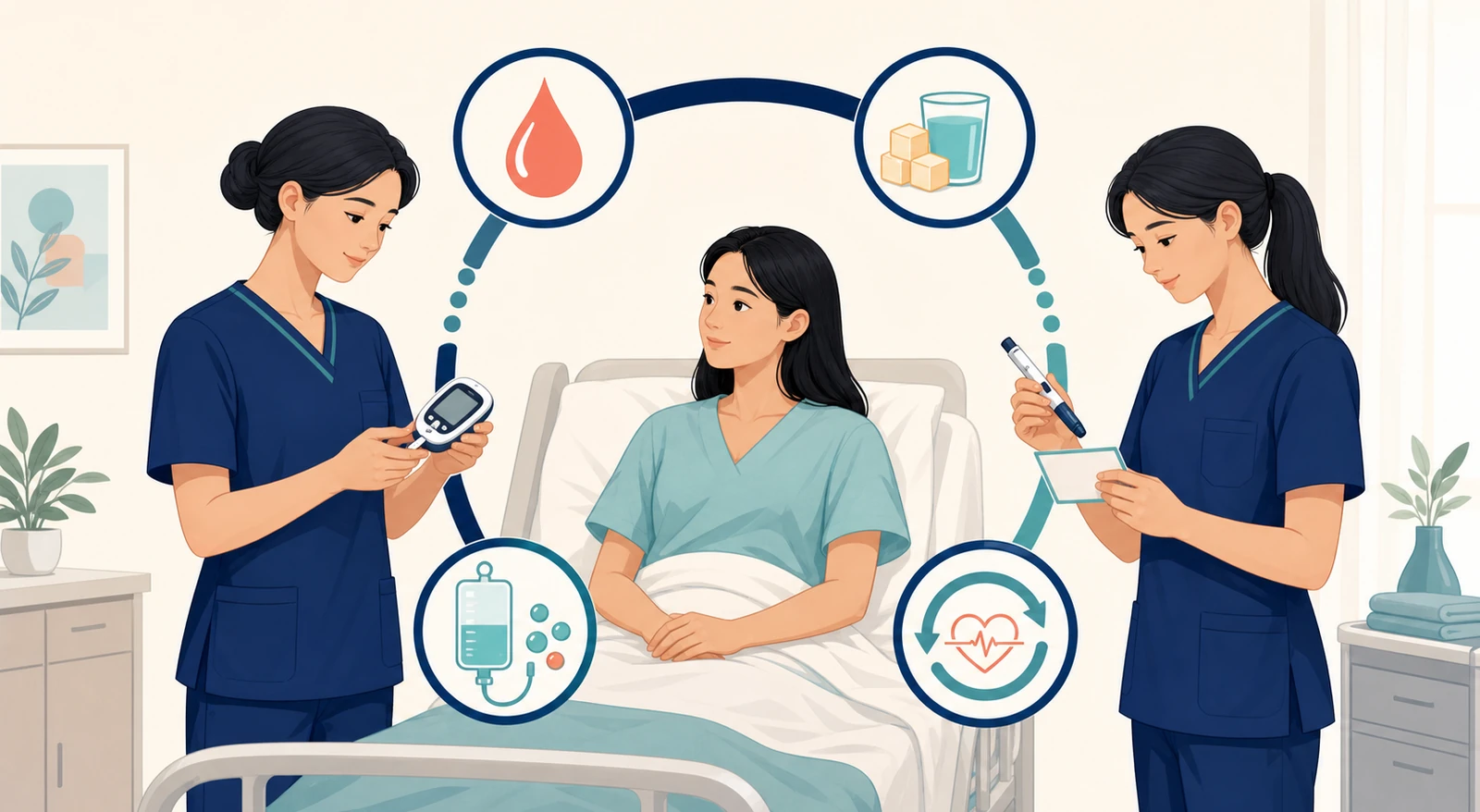
Check responsiveness, speech, airway protection, and the ability to swallow. If consciousness is impaired, do not start with oral intake.
Look for diaphoresis, tremors, confusion, tachycardia, dehydration, hypotension, deep and rapid breathing, vomiting, and abdominal pain.
Get a point-of-care glucose immediately, but if the number doesn't match the clinical picture, verify for sampling errors and equipment issues, then recheck.
Connect the dots with the last insulin dose, meal, and exercise, as well as infection, steroids, SGLT2 inhibitors, vomiting, and fluid intake.
Recheck the same blood glucose, consciousness, and symptoms, and correct the underlying cause to prevent recurrence.
If there is decreased consciousness, seizures, or an inability to swallow, do not give food, juice, or glucose gel by mouth.
Protect the airway and call for emergency help, then prepare glucagon or IV dextrose according to your facility's protocol. Don't delay treatment just to recheck the number, but after treatment, you must reassess the blood glucose and neurological status.
| Classification | Criteria | Nursing Judgment |
|---|---|---|
| Level 1 | <70 mg/dL and ≥54 mg/dL | This is a clinically important alert value, even without symptoms. Correct with fast-absorbing glucose and identify the cause. |
| Level 2 | <54 mg/dL | This is hypoglycemia requiring immediate action. Check for neuroglycopenic symptoms, consciousness, and the ability to swallow together. |
| Level 3 | Severe cognitive or physical functional change requiring assistance from another person, regardless of the glucose value | Airway and emergency treatment are the priority. After recovery, reassess the prescription and the risk of recurrence. |
For most adults, use 15 g of glucose. Foods high in fat or protein can slow initial absorption, so they are not the first choice.
If the blood glucose is still low, repeat the fast-acting carbohydrate and reassess symptoms and consciousness.
If there's still time until the next meal, a snack tailored to the individual's plan may be needed. Review recent insulin, delayed meals, activity level, renal function, and alcohol use.
Don't think "no symptoms means it's fine." Repeated hypoglycemia or hypoglycemia unawareness can blunt the warning symptoms. If even one Level 2 or 3 event occurs, don't just replace the sugar and stop—re-evaluate the treatment plan and prevention education.
| Component | Main Purpose | Information to Connect Before Administration |
|---|---|---|
| Basal | Covers the basic insulin needs between meals and overnight | Don't automatically stop all basal insulin just because the patient is NPO or vomiting. Especially in Type 1 diabetes, a basal insulin plan is needed to prevent DKA. |
| Prandial | Handles the glucose coming in from a meal | Check the actual meal arrival, the patient's ability to eat, the carbohydrate amount, the administration timing specific to the formulation, and the current blood glucose together. |
| Correction | Corrects a blood glucose that is currently out of the target range | Check the prandial and basal doses for the same time period, the previous correction dose, and the potential for insulin stacking. Don't just repeat correction doses as a substitute for the basal/meal plan. |
Don’t mix insulins on your own just based on clear vs. cloudy appearance.
Not all insulins can be mixed — long-acting and ultra-long-acting formulations often should not be mixed with other insulins. Check the exact product label, prescription, and facility policy for compatibility, mixing order, timing of injection, and storage duration. Also, never substitute one product for another on your own, even if the unit number looks the same.
| Category | DKA | HHS |
|---|---|---|
| Core problem | Insulin deficiency leads to ketone buildup and metabolic acidosis | Severe hyperglycemia and osmotic diuresis cause profound dehydration and hyperosmolarity |
| Diagnostic axis | Diabetes or blood glucose ≥200 mg/dL + β-hydroxybutyrate ≥3.0 mmol/L or urine ketones 2+ or greater + pH <7.3 and/or HCO₃⁻ <18 mmol/L | Plasma glucose ≥600 mg/dL, hyperosmolarity and severe dehydration, with no significant ketoacidosis or only mild |
| Common presentation | Polyuria, thirst, nausea, vomiting, abdominal pain, deep and rapid breathing, dehydration, fruity breath odor, altered mental status | Polyuria and thirst developing over several days, severe dehydration, weakness, neurological changes such as confusion, drowsiness, or seizures |
| Lab focus | β-hydroxybutyrate, venous pH, bicarbonate, electrolytes, renal function, and precipitating cause | Blood glucose, effective and total serum osmolality, electrolytes, renal function, mental status, and precipitating cause |
| Caution | Euglycemic DKA with glucose below 200 is possible with SGLT2 inhibitors, pregnancy, or fasting | Mixed forms of DKA and HHS can overlap, so always check ketones and acid-base status |
Assess the airway, breathing, blood pressure, perfusion, and level of consciousness/neurological status, and prepare ECG monitoring and IV access. Draw blood for glucose, electrolytes, renal function, ketones, venous pH, and precipitating causes such as infection.
Start the prescribed isotonic or balanced crystalloid solution and adjust the rate according to cardiac and renal function, blood pressure, urine output, corrected sodium, and changes in osmolality.
Even if the initial serum potassium appears normal or high, total body potassium may be depleted. Insulin and correction of acidosis shift potassium into cells, so monitor the ECG and serial levels.
After confirming potassium and fluid status, start IV short-acting insulin. If potassium is less than 3.5 mmol/L, replace potassium before starting insulin to prevent fatal arrhythmias and respiratory muscle weakness.
Blood glucose may approach the normal range before ketoacidosis resolves. As prescribed, add dextrose to the fluids to prevent hypoglycemia while continuing insulin until ketones and acidosis clear.
Treat infection, missed insulin, myocardial infarction/stroke, medications, pump problems, and dehydration. Judge resolution not by glucose alone, but by ketones, pH, bicarbonate, osmolality, level of consciousness, and overall clinical status.
Don't fall into the trap of thinking "the potassium is high, so we don't need to replace it."
In DKA/HHS, the body's total potassium is actually depleted due to osmotic diuresis and vomiting, but the initial serum potassium can look normal or even high because of acidosis and insulin deficiency. Once you start fluids and insulin, potassium levels can drop fast, so repeated checks and ECG monitoring are key.
Watch the hourly downward trend and the risk of hypoglycemia. A drop that's too rapid can increase the risk of a sudden shift in osmolality, especially in HHS.
After starting insulin, monitor for dropping potassium levels, arrhythmias, and changes in muscle strength or respiratory muscle function, and adjust prescribed replacement accordingly.
In DKA, ketones and acidosis can persist even when blood glucose is improving. Track the pH, bicarbonate, and β-hydroxybutyrate.
In HHS, the key things to watch are the level of consciousness, confusion or seizures, and changes in sodium and osmolality. Don't stop your assessment just because the blood glucose is coming down.
Use blood pressure, heart rate, mucous membranes and skin turgor, urine output, and BUN/creatinine to evaluate both the recovery from dehydration and any signs of fluid overload.
When switching from IV to subcutaneous insulin, adhere to the prescribed overlap time to prevent an insulin gap and recurrent ketoacidosis.
Don't just label morning hyperglycemia by its name. Use CGM or early morning blood glucose trends to figure out if it's a rebound from nighttime hypoglycemia, a persistent dawn phenomenon rise, or caused by a late meal, a missed insulin dose, or illness. If you just blindly increase the bedtime insulin without finding the cause, you could make nighttime hypoglycemia worse.
The examples below are newly created scenarios to help you practice your judgment process and do not reproduce actual NCLEX questions, answer choices, or correct answers.
A patient who received rapid-acting insulin before a meal has their meal tray delayed. The patient is now diaphoretic and tremulous, with a blood glucose of 62 mg/dL. The patient is awake and can swallow safely.
Judgment: Do not make the patient wait for the meal. Provide a rapidly absorbed glucose source and reassess the blood glucose and symptoms in 15 minutes. At the same time, report the meal delay and the timing issue with the insulin administration so the plan can be revised to prevent this from happening again.
A patient taking an SGLT2 inhibitor develops nausea, abdominal pain, dehydration, and deep, rapid breathing after an infection. The point-of-care blood glucose is 186 mg/dL.
Judgment: Do not rule out DKA just because the blood glucose is under 200. Suspect euglycemic DKA, immediately check ketones, pH, bicarbonate, electrolytes, and renal function, and prepare to initiate the emergency treatment pathway.
An older adult patient with several days of thirst and polyuria presents with confusion and severe dehydration. The blood glucose is 760 mg/dL. Breathing is not deep or rapid, and there is no abdominal pain.
Judgment: Suspect HHS first, but check ketones and acid-base status to rule out a mixed picture. Assess circulatory and neurological status, and prepare for fluid resuscitation, electrolyte and osmolality monitoring, and an insulin protocol.
After fluid resuscitation and IV insulin therapy, the blood glucose has come down to 210 mg/dL, but β-hydroxybutyrate remains high, bicarbonate is low, and the anion-gap acidosis persists.
Judgment: Do not stop the insulin just because you see an improving blood glucose number. As prescribed, start or adjust a dextrose-containing fluid while continuing the insulin, and keep reassessing ketones, acid-base status, potassium, and the overall clinical picture.
1. Is the patient awake, able to protect their airway, and swallow safely?
2. If blood glucose is below 70, do they need fast-acting glucose and a recheck in 15 minutes?
3. Do the blood sugar changes line up with meals, exercise, recent insulin, and kidney function?
4. Did you differentiate basal, prandial, and correction doses and confirm that the meal has arrived?
5. Have you separated DKA (ketones, acidosis) from HHS (dehydration, hyperosmolarity, neurologic changes)?
6. Is a total body potassium deficit hiding behind a potassium level that looks normal early on?
7. Did you connect the sequence: fluids → check and replace potassium → insulin → add dextrose?
8. Beyond blood glucose, did you reassess ketones, pH, bicarbonate, osmolality, and level of consciousness?
9. Are you treating the precipitating cause, like infection, missed insulin, medications, or a pump problem?
Official sources: NCSBN, 2026 NCLEX-RN Test Plan · American Diabetes Association, Standards of Care in Diabetes—2026: Glycemic Goals, Hypoglycemia, and Hyperglycemic Crises · ADA/EASD/JBDS/AACE/DTS, Hyperglycemic Crises in Adults With Diabetes: A Consensus Report · American Diabetes Association, Standards of Care in Diabetes—2026: Pharmacologic Approaches · American Diabetes Association, Planning for Sick Days · FDA, Insulin Storage and Switching Between Products
This independent study flow was built on the NCSBN's diabetes and endocrine clinical activities, along with the 2026 ADA hypoglycemia classification and response, insulin regimens, and the latest hyperglycemic crisis diagnosis and treatment sequence. Actual clinical care follows the most current prescriptions, product labels, institutional protocols, and each patient's individual cardiac and renal function.
Content boundary: Only recurring study topics were reviewed in local feedback materials. Actual exam questions, answer choices, correct answers, tables, screens, patient values, or illustrations were not copied or reproduced. All example situations, sentences, tables, judgment sequences, and images were newly created.
다음 이론을 계속 학습하려면 로그인하세요.
로그인하고 계속 학습필기노트, 하이라이터, 메모는 잘 쓰고 있어?
내보내줘운영진이 검토할게요!
마이페이지에서 차단한 회원을 관리할 수 있어요.