A nurse is caring for a client with a newly implanted perman… | 마이메르시 MyMerci
마이메르시 — 문제와 상세 해설까지 전부 무료 무료로 시작하기
Adult Health
문제

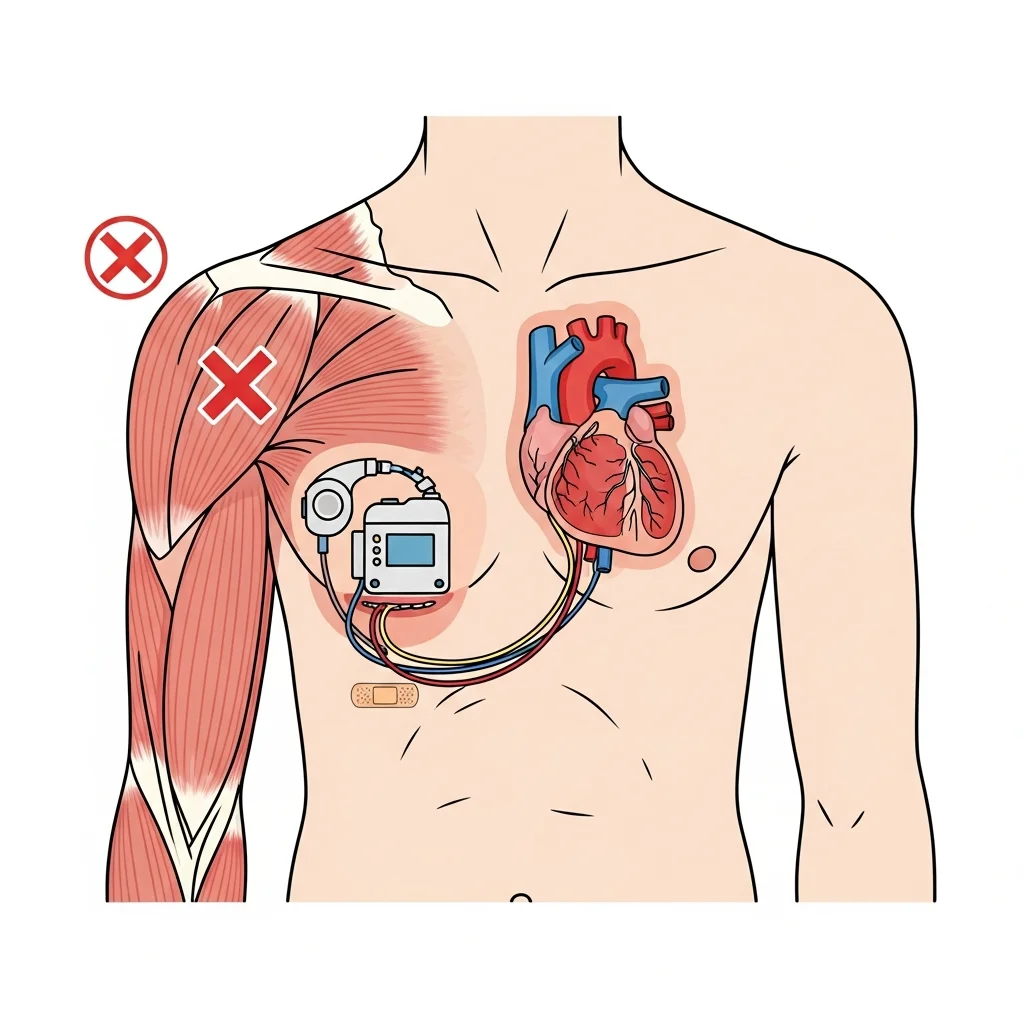
A nurse is caring for a client with a newly implanted permanent pacemaker. Which nursing intervention is most important to prevent complications?

문제 이미지

해설
Restricting arm movement on the pacemaker side prevents lead displacement, the most critical complication. Other options risk displacement, bleeding, or swelling.
같은 주제 다음 문제A nurse is caring for a 72-year-old client with a permanent single-chamber pacemaker inser…

심화 해설

Understanding the Rationale

The most critical nursing intervention after permanent pacemaker implantation is instructing the client to avoid lifting the arm on the operative side above shoulder level for a defined period. This restriction is not arbitrary; it is a mechanical safeguard against one of the most common and serious early complications: lead dislodgement or macro-dislodgement.

Pathophysiology and Mechanical Basis

A pacemaker system consists of a pulse generator (the "can") and one or more leads. During implantation, the leads are advanced through the venous system and anchored into the endocardium. In the immediate postoperative phase, the lead tip is secured only by a small fixation mechanism (either a passive tine or an active screw) and the surrounding tissue edema. Fibrotic encapsulation, which provides long-term stability, has not yet occurred. Abduction of the arm beyond 90 degrees or elevation above the shoulder generates significant traction on the pectoralis muscles and the subcutaneous tissue pocket. This mechanical force is transmitted directly to the leads, creating a "pulling" effect that can dislodge the electrode tip from the myocardial wall . This is a primary surgical complication identified in systematic reviews, with a reported prevalence that underscores the need for strict postoperative immobilization protocols .

Analysis of Correct and Incorrect Options


OptionAnalysis
1. Encourage the client to perform full range of motion exercises with both arms immediately after surgery Incorrect. This action directly contradicts the mechanical principles of lead stability. Early, aggressive mobilization of the operative arm is a primary risk factor for lead dislodgement. While restoring upper extremity function is a long-term goal to prevent shoulder dysfunction, a systematic scoping review indicates that exercise must be carefully prescribed. Immediate full range of motion is unsafe; rehabilitation typically begins with gentle, restricted movements and progresses based on tissue healing .
2. Position the client in a prone position to reduce swelling at the insertion site Incorrect. The prone position would place direct pressure on the surgical site, potentially causing pain, compromising skin integrity, and increasing the risk of pocket hematoma or generator migration. Furthermore, it does not provide any mechanical advantage for venous return or edema reduction compared to the standard semi-Fowler's or supine position with the operative arm immobilized.
3. Instruct the client to avoid lifting the arm on the pacemaker side above shoulder level for 4-6 weeks Correct. This is the cornerstone of post-implantation self-management. Evidence-based home care guidelines specify that patients must restrict arm movement on the surgical side to prevent lead displacement. The 4-6 week timeframe corresponds to the biological process of tissue encapsulation, which provides a fibrous anchor around the lead tip, securing it against the forces generated by normal arm movement . This restriction is a standard component of the consensus-based optimal implantation technique to minimize postoperative complications .
4. Apply continuous pressure to the pacemaker insertion site to prevent bleeding Incorrect. While preventing pocket hematoma is a valid nursing concern, continuous pressure is not the standard prophylactic intervention. A pressure dressing may be applied initially, but constant manual pressure is impractical and can compromise tissue perfusion. The primary prevention for hematoma involves meticulous surgical hemostasis and, postoperatively, avoiding anticoagulants as ordered and applying a cold compress intermittently if prescribed, not continuous pressure.


Integration of Evidence into Nursing Practice

The management of a patient with a newly implanted pacemaker requires a dual focus: preventing acute surgical complications while planning for long-term functional recovery. The meta-analysis by Suárez-Paúl et al. confirms that complications like lead dislodgement and pocket hematoma are significant clinical events that nurses must actively work to prevent . The expert consensus statement provides the technical rationale, emphasizing that implantation technique directly influences lead stability, and that postoperative care must protect the newly implanted system from mechanical stress . This is balanced with the need for eventual mobilization, as highlighted by Surendran et al., who note that persistent shoulder dysfunction is a concern one-year post-implantation, making the timing of exercise initiation crucial—it must be delayed until the leads are secure . The evidence summary by Yan et al. translates this into practical, home-based self-management instructions, solidifying the 4-6 week arm restriction as a key educational point for patients to ensure safe recovery .

임상 시나리오

Pacemaker Arm ImmobilizationPreventing Early Lead Dislodgement

Instruct the client to avoid lifting the operative arm above the shoulder or abducting it beyond 90 degrees for 4 to 6 weeks. This restriction prevents traction on the newly implanted leads before fibrotic encapsulation secures them to the endocardium.

A sling or immobilizer may be used for the first 24 to 48 hours to limit movement. Gentle elbow and wrist exercises are permitted to prevent stiffness, but shoulder motion must remain restricted.

Caution

Do not immobilize the arm completely for the full 4-6 weeks, as this can lead to frozen shoulder. Teach the client to avoid activities like reaching overhead, combing hair, or hanging clothes with the affected arm.

핵심 개념

Merci NCLEX-RN Question Bank 3,445 문제 · 로그인 없이 바로 볼 수 있어요

마이메르시로 국가고시 완벽 대비

기출문제와 상세 해설을 무료로. 내 약점을 분석하고 진도를 관리하며 더 똑똑하게 공부하세요.

무료로 시작하기

학습 참고용입니다. 실제 임상은 최신 지침과 소속 기관 프로토콜을 따르세요.