컨텐츠 내용을 수정할 수 있습니다
In Bowtie, you logically connect cues → priority condition → actions → monitoring. In Trend, the focus is on reading the direction, speed, and response to interventions over time, rather than looking at isolated numbers.
Core judgment: Bowtie: Group cues → one central condition → immediate action → monitor for effectiveness/deterioration / Trend: Baseline → direction of change → speed of change → intervention timing → response.
The clinical topics in the local NGN materials were used only to help you understand the format; actual cases, correct answers, options, and tables have not been reproduced.
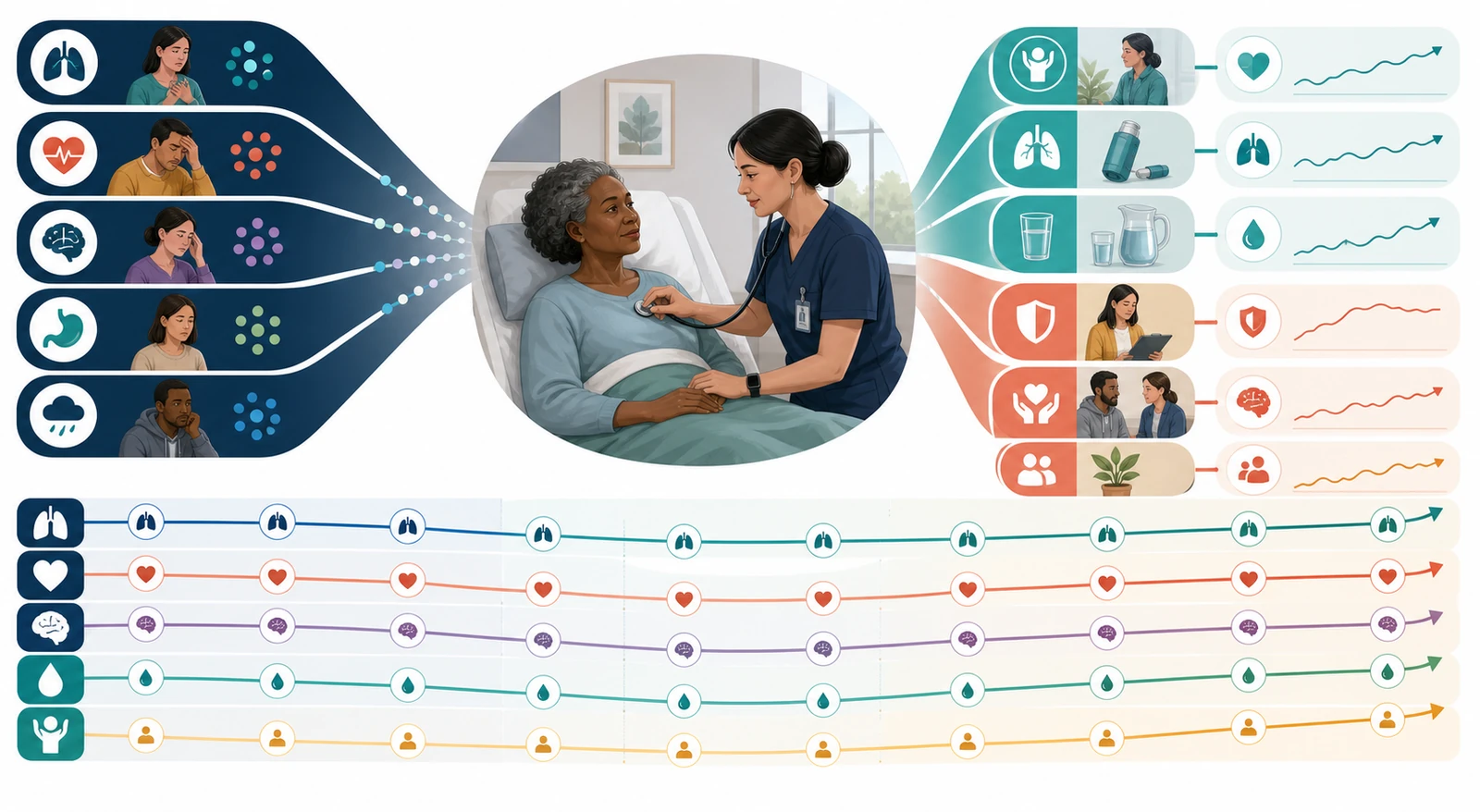
You’re not trying to list every possible diagnosis. Instead, choose the one condition that best explains the current cluster of cues and would cause the most harm if delayed. Prioritize the condition phrasing and clinical meaning provided in the question over nursing or medical diagnosis labels.
| Candidate Cue | Selection Judgment |
|---|---|
| New increased work of breathing / decreased oxygenation | Directly supports an acute respiratory condition |
| Long-standing smoking history | It's a risk factor, but verify further if it's a direct cue for the current central condition |
| Oxygen administration record | This is an action record; distinguish whether the question is asking for a cue |
| Stable past values | Exclude if unrelated to the current change |
Three questions: Can the selected cues appear together in this condition? Is there another condition that explains them better? Do any opposing cues break down the central hypothesis?
| Category | Role | Verification Question |
|---|---|---|
| Actions | Immediately reduce harm, correct the cause, or request support | Can the nurse safely implement this right now? |
| Monitoring | Measure effectiveness, side effects, deterioration, or recovery | If this value changes, can it alter the next decision? |
Identify the patient's usual or admission values and function.
See if it's improving, deteriorating, or showing no change.
Check if it's changing gradually or taking a sudden turn.
See if it's the expected response after a medication, fluid, oxygen, or procedure.
Are blood pressure, pulse, consciousness, skin, and urine output moving in the same direction?
Are respiratory rate, effort, oxygenation, gas exchange, and consciousness changing together?
Are weight, intake and output, edema, lung sounds, and electrolytes connected?
Are temperature, pulse, blood pressure, consciousness, lab results, and the source of infection changing together?
If a patient’s usually high blood pressure suddenly drops to the lower limit of normal, or if urine output or consciousness decreases rapidly from baseline, don't be reassured just because the absolute value is normal. Conversely, if an abnormal value moves in the intended direction after treatment, it could be an improvement.
| Change | Interpretation Question |
|---|---|
| Decreased pain and respiratory depression after an analgesic | Did the desired effect and harm occur simultaneously? |
| Increased blood pressure and dyspnea after fluids | Is there improved perfusion along with fluid overload? |
| Improved breathing and tachycardia after a bronchodilator | What is the balance between the expected effect and the known response? |
Check which direction the monitoring indicators you selected in your Bowtie actually moved on the Trend screen. If the expected response isn't there, reassess the appropriateness of your central condition and actions.
Trend: Don't just see the blood pressure as an improvement—look at work of breathing, oxygenation, lung sounds, urine output, and edema all together.
Bowtie: Reconnect the new respiratory cues to your central condition. Immediately choose respiratory assessment and safety interventions as your actions, and select oxygenation, work of breathing, lung sounds, and circulatory response as your monitoring.
다음 이론을 계속 학습하려면 로그인하세요.
로그인하고 계속 학습필기노트, 하이라이터, 메모는 잘 쓰고 있어?
내보내줘운영진이 검토할게요!
마이페이지에서 차단한 회원을 관리할 수 있어요.