컨텐츠 내용을 수정할 수 있습니다
In cases where new data unfolds over time, this strategy helps you avoid getting locked into your first diagnosis. Instead, you'll reconnect cues, hypotheses, actions, and responses with each new screen.
Core sequence: Check the baseline → Note current changes → Cluster related cues → Prioritize the most dangerous hypothesis → Choose safe actions → Revise your hypothesis based on new responses.
We use the NCSBN Clinical Judgment Model's six steps as our learning framework. While the local PDF included longitudinal records and multiple data presentations, actual cases, answers, options, values, and layouts are not reproduced here.
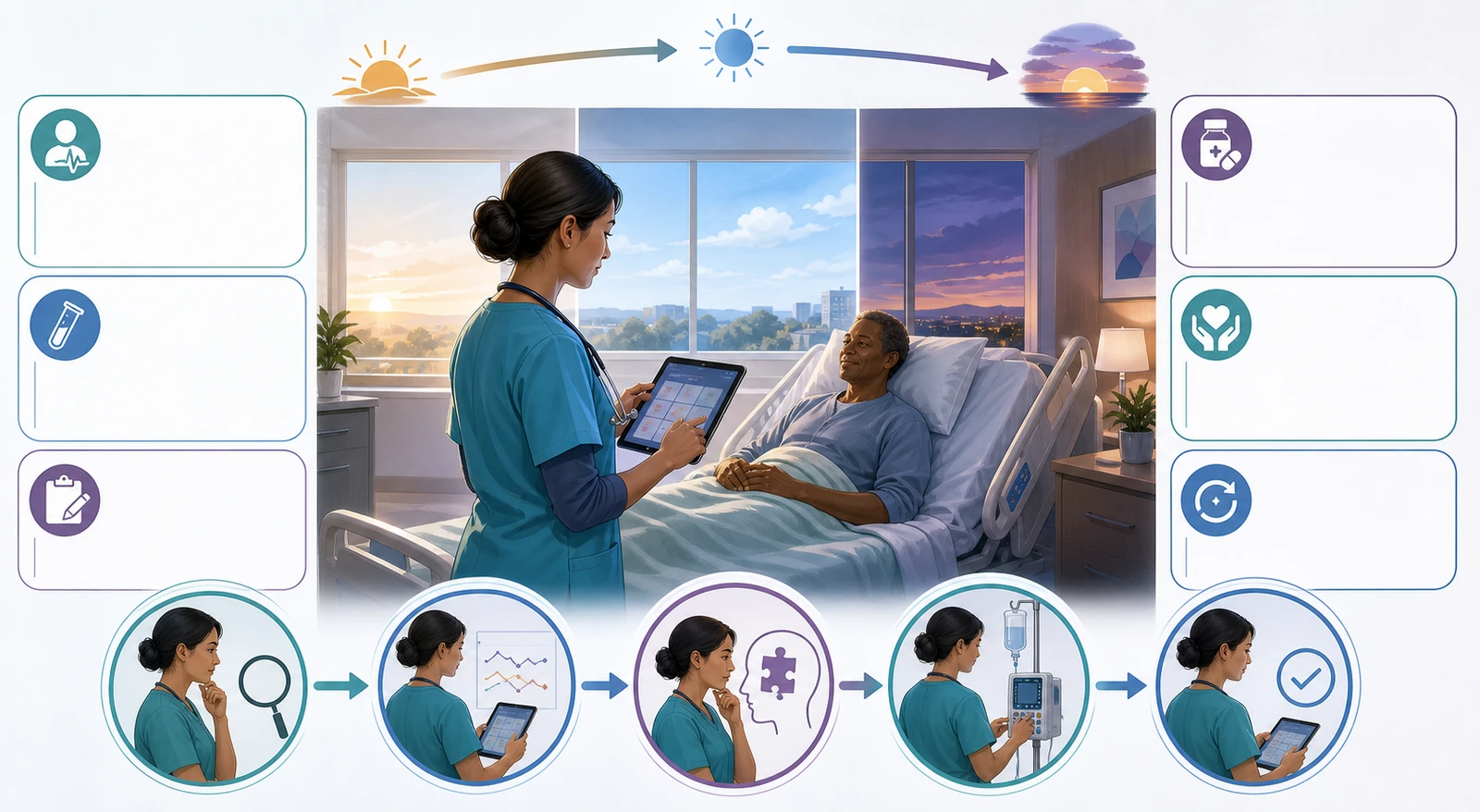
Compressed sentence: Who is this + Why did they come in + What's the most important change right now + Is there an immediate danger.
Rather than copying over every detail like age and diagnosis, keep only the information that would change your current decision-making.
| Data | Question to ask while reading | Data to connect it with |
|---|---|---|
| Nursing notes | Any new symptoms, functional changes, or patient statements? | Vital signs, medications, I&O from the same time |
| Vital signs & assessment | How much and how quickly has it changed from baseline? | The most recent interventions like oxygen, fluids, or pain meds |
| Lab results | Is this a one-time abnormality or a trend? | Symptoms, organ function, specimen collection time |
| Orders & medications | What's the purpose and risk of the new order? | Allergies, contraindications, renal/hepatic function, response |
Cues where delay causes significant harm: airway, breathing, circulation, consciousness, bleeding, or rapid neurological changes.
Lab results, assessments, or responses that move in the same direction as the symptoms.
History or medications that increase likelihood but aren't causing current deterioration themselves.
Stable findings or already-resolved issues that don't change what you need to do right now.
If you only gather the typical cues for one condition, confirmation bias creeps in. For each hypothesis, write down supporting cues, opposing cues, and data you still need together.
| Hypothesis | Supporting cues | Opposing / unconfirmed cues | Additional checks needed |
|---|---|---|---|
| Acute respiratory deterioration | New increased work of breathing, decreased oxygenation | Possible equipment malfunction | Direct patient assessment, waveform/equipment check, breath sounds |
| Medication effect | Change in consciousness or BP after administration | Infection or bleeding not yet ruled out | Administration time, dose, renal function, full-body assessment |
ABCs, acute change in consciousness, massive bleeding, fatal drug reactions.
Problems that suddenly deviate from baseline and are worsening rapidly.
Issues with current symptoms and functional impairment take priority over potential risks.
Once immediate threats are stabilized, shift to long-term prevention and teaching.
| Action relationship | Example |
|---|---|
| Must do first | Patient identification, allergy check, ABC assessment before medications or transport |
| Do simultaneously right away | Oxygen, monitor, call for emergency support along with focused assessment |
| After stabilization | Detailed education, discharge planning, long-term risk factor counseling |
Decide on the expected response ahead of time. Check whether symptoms, vital signs, function, lab results, side effects, and the patient’s goals are all moving in the same direction. If there’s no response or things get worse, go back and rework your hypothesis, actions, and the support you need to provide.
Don’t assume your previous choice was correct and use it to figure out the next answer. Judge each item independently, based on the current data shown on the screen. Even if you can’t go back and change a past selection, you can still form a new judgment using the new information.
First, sort out whether it’s asking you to recognize cues, form a hypothesis, take action, or evaluate.
Open every tab and look for new, changed, or abnormal flags.
For each candidate answer, quickly check the data that supports it and the data that goes against it.
Cues: Bundle the fluid administration time, work of breathing, oxygenation, lung sounds, and trends in edema, urine output, and blood pressure.
Judgment: Immediately assess the patient’s breathing and start safety interventions and support, while checking the fluid rate, equipment, and order. Don’t lock yourself into thinking it’s just anxiety.
Re-evaluation: Compare the work of breathing, oxygenation, lung sounds, vital signs, and the response to your interventions.
다음 이론을 계속 학습하려면 로그인하세요.
로그인하고 계속 학습필기노트, 하이라이터, 메모는 잘 쓰고 있어?
내보내줘운영진이 검토할게요!
마이페이지에서 차단한 회원을 관리할 수 있어요.