컨텐츠 내용을 수정할 수 있습니다
The core of suicide and violence risk nursing isn't about labeling a person by a diagnosis or a single score. It's about assessing their current thoughts and actions, plan, intent, and access to means, along with their history, acute changes, and protective factors—all to choose the next step that is the least restrictive while still keeping them safe enough.
Core Goal: Get familiar with this order: Identify medical emergencies → Ask about risk directly → Assess acuity and access to means → Secure immediate safety → Create a collaborative safety plan → Reassess and hand off. For agitation and violence risk, respond with this approach: Spot early signals → Designate one calm communicator → Reduce stimulation, offer choices, set limits → Apply the least restrictive measure.
In the local feedback materials, we only looked at topics related to suicide warning signs, past attempts, self-harm, command hallucinations, agitation and threats, safety in mania, setting boundaries, and restraints. We didn't reproduce any actual test questions, answers, options, tables, or images. This content was independently rewritten using current public resources from NIMH, VA/DoD, SAMHSA, The Joint Commission, and HHS.
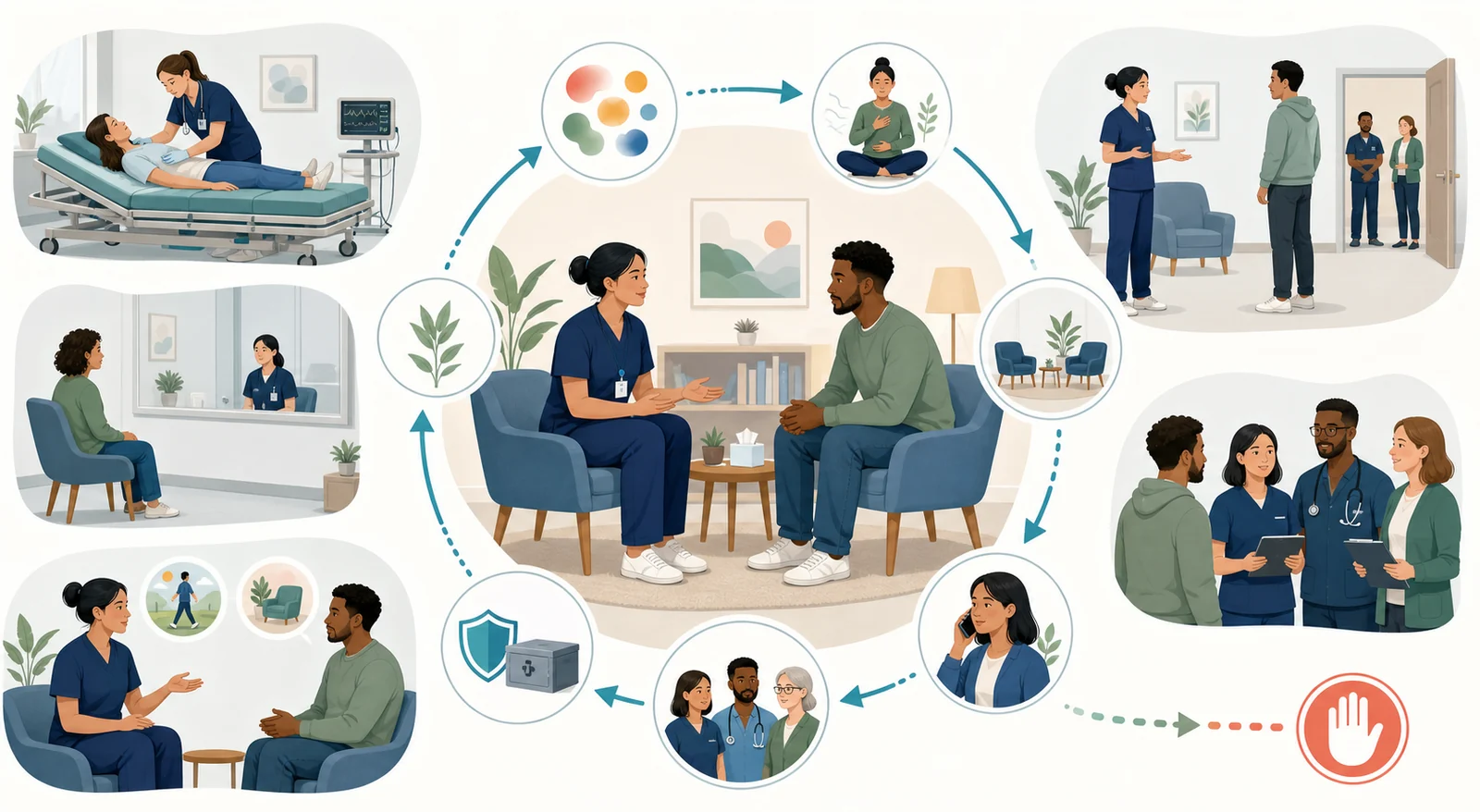
If you see decreased responsiveness, airway, breathing, or circulation problems, bleeding, intoxication or overdose, trauma, seizures, high fever, hypoglycemia, or acute confusion, your first priority is ABCs and emergency medical stabilization. Don't let asking about suicidal ideation delay detoxification or trauma care.
Check for ongoing self-harm or harm to others, accessible dangerous objects, fire, traffic, or fall risks, as well as exits and available support staff. Don't try to be a hero and intervene alone—activate your facility's emergency call and safety procedures.
Ask directly: Are they having thoughts of suicide or homicide right now? Is there a plan, intent, a timeframe, and access to means? Are there accompanying command hallucinations, intoxication, agitation, impulsivity, or a sense of losing control?
Choose observation, environmental adjustments, connection to supporters and the professional team, treatment, and a safety plan that fits the risk level and setting. Don't apply the same seclusion, belongings removal, or observation intervals to every single client.
Talk of wanting to die, being a burden, or feeling hopeless, saying goodbyes, giving away prized possessions, searching for methods, or suddenly writing a will or closing accounts are warning signs that should lead you to ask directly right away.
Pay attention to severe agitation, insomnia, anxiety, rage, impulsivity, hopelessness, withdrawal, increased substance use, psychosis, or changes following a major loss or humiliation. Don't assume someone has improved just because they suddenly seem calm.
Past suicide attempts and self-harm, a recent discharge from a hospital or release from incarceration, mental illness, substance use, chronic pain, family history, and exposure to violence can raise the background risk. Specifically check the method, intent, timing, and treatment of past attempts.
Ask about people they can reach out to for help, connection to treatment, safe housing, caregiving responsibilities, beliefs and values, future plans, coping skills, and reasons for living. Don't automatically assume that having protective factors cancels out a current plan and intent.
| Confirmation Area | Independent Question Examples | Judgment Focus |
|---|---|---|
| Death/Suicidal Thoughts | "Have you recently had thoughts of wanting to die or commit suicide?" | Frequency, duration, most recent, intensity and changes |
| Immediacy | "Are you having suicidal thoughts right now, at this very moment?" | Current thoughts immediately change safety assessment and observation level |
| Plan/Timing | "What plan did you think of, and when were you going to carry it out?" | Specificity, feasibility, preparatory actions and imminence |
| Intent/Control | "How likely do you feel you are to carry out that plan? What is stopping you?" | Intent to die, impulse control, ambivalence and inhibiting factors |
| Access to Means | "Can you access the means you would use for your plan right now?" | Availability, location, access time and possibility of securing |
| Past Behavior | "Have you ever harmed yourself or tried to die before? Did you think you could die at that time?" | Distinction between attempt and NSSI, intent, lethality, rescuability, treatment |
NIMH explains that asking directly about suicidal thoughts and behaviors does not create or increase those thoughts. Avoid leading questions that invite denial, such as “You’re not having any unreasonable thoughts, are you?” and never dismiss talk of suicide as attention-seeking or manipulation.
| Step | Role | Interpretation to avoid |
|---|---|---|
| Brief screening | Quickly identifies people with possible risk who need further evaluation | Assuming positive = admission confirmed, negative = completely safe |
| Brief safety assessment (e.g., BSSA) | Checks thoughts, plan, access, past behavior, symptoms, support, and protective factors to guide next evaluation and disposition | Deciding that simply re-reading screening questions is enough |
| Comprehensive mental health & safety evaluation | Integrates clinical status, differential diagnosis, risk and protective factors, legal status, environment, and treatment to determine disposition | Drawing a conclusion based solely on one tool’s score or the patient’s denial |
| Ongoing reassessment | Rechecks risk and plan when there is a change in condition, treatment response, or before handoff, transfer, or discharge | Viewing hospitalization or a single interview itself as a guarantee of safety |
The NIMH ASQ pathway is a three-step structure: after a positive screen, a trained clinician conducts a brief suicide safety assessment, then determines the need for a comprehensive evaluation and disposition. An acute positive—meaning “yes” to current suicidal thoughts—requires an urgent safety assessment, and a negative screen does not override clinical judgment.
Summarize current thoughts, plan, intent, preparatory behaviors, impulse control, mental status, and the pace of change. Document observable facts rather than simply stating “at risk for suicide.”
Identify past attempts, NSSI, recent ED visits, hospitalizations, discharges, violence, treatment dropouts, and coping strategies that were effective in previous crises.
Evaluate means availability, time spent alone, actual accessibility of support persons, and barriers related to housing, transportation, and follow-up care.
Look for intoxication or withdrawal, command hallucinations, insomnia, agitation, pain, shame, relationship, legal, or financial crises, recent loss, and medical illness.
Assess the ability to accept help, trusted individuals, therapeutic relationships, coping skills, reasons for living, and future plans—checking whether they are specific and usable.
Document why the current observation, environmental measures, specialist evaluation, disposition, and follow-up plan are necessary, and specify the conditions that should trigger reassessment if things change.
Do not leave the patient alone. Immediately notify the facility's emergency, mental health, and medical personnel in charge. Do not try to take objects away by yourself or keep trying to persuade them, as this can make the situation worse.
Reduce access to dangerous items and move to a safer location, tailored to the current clinical setting and risk. Do not remove medically necessary equipment without thought — plan for observation and alternative measures together.
Explain: "Thank you for telling me. For safety right now, I'm going to stay with you and call the team." Do not punish, blame, or promise to keep secrets.
Check vital signs, level of consciousness, intoxication/withdrawal, pain, pregnancy possibility, trauma, and medications while preparing for an urgent mental health evaluation and disposition.
When the person responsible for observation changes or the patient moves for tests or transfer, directly hand off the current risk, access to means, recent statements and behaviors, interventions taken, and the response. Confirm a seamless transfer of responsibility with no gaps.
| Priority Area | Key Assessments | Safety Principle |
|---|---|---|
| Airway, Breathing, Circulation | Level of consciousness, oxygenation, ventilation, pulse and blood pressure, bleeding and shock | Do not delay resuscitation or medical treatment because of a psychiatric interview |
| Poisoning or Overdose | Substance, amount, time of ingestion, whether taken on an empty stomach, co-ingestants, extended-release formulations, need for antidote or lab work | Do not rely solely on the patient's report to determine safety; consult toxicology resources |
| Trauma and Neurological Status | Falls, hypoxia, head or neck injury, seizures, neurological changes | Even if the patient appears calm externally, monitor for delayed deterioration |
| Mental Status and Intent | Current thoughts, regret, disappointment, whether they sought help, plan and access to means, psychosis, intoxication | Do not assume the risk is resolved just because the patient is medically stable |
| Transfer or Discharge | Safe transportation, handoff of responsibility, support person, safety plan, means safety, follow-up | Do not conclude care with just a piece of paper or a promise that "I won't do it again" |
| Category | Key Question | Nursing Judgment |
|---|---|---|
| Nonsuicidal Self-Injury (NSSI) | Did the person hurt themselves to regulate emotions or reduce tension, without intent to die? | Treat wounds, assess the function, triggers, and repetitive patterns, and evaluate for separate suicide risk |
| Suicide Attempt | At the time of the act, did the person know it could be fatal and want to die? | Confirm intent, plan, and current risk independently of the medical lethality |
| Unclear Intent | Is there a memory gap, intoxication, ambivalence, or a changing story? | Do not force the behavior into one category; document the uncertainty and connect to a comprehensive evaluation |
| Co-occurrence | Does the person have a history of NSSI but this time had an intent to die? | Do not minimize the current behavior as "just like usual" because of past self-injury |
Write down thoughts, feelings, physical changes, and behaviors in the person's own words. They should be recognizable as signals to start the plan—for example, "I can't sleep and I stop answering calls."
Identify specific actions to try first without needing any tools, like breathing exercises, sensory grounding, walking, listening to music, showering, or journaling, and practice them to make sure they are realistic.
List several people and public places where the person can spend time safely without having to disclose the crisis, and check operating hours and transportation barriers.
Write down the names and actual contact methods of family, friends, or colleagues the person can tell they are in crisis and ask for help. Have a backup plan if they are unreachable.
Write down the clinician, local crisis services, emergency department, local emergency number, and how to get there. In the United States, 988 is one resource; in other countries, use local resources.
Work with the person and their supporters to create a specific plan for storage, removal, or supervision that reduces access time and lethality of dangerous means during a crisis.
The VA's Safety Planning Intervention presents these six elements as a collaborative, person-centered, step-by-step plan. A safety plan does not replace professional treatment, and it is different from "promising to stay safe." The NIMH warns that safety contracts are not effective and can create a false sense of security.
Directly ask what means the person has thought about, where they are right now, who has access to them, and how quickly they could be used. Do not assume based on general warning signs alone.
Explain the reason for reducing access during a crisis period and decide on a feasible method together with the person. When possible, clarify roles, the time frame, and conditions for return with a trusted supporter.
Follow jurisdictional laws and institutional policies for the storage or transfer of firearms, medications, and toxic substances, and seek help from pharmacists, security, legal advisors, or crisis teams as needed.
Check not only the home but also the vehicle, workplace, other residences, and actual access routes like online purchases or prescription renewals. Do not confirm safety just because one means has been removed.
| Area | What to Check | Assumptions to Avoid |
|---|---|---|
| Level of Observation | Line of sight, proximity, and frequency that match current risk, behavior, clinical setting, orders, and agency standards. | Memorizing a universal, fixed interval for everyone at risk. |
| Environmental Hazards | Anchor points, cords, sharps, medications, personal belongings, visitor items, and medical equipment. | Assuming an empty room or total removal of belongings is always the safest option. |
| Privacy and Dignity | The reason for searches, clothing, hygiene, and bathroom observation, ensuring minimal intrusion, and considering trauma-informed and cultural factors. | Justifying humiliation, punishment, or unnecessary exposure in the name of safety. |
| Tests, Transport, and Transfer | Escort, route, vehicle, arrival confirmation, direct handoff, and documentation access. | Considering responsibility ended the moment the patient was handed to the transport team. |
| Change and Reassessment | Changes in status after speech, behavior, vital signs, intoxication, medication effects, visits, or bad news. | Lowering the level of observation just because the person denies suicidal thoughts or falls asleep. |
The Joint Commission's suicide risk reduction resources require written policies for monitoring high-risk individuals, reassessment, mitigating environmental hazards, and safe transport, discharge counseling, and follow-up. Specific observation methods must align with the setting and policy.
| What to Document | Focus of Good Documentation | Phrases to Avoid |
|---|---|---|
| Direct Statements | Record key suicidal or homicidal statements with exact wording and timing, to the extent possible. | Only writing "bizarre speech," "attention-seeking," or "looked dangerous." |
| Assessment Rationale | Immediacy, plan, intent, means, history, mental and medical status, protective factors, and areas of uncertainty. | Documenting only a tool score or a low/medium/high label. |
| Interventions and Response | Notifications, observation and environmental actions, treatment, safety plan, contacts made, the individual's response, and reassessment. | Sentences with no content or outcome, like "safety teaching done" or "doctor notified." |
| Information Sharing | Who received what information, why, and when; consent, legal basis, or direction from the person in charge. | Making an unconditional promise of confidentiality or automatically disclosing to all family members. |
| Handoff and Disposition | Receiver's name, time, risk level, unfinished tasks, and confirmation of arrival or follow-up appointments. | Assuming continuity is secured just because a referral form was sent. |
Disclosure of information to prevent serious and imminent harm is carried out to the necessary extent, following jurisdictional law and agency procedures. The U.S. HHS explains that a healthcare provider, using good-faith professional judgment, may disclose necessary information to a person who is in a position to prevent or lessen the harm, but HIPAA does not automatically require notifying a specific person in every situation.
Look for pacing, clenched fists or jaw, hitting or throwing objects, watching the exit, invading personal space, sudden approaches, threatening postures, and changes in compliance with instructions.
Identify rising voice volume or speed, repetitive demands, cursing or specific threats, paranoid fear, shame, hopelessness, extreme anxiety, and a sense of losing control.
Assess for delirium, hypoxia, hypoglycemia, pain, head injury, intoxication or withdrawal, medication side effects, command hallucinations, sleep deprivation, overcrowding, noise, waiting, and unclear rules.
Recent or past violence, a specific target, plan, and access, current behavior and previous escalation patterns, and triggers or calming methods the person tells you about are more direct information than a diagnosis.
Ask directly, "Are you having thoughts of harming someone? Is there a specific person?" and differentiate between vague anger and a specific threat.
Confirm what they plan to do, when, and where; whether they have access to the target and means; and if they have already prepared or traveled somewhere.
Ask about the likelihood of acting on it, whether they can stop themselves, and what is holding them back. Do not minimize a specific threat as just an expression of emotion.
Check the content of and compliance with command hallucinations, intoxication or withdrawal, delirium, pain, sleep deprivation, and acute stress, and concurrently evaluate for treatable causes.
If the risk is imminent, call for on-site support and the person in charge, and protect the individual, potential targets, and staff. Decisions about notification, protection, and involuntary treatment follow jurisdictional law, professional judgment, and agency procedures.
Don't block the exit, keep enough distance, and make sure both the patient and staff have a way out. Remove dangerous objects and bystanders, and have support staff ready but not surrounding the person in a threatening way.
One trained staff member introduces themselves by name and role, speaking in a low, calm voice with short phrases. Don't have multiple people asking questions or giving directions at the same time.
Acknowledge the emotion without approving threatening or violent behavior. For example: "It sounds like the wait has made you really angry. Can you tell me what you need most right now?"
Offer two or three options you can actually provide, like a quiet space, water or a snack, a pain assessment, a call to someone in charge, or voluntary oral medication. Don't phrase it as a punishment if they don't choose.
Make one request at a time and give them time to respond. Check whether their voice, distance, posture, and threats are decreasing. If things get worse, escalate the level of support and your emergency plan.
| Situation | Therapeutic approach | Approach to avoid |
|---|---|---|
| Expressing anger | "I understand you're angry. I want to hear what's been hardest for you." | Invalidating their feelings with "Calm down" or "There's no reason for that." |
| Threatening behavior | "You can express your anger with words, but hitting people or throwing things is not allowed." | Labeling the person as bad or aggressive. |
| Offering choices | Briefly and consistently explain two possible choices and the outcome of each. | Promises you can't keep, punishment or humiliation, or forcing something while making it look like a choice. |
| Offering PRN medication | Explain the purpose, expected effect, main risks, and alternatives, then confirm it's a voluntary choice. | Automatically judging refusal as non-cooperation or danger, or giving it by force. |
| Responding after a refusal | Reassess the reason for refusal, decision-making capacity, medical and mental status, current risk, and legal authority. | Assuming that having a prescription alone justifies giving it without consent. |
Consistency doesn't mean giving everyone the same robotic response. It means applying the same safety principles and team plan in a predictable way. Medication can be one option for de-escalation, but refusal alone does not justify chemical restraint.
Identify the target, what was said, the timeframe, the plan, access to means, and intent. Document it using the most accurate wording possible. Don't try to provoke them into repeating the threat or go directly to the target to verify it.
Make the patient, staff, and visitors safe. Immediately call the person in charge, the mental health team, security, and any needed emergency services. Don't try to handle it secretly on your own.
Decide who gets notified and what information to share based on severity, imminence, and credibility, along with jurisdictional law and case precedent, your license and ethical standards, and institutional policy. Make this decision together with leadership and legal counsel.
Give only the information needed for the purpose to people who are in a position to prevent or reduce the harm. Document the recipient, time, rationale, any instructions given, and follow-up actions.
Try possible alternatives first and assess the response: treat medical causes, use verbal de-escalation, adjust the environment and stimuli, address basic needs, and offer choices and voluntary medication.
The Joint Commission explains that seclusion or restraint should only be started when less restrictive methods haven't worked and the behavioral emergency poses a serious and imminent risk to the patient, staff, or others.
Follow the orders, training requirements, time limits, face-to-face evaluation, and documentation rules in your jurisdictional laws and institutional policy. Confirm the number of staff, their skills, emergency equipment, and everyone's role beforehand.
Monitor airway, breathing, circulation, level of consciousness, positioning, skin and neurovascular status, vital signs, hydration and elimination, pain, and emotional state according to policy. Immediately assess any new medical concerns.
Discontinue as soon as the behavioral criteria for release are met. Never use it as punishment, retaliation, for convenience, as compliance training, or as a solution for staffing shortages.
SAMHSA explains that seclusion and restraint can be traumatic, so they should only be used as a last resort when less restrictive measures have failed and safety is seriously threatened. Even physically holding someone can count as restraint if it limits their movement, so don't assume "it's not restraint just because there's no device."
Check for injuries to the client and staff, vitals, breathing, level of consciousness, medication effects and side effects, pain, and any treatment needed. Don't skip the physical assessment just because the person looks calm on the outside.
Once the person is stable, listen to what triggered the event, what helped or made things worse, and whether their dignity and choices were respected. This is not an interrogation to assign blame.
Review early warning signs, medical causes, the environment, communication, calling for support, the less restrictive interventions tried, and the appropriateness of decisions made. The goal is learning and system improvement, not punishment.
Update the individual's triggers, preferred de-escalation methods, approaches to avoid, early support strategies, medication/sleep/pain plans, safety plan, and handoff information.
Do not offer vague encouragement or simply hand them over to family. Directly ask about current suicidal ideation, plan, intent, and access to means, as well as past behavior. Initiate a safety assessment and observation appropriate to the level of acuity.
Do not rely on the screening tool result alone. Use your clinical judgment to reassess directly. Check for recent changes, preparatory behaviors, access to means, protective factors, and any discrepancies between different sources of information.
Respect the possibility of NSSI, but separately assess current and past suicidal ideation and intent, the function of the behavior, the wound and infection status, and any repetitive patterns. Do not use stigmatizing language.
Rather than a lengthy psychiatric interview, first prioritize airway, breathing, circulation, identifying the substance taken, time of ingestion, and amount, while monitoring toxicity, ECG, and level of consciousness for emergency stabilization. Then, follow up with a psychiatric evaluation.
Do not dismiss or argue with the content of the auditory hallucinations. Assess the target, the command, the intent, means, and access to carry it out, as well as the likelihood of compliance, level of control, and any signs of intoxication or delirium. Immediately activate safety protocols.
Do not surround the client with multiple staff members or use medication refusal as grounds for forced administration. Maintain a safe distance from the exit, have one person listen to their feelings and demands, and offer a low-stimulation environment, real choices, and clear behavioral limits.
Do not promise confidentiality or automatically contact that relative on your own. Explore the specifics of the plan, time, means, access, and intent. Immediately initiate on-site protection measures and follow the proper chain of command, security, and legal notification procedures.
Quietness alone does not close the incident. Reassess medical and mental status, injury and medication effects, and update the client and team debriefing, triggers, preferred interventions, safety plan, and handoff.
This material is a study summary and is not a guideline for determining an individual's level of suicide or violence risk, diagnosis, treatment, admission, discharge, observation, involuntary treatment, seclusion or restraint, exceptions to confidentiality, or who to report or notify. In actual situations, follow local emergency services, current jurisdictional laws, licensing standards, institutional policies, prescriptions, and the judgment of a trained professional team. The original sources were only checked for the presence of exam topics; questions, correct answers, answer choices, tables, and images have not been reproduced.
다음 이론을 계속 학습하려면 로그인하세요.
로그인하고 계속 학습필기노트, 하이라이터, 메모는 잘 쓰고 있어?
내보내줘운영진이 검토할게요!
마이페이지에서 차단한 회원을 관리할 수 있어요.