컨텐츠 내용을 수정할 수 있습니다
Therapeutic communication isn’t about memorizing “correct” phrases. It’s a professional process where you accurately understand the client’s feelings and meaning, confirm safety, and help them make their own choices. The same question can feel therapeutic or like pressure and judgment, depending on the timing, tone, relationship, and level of risk.
Core Goal: Design the conversation in this order: Observation & Safety → Presence & Active Listening → Reflecting Feelings & Meaning → Clarification & Direct Questions → Information & Options → Collaborative Planning → Summary & Re-evaluation.
In local feedback materials, active listening, empathy, reflection, open-ended questions, silence, responding to auditory hallucinations/delusions, trauma/domestic violence/loss situations, and professional boundaries were identified only as recurring themes. Actual questions, correct answers, answer choices, tables, and images were not restored. This content was independently rewritten based on current public resources from SAMHSA, NCSBN, NIMH, HHS, AHRQ, WHO, VA/DoD, and The Joint Commission.
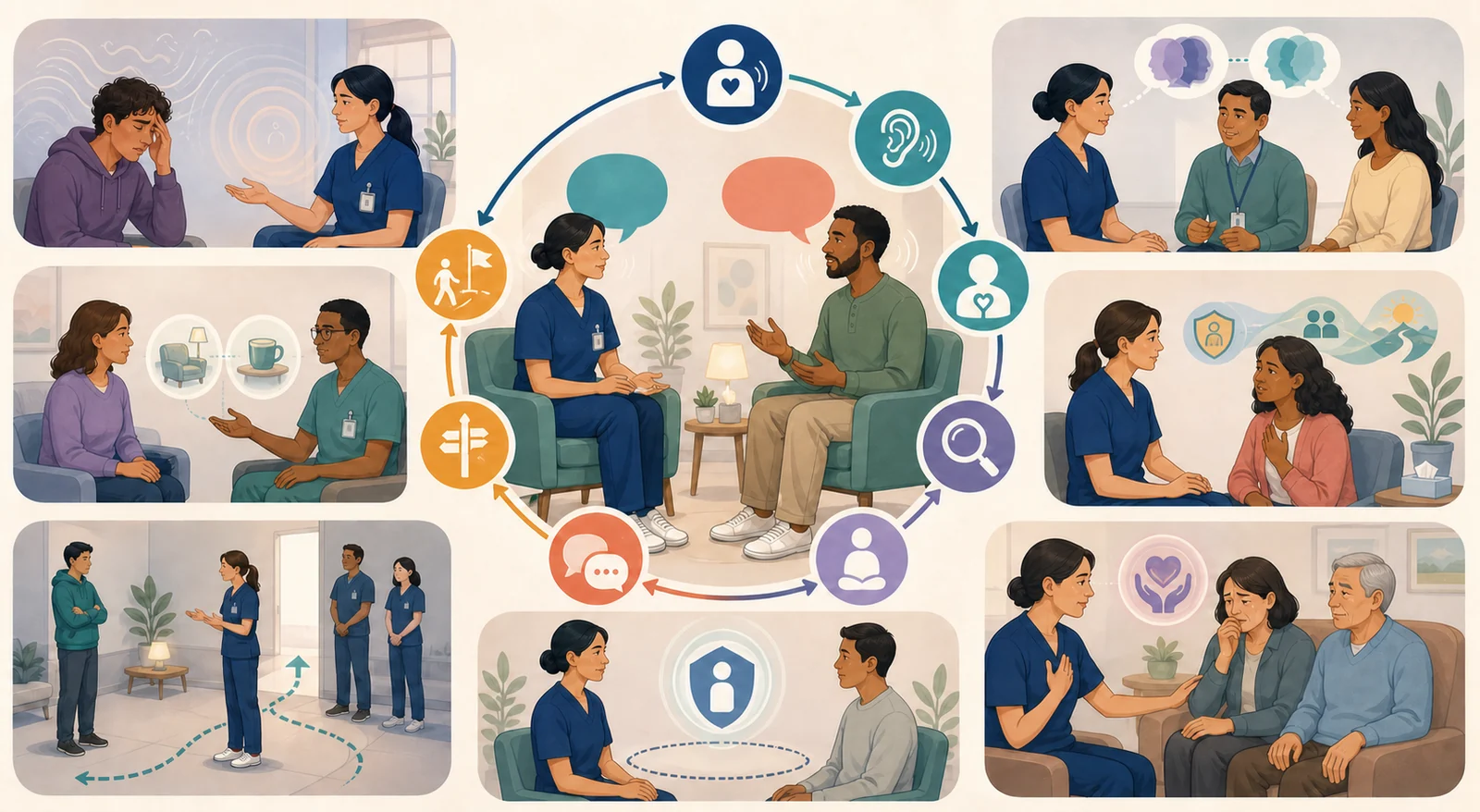
First, assess for self-harm or harm-to-others thoughts, severe agitation, command hallucinations, acute confusion, or medical instability. If the risk is high, direct questions, increased observation, calling the team, and environmental safety take priority over lengthy exploration.
Distinguish whether the immediate need is emotional expression, fact-finding, providing information, or setting behavioral limits. Don’t try to achieve multiple goals with a single sentence.
The amount of information a person can handle at once varies with anxiety, pain, hallucinations, medications, language, hearing, and cognitive status. With severe anxiety, start by offering one short, concrete sentence and one choice.
Tailor your approach to whether this is a first meeting, a working phase where trust is established, or a termination phase nearing discharge or transfer. Confirm privacy, culture, preferred language, and whether a family member is present.
After you speak, observe facial expression, voice, eye contact, tension, silence, and behavioral changes. Therapeutic communication is complete not the moment you say the words, but when you check the other person’s response and adjust accordingly.
Whenever possible, position yourself at the same eye level without blocking the exit and respect personal space. Do not move in close or touch someone suddenly if they are anxious or paranoid.
Crossed arms, a body angled toward the door, or frequently checking your watch can be perceived as impatience and judgment. Use a relaxed, open posture, natural eye contact, and a calm tone of voice.
Give them time to answer, but don’t leave them hanging with no response at all. Slow down your rate of speech and reduce the amount of information. Even during silence, show you are present through your facial expression and posture.
If they say “I’m fine” but are crying or their hands are shaking, share your observation without blaming. Don’t jump to conclusions by interpreting the mismatch between words and actions; instead, help the client explain the meaning.
| Technique | Purpose | Independent Example |
|---|---|---|
| Open questions | To hear the story and perspective broadly | “What part of your situation feels like it needs the most help today?” |
| Affirming | To acknowledge specific efforts, strengths, and values | “It must have been difficult to ask for help, so the fact that you came here is significant.” |
| Reflective listening | To check back feelings and meaning like a hypothesis | “It sounds like taking medication feels to you like losing control.” |
| Summarizing | To organize key points, ambivalence, and next steps | “So, you want the benefits but are worried about drowsiness, and you’d like to discuss an adjustment plan with your provider first—is that right?” |
SAMHSA's motivational interviewing materials highlight open-ended questions, affirmations, reflective listening, and summaries as core skills in person-centered conversations. Affirmations should be based on observable effort and values, not vague praise.
| Technique | Nurse's Role | When to Use |
|---|---|---|
| Restatement | Briefly repeat the core content to confirm what you heard | When you need to accurately capture a fact or topic |
| Reflection of Feeling | Tentatively verbalize the emotion without assuming | When the emotion is more central than the words |
| Clarification | Make vague words and meanings more specific using the client's own expressions | For phrases like "it's all over" that can have multiple meanings |
| Focusing | Collaboratively choose one topic that's important right now among several | When the conversation scatters due to anxiety |
| Summarizing | Link together emotions, facts, decisions, and remaining questions | Before transitioning topics, ending the interview, or confirming a plan |
| Presenting Reality | Convey current facts and safety without agreeing with the perceptual experience | During hallucinations, delusions, or severe confusion |
After emotions surface or a difficult decision is shared, give the person time to think and continue expressing themselves. Maintain your presence without turning away or focusing only on charting.
If the silence becomes prolonged, confirm their preference with something like, "Do you need more time to gather your thoughts, or would you like to rest for now?"
Response speed may be slow due to interpreter delay, hearing loss, aphasia, depression, slowed thinking, or medication sedation. Don't rush to finish their sentences for them.
If you suspect self-harm risk, acute confusion, or severe agitation, don't just maintain silence. Switch to direct, brief safety questions.
| Question Type | Strengths | Cautions |
|---|---|---|
| Open-ended | Explores experiences, feelings, values, and priorities | May feel too broad for patients with severe anxiety or confusion |
| Closed | Quickly confirms necessary facts like time, intake, sleep, or medication use | Can feel like an interrogation if used in succession |
| Direct question | Clearly assesses self-harm, harm to others, command hallucinations, and plan, means, or intent | Don't miss risk by using vague euphemisms |
| Multiple choice | Reduces overload and helps restore a sense of control | Offer only two or three realistically possible options |
"Why" questions aren't absolutely forbidden. However, questions that make the patient justify the cause or sound accusatory — like "Why did you do that again?" — increase defensiveness. It's safer to ask about observable processes and meaning, such as "What changed right before that happened?" or "What was the hardest part for you?"
You guess what the client might be feeling from their perspective, then check if you’re right. You express it humbly, like: “It sounds like you were really scared. Did I understand that correctly?”
Saying things like “You poor thing” can come across as looking down on someone or making them feel helpless. Always preserve their dignity, strengths, and ability to choose.
When the nurse centers their own experiences and feelings, the client’s story gets lost. Don’t jump to conclusions like “I know exactly how you feel.”
Use self-disclosure carefully — only when it has a clear therapeutic benefit for the client, is brief, and the focus shifts right back to the client. It’s not a tool for meeting the nurse’s own need for support.
| Avoidance reaction | Problem | Therapeutic shift |
|---|---|---|
| False reassurance | Guaranteeing outcomes and minimizing fears | Acknowledging uncertainty and offering support available now |
| Premature advice | Making decisions on behalf of the client’s values and choices | Exploring goals and options, and seeking permission to provide information |
| Approval or disapproval | Making the client speak according to the nurse’s standards | Reflecting specific behaviors, outcomes, and values instead of judgment |
| Minimizing feelings | Erasing personal experience with “Everyone goes through that” | Asking what it means to this person right now |
| Changing the subject | The nurse escaping from uncomfortable emotions | Acknowledging emotions and checking readiness and priorities for discussion |
| Excessive probing | Demanding more details than necessary, undermining a sense of control and safety | Explaining the scope needed for safety, seeking permission, and then asking questions |
Ask, "Would you mind sharing what you already know about this?" to catch redundant explanations and misunderstandings. Also check if they're ready to receive information right now.
Cut down on jargon. Stick to one concept per sentence and deliver just two or three key points at a time. Explain risks, benefits, alternatives, and the option of doing nothing—all fairly.
Compare the available choices alongside the client's preferences, values, and life circumstances. Providing information is not about persuading someone to comply.
Say, "I want to make sure I explained things clearly. Could you tell me what you'll do when you go home?" This isn't about testing the client—it's a way to check how effective your explanation was.
Everyday conversational ability and the capacity to understand medical information can be different. For important consent, risk discussions, and discharge teaching, verify the preferred language and the need for an interpreter.
Don't routinely use family members or minor children as interpreters. Call in a qualified interpreter, and as the nurse, look at and speak directly to the client—not the interpreter.
Speak in brief chunks and allow time for interpretation. Avoid slang, idioms, and jokes. Carry out teach-back through the interpreter as well.
Use hearing aids, glasses, pictures, writing, and augmentative and alternative communication. For aphasia, use yes/no questions and choice boards as aids, but never speak to an adult as if they were a baby.
| Phase | Key Tasks | Nurse Self-Check |
|---|---|---|
| Orientation Phase | Explain roles, time, place, limits of confidentiality, and goals; build trust | Keep promises and avoid creating excessive personal intimacy |
| Working Phase | Explore feelings and behavior patterns; practice coping skills and work toward goals | Reflect on and seek supervision for transference, countertransference, the urge to rescue, favoritism, and avoidance |
| Termination Phase | Summarize achievements and remaining tasks, acknowledge feelings of loss, and review follow-up plans and resources | Avoid abrupt cut-offs or shifting into a personal relationship |
The NCSBN explains that nurses must safeguard the client's best interests and independence, and avoid personal gain or inappropriate involvement. A therapeutic relationship is not a friendship, companionship, or rescuer relationship—it is a professional relationship with clear purpose and accountability.
Watch for repeatedly giving certain clients longer visits or applying rules differently just for them. If there's a clinical need, make it transparent through the team plan and documentation.
Check agency policy, the gift's value, timing, and intent, and consult with the team. Cash, expensive gifts, personal transactions, and loans seriously blur professional boundaries.
For touch, check culture, trauma history, and preferences, and get consent. Don't place the burden of your personal contact information, private life, or emotional needs onto the client.
Avoid friend requests, private messages, photo sharing, and in-person meetups; use agency channels. The power imbalance doesn't instantly disappear just because treatment has ended.
Ask about physical and psychological safety first. Check on room door positioning, who else is present, gender preferences, and whether touch is okay.
Explain upfront what you're asking and why, what will be documented and shared, and what's going to happen next. Don't guarantee confidentiality or outcomes that you can't promise.
Offer available options and inform them of their right to refuse, take a break, or ask questions. Even for clinically necessary procedures, collaborate on adjusting the pace and approach wherever possible.
Avoid approaches that involve making them repeat unnecessary details of the event, touching them suddenly, having multiple staff members question them at once, or taking away their sense of control.
SAMHSA identifies safety, trust and transparency, peer support, collaboration, empowerment·voice·choice, and cultural·historical·gender context as the core principles of a trauma-informed approach.
Validate the distress, like “That voice sounds really threatening to you.” Don’t agree (“the voice is right”) or argue/ridicule (“there’s no sound at all”).
Calmly explain the difference in perception, such as “I don’t hear that voice, but I understand it feels very real to you.”
Ask directly what they’re hearing, whether it’s commanding harm to self or others, and if there’s any thought, intent, or means to follow through—and whether they feel in control. Avoiding the topic of voices entirely to skip safety questions is dangerous.
Reduce stimulation and connect them with trusted people, activities, and their medication plan. For sudden-onset hallucinations with altered consciousness, rule out delirium, infection, withdrawal, substances, or neurological causes first.
Don't help the person check for secret devices or conspiracies. On the flip side, don't try to break their belief by presenting evidence, either.
Keep the focus on the emotion and the immediate risk, like saying, "It sounds like you're frightened that someone might hurt you. What would help you feel safe right here, right now?"
With disorganized thinking, ask one question at a time and clarify vague expressions. Don't pretend you understand when you don't.
Assess sleep, hydration and nutrition, hygiene, medications, physical illness, and self-care. Don't label negative symptoms as laziness or being uncooperative.
Secure the exit, remove dangerous objects and bystanders, and have support staff ready but out of sight. Don't have multiple people giving directions at once or surround the person.
In a low, calm voice, state your name and role, acknowledge their feelings, then make one request at a time. Give them plenty of time to process it.
Offer realistic options and explain limits in behavioral terms. For example: "I understand you're angry, but hitting people is not allowed. Would you prefer a quiet room or the open lounge area?"
Seclusion and restraint are used only when less restrictive methods have failed and there is serious, imminent danger — and only according to legal and facility standards. Discontinue immediately once release criteria are met. They are never a form of punishment, convenience, or threat.
Ask clearly about thoughts of wanting to die, suicidal ideation, current plan, means, access, intent, and past attempts without being vague. The NIMH explains that asking directly about suicide does not create or increase such thoughts.
Say something like, “Thank you for telling me. I’m going to ask a few more things to help keep you safe.” Do not dismiss it as attention-seeking, manipulation, or breaking a promise.
Do not promise to keep it just between the two of you. Be transparent that if there is serious risk, you will need to share information with the team to ensure safety.
If there is current suicidal ideation or the screening is positive, connect the person to your facility’s safety assessment, observation, environmental safety measures, and professional referral pathway. Do not rely on a simple “I promise I won’t do it” to determine safety.
Detailed suicide risk stratification, observation, environment, and safety planning continue in the next category: 8020 Suicide, Violence, and Safety.
| Check | Question Focus | Action |
|---|---|---|
| Target and content | Who they intend to harm and what they plan to do; whether the target is specific | Do not argue. Immediately notify the team leader and activate the safety pathway |
| Plan and timing | When, where, and in what sequence they plan to carry it out | Assess imminence and feasibility |
| Means and access | Tools, weapons, transportation, and access to the target | Secure safety and implement necessary protective measures |
| Intent and control | Intent to act, inhibiting factors, command hallucinations, substance use | Individualize observation, specialist evaluation, and legal procedures |
Under U.S. HIPAA, a healthcare provider who believes in good faith that a serious and imminent threat exists may disclose necessary information to a person in a position to prevent or lessen the harm. However, whom to notify and the duty to do so vary by state law, case law, and institutional policy. Nurses do not simplify this into a rule of automatically contacting family for every threat; instead, they immediately secure safety and follow the pathways for the person in charge, the mental health team, security, legal, and law enforcement.
| Situation | Therapeutic Approach | Approach to Avoid |
|---|---|---|
| Intimate partner violence | Interview privately without the partner and use LIVES: Listen, Inquire about needs, Validate experience, Enhance safety, Support connection | Ordering them to leave, blaming the victim, confronting the abuser, contacting resources without consent |
| Loss and grief | Name the emotion, offer silence and presence, ask about cultural and spiritual preferences | Forcing stages or minimizing with phrases like “time heals” or “you have to be strong” |
| Serious illness and end of life | First listen to the meaning of their worries and the patient’s values and goals, then discuss options collaboratively with the healthcare team | Guaranteeing outcomes, unilaterally imposing reality, presenting one intervention such as nutrition or fluids as the automatic right answer |
| Sensitive sexual or physical changes | Normalize without erasing individual experience; ask permission for questions and offer privacy | Embarrassment, joking, avoidance, unfounded promises of recovery |
The WHO's LIVES approach guides you to listen to survivors of violence without pressure, ask about their needs and concerns, validate their experience, and connect them with a safety plan and local support. For adult reporting duties and exceptions, as well as protection regulations for minors, older adults, and persons with disabilities, check your jurisdictional laws and institutional policies.
Don't offer hasty hope or comment on the surgeon's reputation. Reflect on which part of the change is most frightening, and when the client is ready, provide accurate information about function, rehabilitation, and support.
Don't label it as refusal or threaten to tell the provider. Listen to what they know, their expected benefits, and their feared side effects. Explain in plain language, then confirm understanding using teach-back.
Don't deny the voice or affirm it as real. Ask directly about the current command content, intent to follow it, means, and ability to control it, and immediately initiate the safety pathway.
Don't argue by presenting evidence or join them in searching for the watcher. Acknowledge the fear and explore ways to increase safety in the current environment and check basic needs.
Don't surround them with multiple staff or immediately prepare restraints. One person should maintain a safe distance, acknowledge the emotion, and briefly offer feasible choices and behavioral limits.
Don't ask why they haven't left or automatically recommend couples counseling. Privately apply LIVES and assess current risk, safety planning, and the support they want.
Don't promise secrecy or treat it as a one-sentence answer of calling the family personally right away. Assess the target, plan, timing, means, and intent, and immediately activate the team's legal and safety procedures.
Don't just refuse and end it, or give out your personal account. Acknowledge the feelings related to the relationship ending, and together review official contact pathways, future support, and crisis resources.
This material is a study summary and is not a guideline for determining an individual client's diagnosis, treatment, risk level, confidentiality exceptions, reporting obligations, seclusion, restraints, or who to notify. In actual situations, follow current jurisdictional laws, licensure standards, institutional policies, prescriptions, and the judgment of the professional team. The original sources were used only to confirm the existence of exam topics; no questions, answers, answer choices, tables, or images have been reproduced.
다음 이론을 계속 학습하려면 로그인하세요.
로그인하고 계속 학습필기노트, 하이라이터, 메모는 잘 쓰고 있어?
내보내줘운영진이 검토할게요!
마이페이지에서 차단한 회원을 관리할 수 있어요.