컨텐츠 내용을 수정할 수 있습니다
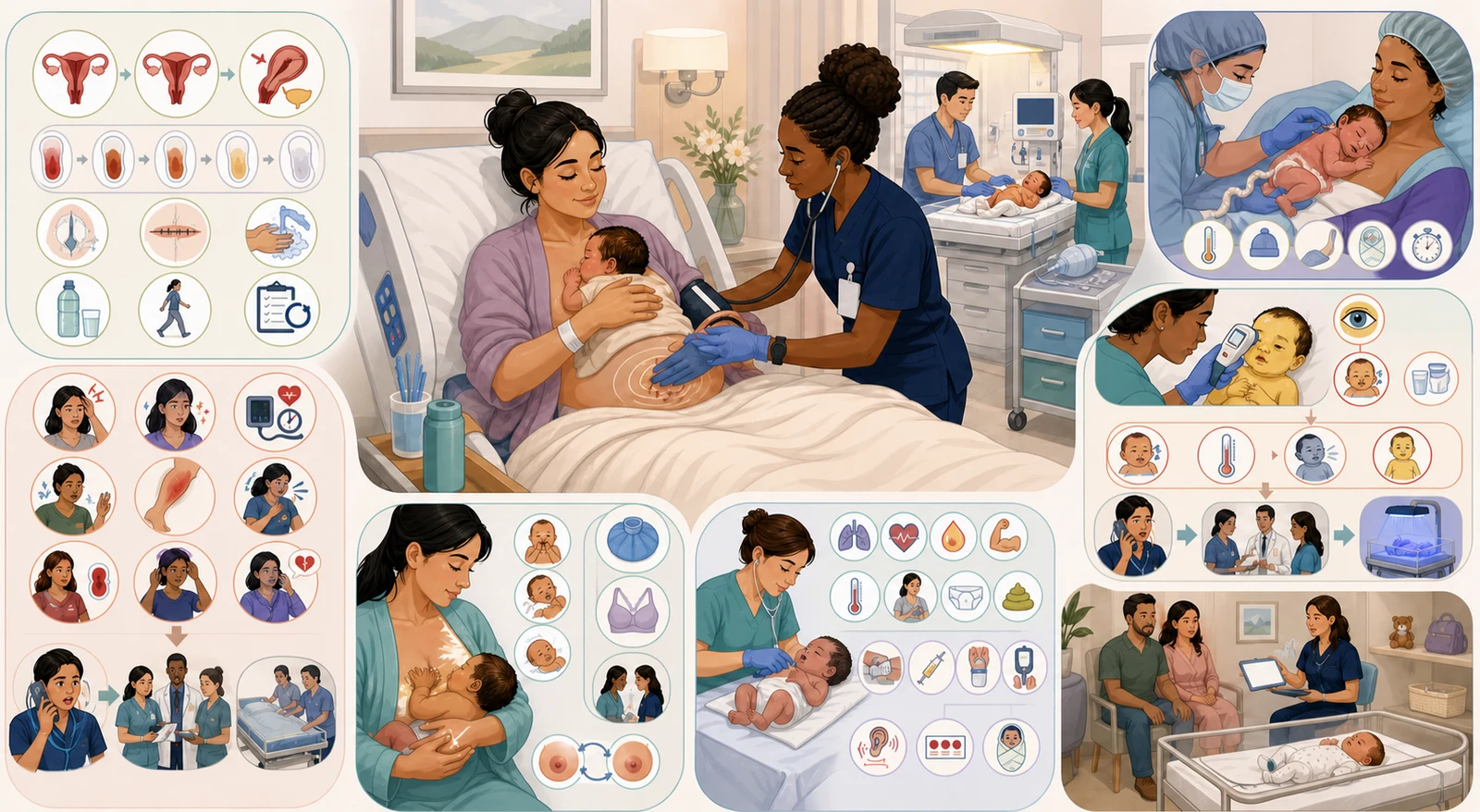
Maternal recovery and newborn transition are not two separate processes that finish independently. We look at the mother's bleeding, blood pressure, infection, thrombosis, and emotional state on the same timeline as the newborn's breathing, temperature, feeding, jaundice, and infection risk. This is organized as a decision-making sequence that helps you distinguish between normal recovery and signals that need immediate reporting.
Core Objective: Connect the dots in this order: Maternal ABCs & Bleeding → Uterus, Lochia & Bladder → Blood Pressure, Infection, Thrombosis & Emotion → Newborn Breathing & Temperature → Feeding, Blood Glucose & Jaundice → Prevention & Safe Sleep → Reassessment.
The original feedback material only covered postpartum infection, lochia, endometritis, and postpartum contraception. The newborn part is not a restoration of original questions but a newly constructed independent study summary based on open guidelines from AHA, AAP, CDC, and ACOG. Actual treatment, testing, and vaccinations should follow the current protocols and prescriptions at the place of birth.
Look at consciousness, breathing, skin color, pulse, blood pressure, pain, and cumulative blood loss first. If you see pallor, cold sweats, a feeling of faintness, tachycardia, or hypotension, prioritize shock even if the visible amount of lochia seems small.
Evaluate the firmness, height, and midline position of the uterine fundus, along with the amount, color, odor, and clots of the lochia, and bundle that with an assessment of bladder distension and voiding.
Do not dismiss a severe headache, visual changes, difficulty breathing, fever, uterine tenderness, unilateral leg swelling or pain, chest pain, self-harm, or thoughts of harming the baby as normal postpartum changes.
Check breathing or crying, heart rate, muscle tone, skin color, and temperature. For apnea, gasping, or a low heart rate, ventilation and resuscitation readiness come before feeding or bathing.
Check feeding cues and swallowing, voiding and stooling, blood glucose for at-risk groups, visual and measured jaundice levels, and newborn identification, fall risk, and safe sleep. Educate on warning signs even after discharge.
Check that it is firm and midline. A soft, enlarged uterus may suggest atonic bleeding, while a fundus deviated to one side can suggest bladder distension.
There is a general trend from initial red to gradually lighter, but don't use a date chart alone to definitively judge normal versus abnormal. Evaluate a sudden increase in flow, repeated large clots, a foul odor, or a return of bright red bleeding that had been lightening.
Difficulty voiding and distension can push the uterus up and to the side, interfering with contraction. Safely assist with voiding and then reassess the uterine position, tone, and bleeding before and after.
| Observation | Meaning | Priority Action |
|---|---|---|
| Soft, enlarged uterus + heavy bleeding | Possible uterine atony | Call for help, perform uterine massage, check the bladder, administer prescribed uterotonics and hemorrhage bundle |
| Firm uterus + continuous bright red bleeding | Possible laceration or trauma | Assess the bleeding site and call the obstetric provider rather than repeating massage |
| Sudden tachycardia, pallor, dizziness, altered consciousness | Possible circulatory loss greater than the visible amount | ABCs, prepare large-bore IV access, labs, fluids, and blood products, and escalate rapidly |
| Gushing bleeding, large clots, or feeling faint after discharge | Possible delayed postpartum hemorrhage | Do not wait with self-monitoring; seek immediate emergency evaluation |
Look at vital signs, uterine tenderness, lochia, incision or perineal site, urinary symptoms, breasts, and respiratory system — rule out other causes of fever at the same time.
Draw blood work and cultures based on sepsis risk and orders, but don't delay needed treatment while waiting for results.
Follow your current hospital protocol and orders: broad-spectrum antibiotics, fluids, antipyretics, pain management, and assess for drainage or retained tissue.
Track whether temperature, pain, uterine tenderness, lochia, urine output, and overall condition are improving.
Compare redness, swelling, bruising, drainage, wound separation, and pain. Even if early discomfort is present, a sudden worsening pressure sensation or one-sided swelling makes you think of a hematoma.
Check for warmth, expanding redness, purulent drainage, separation, odor, and fever. Don't just give supportive teaching and wait for infection signs to appear.
Support hand hygiene, wiping front to back, pad changes, prescribed pain control, early ambulation, and adequate fluids and nutrition.
Measure blood pressure accurately and assess neurologic symptoms, oxygenation, pulmonary edema, and urine output. Prepare immediately for severe hypertension treatment and seizure prophylaxis such as magnesium sulfate, following orders and protocol. Before you chalk up a headache to sleep deprivation or a post-spinal headache, rule out blood pressure and red-flag signs first.
| Sign | Suspicion | Nursing priority |
|---|---|---|
| Unilateral calf or thigh pain, tenderness, warmth, redness, swelling | Deep vein thrombosis | Don't have the patient walk or massage the area; limit movement, report immediately, and prepare for testing |
| Sudden shortness of breath, chest pain, tachycardia, hypoxia, syncope | Pulmonary embolism | Call emergency response, focus on ABCs, oxygenation, monitoring, IV access, and prepare for rapid diagnosis, anticoagulation, or resuscitation |
| Mild symmetric ankle swelling only, no pain or warmth | Possible normal fluid shift | Look at the whole context and trend, but reassess if it becomes asymmetric, painful, or respiratory symptoms develop |
| Condition | Typical clues | Response |
|---|---|---|
| Baby blues | Tearfulness, mood swings, and anxiety that start in the first week, peak around days 3–5, and usually improve within 10–12 days | Sleep, support, education, and check whether it's improving |
| Postpartum depression | Depression, guilt, or hopelessness lasting more than 2 weeks or significantly impairing function, sleep, eating, or attachment | Standardized screening, prompt specialist evaluation and treatment connection |
| Postpartum psychosis or immediate risk | Delusions, hallucinations, severe confusion, mania, or thoughts or plans of self-harm or harming the baby | Do not leave the mother and baby alone; get immediate emergency mental health and medical support |
All three conditions must be met: amenorrhea, fully or nearly fully breastfeeding, and less than 6 months postpartum. If feeding intervals repeatedly stretch longer than 4 hours during the day or 6 hours at night, the conditions are no longer met.
Progestin-only methods and postpartum IUDs are options for many mothers, but immediate IUD placement carries a higher expulsion rate, and don't insert one if there is current endometritis or postpartum sepsis.
Don't automatically start estrogen-containing combined methods right after delivery because of the thrombosis risk. Check the timing, breastfeeding status, VTE risk, and the CDC U.S. MEC categories.
Respond to early cues like mouth opening and rooting, hands moving to the mouth, and increased alertness. Crying can be a late cue.
Keep baby’s body aligned and close, and help them open wide for a deep latch onto the areola. Persistent stabbing pain, clicking sounds, or wounds call for reassessment.
Look at the whole picture: regular sucking and swallowing, softer breasts after feeding, and baby’s satisfaction along with weight, urine, and stool trends.
In the early days, 8–12 feedings per day is common, but feeding cues and objective signs of adequate intake matter more than hitting a set number.
| Condition | Cues | Management Direction |
|---|---|---|
| Engorgement | Bilateral tightness and swelling, difficulty latching, minimal systemic toxicity | Physiologic feeding, comfortable milk removal, cold compresses and support, latch correction |
| Mastitis | Localized heat, pain, and redness with fever, chills, and body aches | Usually continue breastfeeding and milk supply; rest, hydration, analgesics/anti-inflammatories; evaluate and give antibiotics if bacterial infection is suspected |
| Suspected Abscess | Persistent worsening, fluctuant lump, lack of response to treatment | Prepare for evaluation such as ultrasound and drainage/culture |
The 2025 AHA/AAP neonatal resuscitation guidelines recommend caring for newborns who are breathing well or crying with skin-to-skin contact while continuing to monitor temperature and respiratory transition. Most term and preterm infants who do not need immediate resuscitation can have cord clamping delayed for 60 seconds or longer when circumstances allow. If the maternal or newborn condition is not reassuring, the team adjusts priorities between cord management and resuscitation.
Prevent hypothermia with a warm environment, prompt drying, removing wet linens, a hat and covering, and skin-to-skin contact.
Watch respiratory effort, skin color, muscle tone, temperature, and feeding. Even during skin-to-skin, the face and airway must be visible and the caregiver must remain awake.
Perform according to facility standards once temperature, vital signs, and feeding are stable. Do not rush it to the point of disrupting thermoregulation and skin-to-skin.
Quickly assess: Is the baby term? Does the baby have good muscle tone? Is the baby breathing or crying?
Provide warmth, dry the baby, position the head and airway, and give stimulation as needed — but do not delay ventilation by stimulating for too long.
If the baby is apneic, gasping, or has a heart rate below 100 bpm after initial steps, start positive-pressure ventilation and judge effectiveness by a rising heart rate.
Correct chest movement, mask seal, airway position, and pressure. If the heart rate does not rise, prepare an advanced airway such as a laryngeal mask or endotracheal intubation.
| Correct Use | Incorrect Use |
|---|---|
| Standardized documentation of heart rate, respiratory effort, muscle tone, reflexes, and skin color at set time points after birth, along with response to resuscitation | Waiting for the 1-minute score before starting resuscitation |
| A low score reinforces the need for ongoing assessment and documentation of resuscitation interventions | Using a single low score to confirm intrapartum asphyxia |
| Interpreted as part of population-level risk and clinical course | Using it alone to predict an individual baby’s long-term neurologic outcome |
The CDC and AAP recommend a single intramuscular injection within 6 hours of birth to prevent vitamin K deficiency bleeding. It can be briefly delayed for the first feeding or cord management, but oral alternatives have inconsistent absorption.
In the United States, erythromycin eye ointment is recommended to prevent gonococcal ophthalmia neonatorum, and state laws may apply. Confirm maternal screening and treatment results along with newborn follow-up.
After the CDC recommendation change in December 2025, if the mother is HBsAg-negative, the birth dose can be given based on shared decision-making between the clinician and parents. If the mother is positive or her status is unknown, administer the vaccine within 12 hours and give HBIG when indicated.
ID bands are checked against the mother, newborn, and records before every transfer and procedure. Metabolic, hearing, and critical congenital heart disease screening follow birth timing and local protocols — an abnormal result is not a diagnosis but the start of prompt follow-up.
| Population / Condition | Judgment | Response |
|---|---|---|
| Asymptomatic healthy term infant after normal pregnancy and delivery | Routine repeated blood glucose screening is unnecessary | Skin-to-skin contact, early feeding, clinical observation |
| At-risk groups: preterm, SGA, LGA, infant of diabetic mother, etc. | Screen according to risk-based schedule | Early feeding, repeat checks per facility protocol, supplementation, consider dextrose gel |
| Jitteriness, limpness, cyanosis, apnea, hypothermia, poor feeding, seizures | Possible symptomatic hypoglycemia | Measure blood glucose immediately; do not delay treatment — prepare IV glucose and evaluate the cause |
Jaundice appearing within the first 24 hours after birth should never be assumed to be physiologic — measure and evaluate it right away.
Use transcutaneous or serum bilirubin. Don't judge severity by skin color alone, and if the transcutaneous reading is high, confirm it with a serum level according to guidelines.
Look at gestational age, hours since birth, hemolysis/DAT, G6PD deficiency, sepsis, clinical instability, as well as feeding and weight together.
The threshold for phototherapy is determined by curves that account for hours since birth, gestational age, and neurotoxicity risk factors. The timing of follow-up after discharge is based on how close the current bilirubin level is to the treatment threshold.
Look for effective swallowing, contentment after feeding, increasing wet diapers and stool changes appropriate for age, and an appropriate weight trend.
Difficulty waking, weak sucking, decreased urine output, persistent meconium, excessive weight loss, dark urine with urate crystals, and worsening jaundice all require a feeding evaluation.
If supplementation is needed, explain the reason, medical indication, and feeding goals, and develop a plan together to maintain milk supply. Do not supplement automatically just because of a schedule.
GBS, preterm birth, maternal fever or chorioamnionitis, prolonged rupture of membranes, and inadequate intrapartum antibiotic prophylaxis are risk contexts. We don’t automatically give the same workup or antibiotics to every healthy newborn just because the mother is GBS‑positive; we follow gestational age, symptoms, intrapartum management, and current pediatric protocols. For a symptomatic infant, immediate sepsis evaluation and treatment take priority over risk calculation.
| Who | Signs that need immediate evaluation |
|---|---|
| Mother | Gushing or rapidly increasing bleeding, fainting · chest pain · trouble breathing, severe headache · vision changes · seizures, one-sided leg pain · swelling, high fever · foul-smelling lochia, wound separation, thoughts of self-harm or harming the baby |
| Newborn | Breathing difficulty · cyanosis · apnea, hard to wake up, repeatedly refusing to feed, abnormal temperature, seizures, decreased urine output, jaundice within the first 24 hours of life or rapidly worsening jaundice |
Before discharge, make sure you go over the postpartum and newborn follow-up schedule, jaundice and weight rechecks, blood pressure tracking, lactation support contacts, and who will be responsible for checking test results — and confirm it all using written instructions and teach-back.
One hour after delivery, the fundus feels soft and is deviated to the right, and the pad is soaking through quickly. Call for help, start uterine massage and vital signs, address any bladder distention or urinary retention, and prepare your postpartum hemorrhage bundle.
A mother whose blood pressure was normal during pregnancy now reports seeing flashing lights and a persistent headache. Don’t dismiss this as just lack of sleep. Immediately assess her blood pressure, neurological status, and breathing, and report it following your postpartum preeclampsia pathway.
On postpartum day 3, you note fever, chills, uterine tenderness, and foul-smelling lochia. Assess for endometritis and sepsis risk, and prepare for cultures, lab tests, and the prescribed broad-spectrum antibiotics.
The baby is crying well and has good muscle tone. Just because meconium was present, do not perform routine suctioning. Instead, focus on skin-to-skin contact, keeping the baby warm, and observing the respiratory transition.
At 18 hours of life, you notice visible jaundice and weak feeding. Don’t just wait and assume it’s physiologic jaundice. Measure a TcB or TSB, and evaluate for hemolysis, sepsis, feeding status, and how the level relates to the treatment threshold.
There is localized breast pain, fever, and body aches. Don’t automatically tell the mother to stop breastfeeding. Support physiologic feeding along with pain and inflammation management, while assessing for the risk of bacterial infection or abscess.
Give the newborn the hepatitis B vaccine within 12 hours of birth and prepare HBIG if it is indicated. Don’t mistakenly apply the shared decision-making recommendation meant for HBsAg-negative mothers to this situation.
If the caregiver looks like they might fall asleep, place the baby on their back in a separate, empty bassinet right away. The benefits of skin-to-skin contact do not override safe sleep principles.
This is a study summary and does not replace patient-specific diagnosis, treatment, drug dosages, local laws, or hospital protocols. The original feedback PDF only confirmed the presence of exam topics; questions, answers, answer choices, tables, and images were not reproduced.
다음 이론을 계속 학습하려면 로그인하세요.
로그인하고 계속 학습필기노트, 하이라이터, 메모는 잘 쓰고 있어?
내보내줘운영진이 검토할게요!
마이페이지에서 차단한 회원을 관리할 수 있어요.