컨텐츠 내용을 수정할 수 있습니다
Instead of just memorizing test names, let's connect maternal stability, gestational age, screening vs. confirmatory diagnosis, fetal well-being, treatment goals, and reassessment into one clear decision-making sequence.
Core Goal: Think in this order: Maternal emergency signs → Gestational age & symptoms → Is this screening or a confirmatory test? → Fetal well-being assessment → Protection & treatment appropriate for gestational age → Reassessment of mother and fetus.
Don't pick an answer based on gestational age alone. Even with the same headache, abdominal pain, or vaginal discharge, the priority changes depending on blood pressure, bleeding, rupture of membranes, cervical changes, fetal movement, and test results. For real patients, the final word always comes from the obstetrician's orders, current test results, your facility's protocols, and the specialist's clinical judgment.
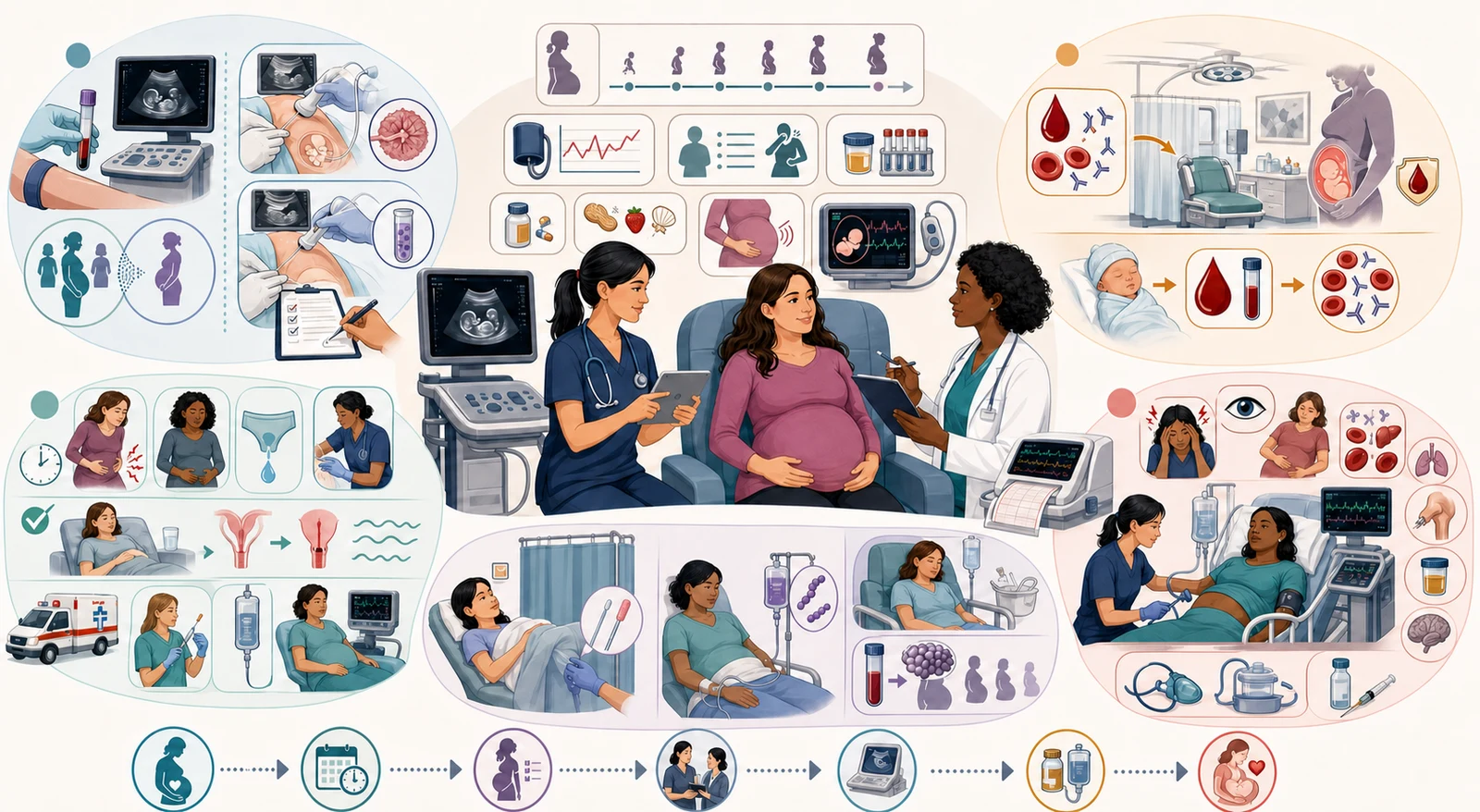
If you see respiratory distress, cyanosis, seizures, altered mental status, shock, or persistent heavy bleeding, emergency stabilization and calling the obstetric team come before any scheduled tests or patient teaching.
Confirm the exact gestational age. Assess the location and duration of pain, regularity of contractions, and the amount, color, and odor of any bleeding or fluid leakage.
Connect severe headache, visual changes, right upper quadrant or epigastric pain, dyspnea, and rapid changes in edema with the blood pressure reading.
Check for decreased fetal movement compared to baseline, the fetal heart rate pattern, and current results from ultrasound, NST, etc.
Distinguish between screening and diagnostic tests. After confirming the treatment goal and watching for side effects, reassess maternal vital signs, symptoms, lab results, and fetal heart rate.
| Common changes that can be normal | Warning signs that need immediate evaluation |
|---|---|
| Mild nausea, fatigue, breast tenderness | Repeated vomiting where she can't keep fluids down, weight loss, syncope, dehydration, or altered mental status |
| Thin, white discharge with no odor or itching | Persistent watery leakage, bright red bleeding, foul odor, fever, or pelvic pain |
| Brief round ligament pain with position changes | Persistent, one-sided severe abdominal pain, shoulder pain, syncope, or uterine tenderness |
| Irregular contractions that ease with rest | Contractions that become regular and stronger, pelvic pressure or backache, changes in vaginal discharge, and cervical changes |
| Gradual ankle swelling | Swelling that suddenly gets worse along with severe headache, visual changes, right upper quadrant pain, or dyspnea |
Pitfall: Just because something is "common in pregnancy" doesn't mean you can ignore severe intensity, a new pattern, how long it lasts, or accompanying findings like bleeding, fever, or high blood pressure.
| Category | Common Examples | How to Interpret Results | Nursing Connection |
|---|---|---|---|
| Screening Test | Maternal serum screening, nuchal translucency (NT) ultrasound, cfDNA | It estimates whether the risk for a certain condition is high or low; it is not a diagnosis. | Explain the possibility of false positives and false negatives, and counsel the patient to choose one screening approach. |
| Structural Assessment | Second-trimester detailed anatomy ultrasound | It can identify structural abnormalities but cannot rule out all genetic conditions. | A structural ultrasound is usually offered to all pregnant women around 18–22 weeks. |
| Diagnostic Test | Chorionic villus sampling (CVS), Amniocentesis | It confirms a specific diagnosis by directly analyzing fetal or placental genetic material. | Explain the invasive risks, timing, and the choices the results might change, along with genetic counseling. |
A positive cfDNA result is not a diagnosis.
A positive or non-reportable result should be linked to genetic counseling, a detailed ultrasound, and an offer of diagnostic tests like CVS or amniocentesis. Regardless of age or risk level, every patient has the right to have screening and diagnostic options explained and to choose to proceed or decline.
First, clarify what the test screens for, what it might miss, and whether the patient would want a diagnostic test after a positive result.
The specific gestational age window and the quality of the ultrasound measurement are crucial. Check the schedules and combinations specific to the lab or institution.
This is the most sensitive screening method for common chromosomal abnormalities, but it uses placental DNA and is not a diagnostic test.
Unplanned, simultaneous use of different serum screenings and cfDNA can create conflicting results and unnecessary anxiety.
Regardless of the screening choice, link to a second-trimester structural ultrasound.
| Item | CVS | Amniocentesis |
|---|---|---|
| Sample | Placental chorionic villi tissue | Amniotic fluid and fetal cells |
| Typical Timing | A specific window in the first trimester | Genetic diagnosis is usually from the second trimester onwards |
| Verification | Confirm informed consent, ultrasound-guided positioning, vital signs, fetal heart rate, blood type/Rh/antibody status, and institution-specific preparations. | |
| Post-Procedure | Reassess fetal heart rate and maternal status. Educate the patient to immediately report severe pain or contractions, bleeding, fluid leakage, or fever and chills. | |
| Rh Negative | For an Rh-negative pregnant woman who is not yet sensitized, confirm the indication for Rh immunoglobulin after the invasive procedure. | |
Do not apply the same rules for bladder status, fasting, and coagulation tests to all invasive prenatal tests.
Preparation varies depending on the access route, gestational age, patient history, and institutional protocol. Check the current orders and the procedural team's instructions rather than relying on the test name alone.
Check if she is Rh negative and whether anti-D antibodies have already formed.
Generally, confirm the indication for prophylaxis around 28 weeks of pregnancy and after any event with potential fetal blood exposure.
For events like pregnancy loss or ectopic pregnancy, CVS or amniocentesis, abdominal trauma, late pregnancy bleeding, or external cephalic version, check whether administration is needed based on gestational age and the latest guidelines.
If the newborn is Rh positive, Rh immunoglobulin is usually given to the mother within 72 hours.
Rh immunoglobulin is not effective, so antibody titers and the risk of fetal anemia are followed up by a specialist.
Education: Count fetal movements quietly and with focus, using the method and time frame your healthcare provider recommends. Since there are various kick count methods, do not apply a single time or number as an absolute rule for every pregnant woman.
Contact Immediately: If movements are significantly less than usual or not felt at all, contact the obstetrics team right away. Do not wait another day or try eating something sweet to see if that helps.
Assessment: Depending on the gestational age and situation, an NST, BPP, ultrasound, and Doppler studies may follow.
Documentation: Record the last time normal fetal movement was felt, current movement, and any bleeding, fluid leakage, or pain.
| Test | What it looks at | How to interpret the borderline |
|---|---|---|
| NST | Fetal heart rate acceleration in response to fetal movement | A reactive result is a reassuring finding right now. A non-reactive result can also be due to sleep, medications, or prematurity, so it doesn’t immediately confirm hypoxia or mean delivery is certain. |
| BPP | NST plus ultrasound for breathing movements, body movements, tone, and amniotic fluid | We decide on repeat testing, further evaluation, or delivery based on the total score, amniotic fluid volume, gestational age, and the overall clinical picture. |
| Modified BPP | NST and amniotic fluid assessment | If it’s non-reactive or the amniotic fluid is abnormal, further evaluation is needed. |
| CST | Fetal heart rate response to contractions, reflecting placental function | It’s used selectively because of contraindications and risks, and a “positive” result name does not mean “good.” |
Usually done at 24–28 weeks, but if there are diabetes risk factors or a history of gestational diabetes, we can evaluate earlier in the first trimester.
If the screening value is elevated, we don’t call it a confirmed diagnosis right away; instead, we proceed with a diagnostic test according to the facility’s protocol.
We teach the meal plan, activity, self-monitoring of blood glucose, and a medication plan if needed. We don’t eliminate carbohydrates completely.
We track hyperglycemia, ketones, growth, amniotic fluid, fetal well-being, and hypoglycemia risk according to the current plan.
We document the history of gestational diabetes and connect the patient to postpartum diabetes screening and long-term follow-up.
| Distinction | Braxton Hicks | Suspected preterm labor |
|---|---|---|
| Contractions | Irregular, intensity doesn’t progress, and they may ease with rest, hydration, or position change | Before 37 weeks, regular, becoming progressively stronger or occurring at shorter intervals |
| Associated symptoms | Usually no severe pelvic pressure, bleeding, or fluid leakage | Menstrual-like cramping, backache, pelvic pressure, change in discharge, suspected bleeding or amniotic fluid |
| Cervix | No progressive dilation or effacement | Progressive cervical dilation and effacement are key to the diagnosis |
| Action | If there are no warning signs, observe after rest and hydration, and provide education | Immediate obstetric evaluation; check fetal heart rate, contractions, cervix, membranes, and infection status |
Check whether it was a sudden gush or a continuous trickle, when it started, the color, odor, and amount, and any recent sexual activity or exams.
Quickly check the fetal heart rate because of the risk of cord prolapse or compression.
Use a sterile speculum exam and facility-approved testing; avoid unnecessary digital cervical exams because they can increase the risk of infection.
Assess temperature, uterine tenderness, foul odor, maternal and fetal tachycardia, contractions, and cervical status.
The specialized team decides on antibiotics, steroids, delivery, or expectant management based on whether the pregnancy is term, the presence of infection, fetal status, and the risk of delivery.
| Treatment | Purpose | Decision Boundaries |
|---|---|---|
| Antenatal Corticosteroids | Fetal lung, brain, and digestive organ maturation and reduction of preterm birth complications | Usually considered when there is a risk of delivery within 7 days at 24–34 weeks, with some making individual judgments up to 22 weeks or 36 weeks 6 days. A fixed number of courses is not arbitrarily repeated. |
| Magnesium Sulfate | Fetal neuroprotection immediately before early preterm birth | Generally used according to institutional protocols when less than 32 weeks and at risk of delivery within 24 hours. It is not a medication for prolonged pregnancy maintenance. |
| Tocolytics | Short-term delay for steroid administration, neuroprotection, or transfer time | May not be appropriate in situations where delivery is safer, such as symptoms without cervical change, infection, severe bleeding, or fetal or maternal risk. |
| Antibiotics | Purpose by indication, such as PPROM latency, infection management, or GBS prophylaxis | Not administered unconditionally for preterm labor itself; check membrane, infection, GBS status, and prescriptions. |
After 20 weeks, connect new-onset hypertension with proteinuria or signs of organ damage.
Even without proteinuria, if you see thrombocytopenia, abnormal kidney or liver function, pulmonary edema, or persistent severe headache with visual changes, it can still be preeclampsia. On the flip side, we don't diagnose it based on edema alone.
| Assessment | Clues suggesting severe features | Nursing actions |
|---|---|---|
| Blood pressure | Systolic ≥160 or diastolic ≥110 | Recheck with the right cuff and positioning, but don't delay treatment — report immediately and prepare the prescribed acute antihypertensive therapy. |
| Neurologic | Persistent severe headache, visual changes, hyperreflexia/clonus | Provide a quiet environment, implement seizure precautions, and verify neuro status along with the magnesium plan. |
| Liver & hematologic | Right upper quadrant or epigastric pain, elevated liver enzymes, thrombocytopenia/hemolysis | Track CBC, platelets, liver function, hemolysis markers, and any signs of bleeding. |
| Renal & pulmonary | Worsening renal function, decreased urine output, pulmonary edema/impaired oxygenation | Monitor intake and output plus respiratory status closely, and avoid excessive fluids. |
| Fetal & placental | Growth restriction, abnormal fetal testing, suspected placental abruption | Assess fetal heart rate, growth, amniotic fluid, along with any bleeding or abdominal pain. |
Purpose of administration: It prevents seizures in severe preeclampsia and treats eclamptic seizures. Blood pressure control is handled by a separate prescribed antihypertensive agent.
Essential monitoring: Check respiratory rate and oxygenation, deep tendon reflexes, level of consciousness, urine output and kidney function, vital signs, and fetal heart rate according to your facility's protocol.
When toxicity is suspected: If you notice loss of reflexes, respiratory depression, significantly decreased consciousness, or reduced urine output, stop the infusion, report immediately, and support the airway and breathing.
Rescue medication: Have injectable calcium ready for immediate use, but administer it only according to the prescription and protocol.
Lab value pitfall: Don't apply a single target or cutoff serum magnesium level to every patient. Instead, consider the clinical status, kidney function, institutional criteria, and the actual timing of the blood draw.
Don't rule out HELLP just because there's no proteinuria or the blood pressure isn't extremely high.
In late pregnancy or postpartum, consider right upper quadrant pain, nausea, severe malaise together with platelet, liver enzyme, and hemolysis findings.
We usually screen with a vaginal-rectal swab between 36 weeks 0 days and 37 weeks 6 days. This is not a blood test.
Don't label it as a disease or STI. Once labor starts or membranes rupture, we give IV antibiotics to lower the risk of early-onset newborn infection.
If there's GBS bacteriuria in this pregnancy or a history of a previous newborn with GBS infection, that confirms the indication for intrapartum prophylactic antibiotics.
Check the type and severity of the penicillin reaction and the organism's susceptibility. For low-risk allergy, you can consider cefazolin; for high-risk, consider clindamycin if susceptibility is confirmed, or vancomycin per protocol.
If it's a planned cesarean section before labor with intact membranes, GBS prophylactic antibiotics are not needed. Intrapartum prophylaxis does not prevent late-onset GBS.
| What to check | Clinical meaning |
|---|---|
| Chorion & amnion | The degree to which the placenta and amniotic sac are shared changes the risk level and follow-up interval. This is confirmed by early pregnancy ultrasound. |
| Preterm birth | This is the most common complication. Teach about contractions, cervical changes, amniotic fluid, and warning signs of preterm labor. |
| Growth discordance | One fetus being small doesn't automatically mean TTTS. Look at the growth curve, amniotic fluid, Doppler studies, and placental sharing. |
| TTTS | A blood flow imbalance can develop in monochorionic twins, so specialized ultrasound follow-up is needed. |
| Maternal risks | Preeclampsia, gestational diabetes, anemia, and nutritional demands can all increase, so more frequent follow-up is needed. |
Connect the dots: a uterus larger than dates, severe nausea and vomiting, vaginal bleeding, a very high hCG, and an abnormal ultrasound.
Generally, the abnormal tissue is removed by suction curettage; we don't wait for a normal term delivery.
Check for bleeding, vital signs, CBC, blood type and Rh, thyroid, respiratory, and hypertensive complications, as well as emotional status.
Measure serially until it normalizes, then follow up for a set period afterward. A plateau or rise calls for an evaluation for persistent disease.
A new pregnancy makes hCG interpretation difficult, so use effective contraception until follow-up is complete. The duration is determined by the disease and treatment program.
Situation: The cfDNA result is positive, so you think a fetal chromosomal abnormality is confirmed.
Judgment: Explain that it's a positive screening result and connect the patient to genetic counseling, a detailed ultrasound, and diagnostic test options like CVS or amniocentesis.
Situation: An Rh-negative pregnant person who is not sensitized has just had an amniocentesis.
Judgment: After the procedure, check the fetal heart rate, bleeding, and fluid leakage, and verify the indication for Rh immune globulin.
Situation: Fetal movement, which is usually active, is markedly reduced today.
Judgment: Don't tell them to wait until tomorrow. Check when the last normal movement was and any accompanying symptoms, and connect them immediately for an obstetric evaluation.
Situation: A pregnant person at 30 weeks has regular contractions, pelvic pressure, and increased vaginal discharge.
Judgment: Don't just dismiss it as Braxton Hicks; immediately assess the fetal heart rate, membranes, infection, and cervical changes.
Situation: During a magnesium infusion, the deep tendon reflexes disappear and respirations slow down.
Judgment: Stop the infusion, report immediately, support the airway and breathing, and prepare injectable calcium as a rescue treatment.
Situation: A pregnant person in the third trimester complains of right upper quadrant pain that feels like heartburn, along with nausea, and their platelets are low.
Judgment: Prioritize the possibility of HELLP syndrome and immediately assess blood pressure, hemolysis, liver enzymes, platelets, bleeding, and fetal status.
Situation: The patient is GBS positive but is having a scheduled cesarean section before labor begins and with intact membranes.
Judgment: Intrapartum GBS prophylaxis is not needed. However, routine surgical antibiotic prophylaxis follows a separate protocol.
Situation: A pregnant woman has started having a generalized seizure.
Clinical Judgment: Do not restrain her or put anything in her mouth. Prevent injury, position her on her side, maintain airway and oxygenation, note the time, and link magnesium administration and fetal assessment once the mother is stabilized.
This material is an educational summary newly constructed based on recurring study topics. It does not reproduce actual exam questions, answer choices, tables, or images, and it does not replace individual obstetric prescriptions, current test results, institutional protocols, or specialist judgment.
다음 이론을 계속 학습하려면 로그인하세요.
로그인하고 계속 학습필기노트, 하이라이터, 메모는 잘 쓰고 있어?
내보내줘운영진이 검토할게요!
마이페이지에서 차단한 회원을 관리할 수 있어요.