컨텐츠 내용을 수정할 수 있습니다
We'll connect the dots between cultures, allergy reaction types, renal function and electrolytes, administration route and rate, and signs of toxicity. Then, we'll establish your ABCs and reassessment priorities when you're facing high-alert meds and their antidotes.
Core Objective: We'll walk through your clinical judgment in this order: urgency of infection → cultures & allergies → renal, hepatic, CBC, K+, Mg++, QT → route, dilution, infusion pump → response & toxicity → stopping, antidote, reassessment.
Let's move past simple memorization traps like "all antibiotics in the same class have the same nursing care," or "give the antidote first because it's available," or "a high-alert drug is safe as long as one number matches." In a real patient scenario, the final word always comes from the product label, the specific prescription, current lab trends, and your institution's protocol.
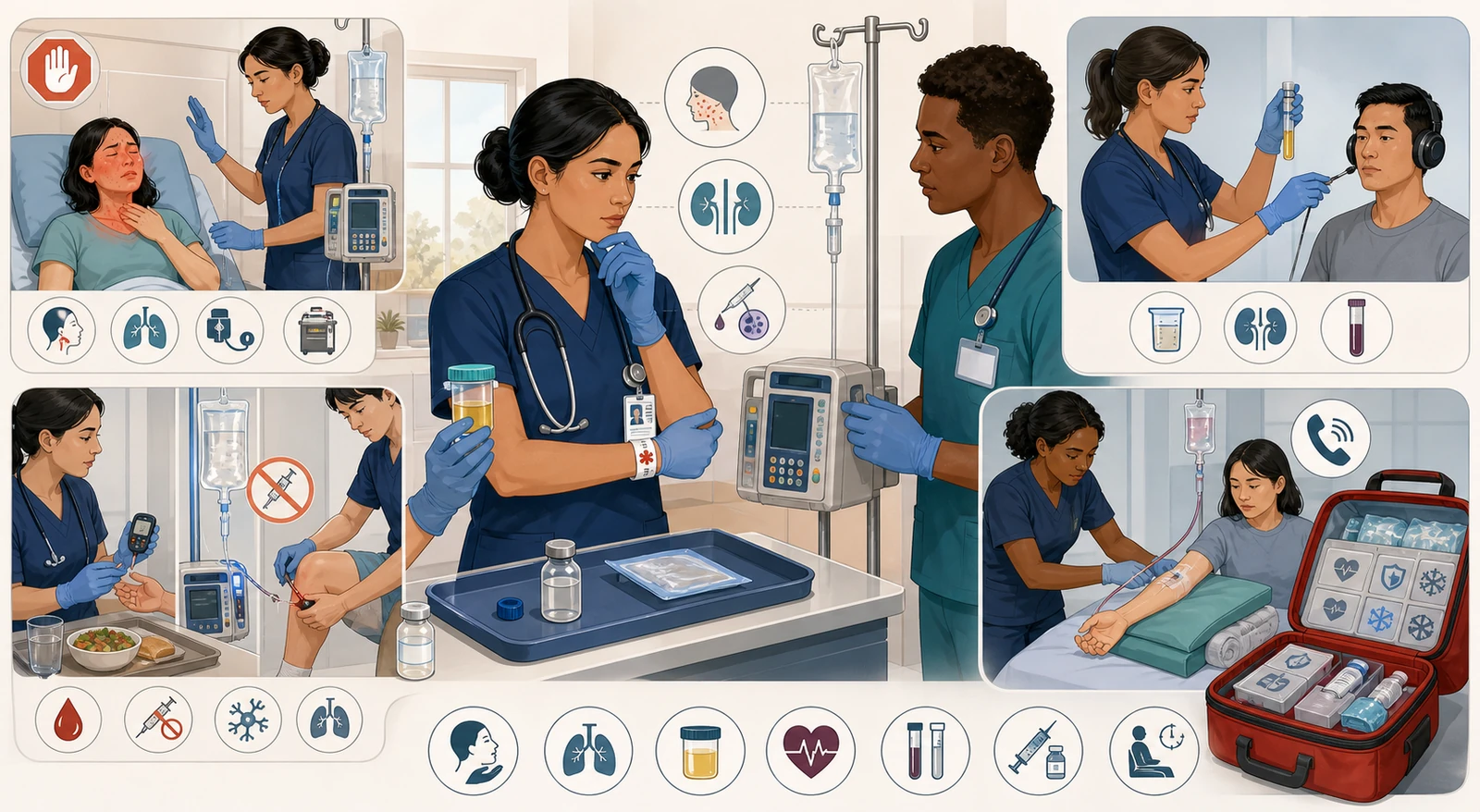
First, look at whether a delay is dangerous, like in sepsis or shock, or if it's a localized infection. Also, consider if the source needs to be removed or drained first.
If blood, urine, sputum, or wound cultures are ordered, check if you can get them before the first dose of antibiotics. But don't let a difficult collection dangerously delay emergency treatment.
Don't just stop at "has allergies." Dig deeper: what's the specific drug name? When did the reaction happen? Was there a rash, trouble breathing, hypotension, or mucosal involvement? What happened if they were re-exposed?
Connect the dots between renal and liver function, CBC, potassium and magnesium levels, QT interval risks, and drug-specific baselines like hearing and vision.
Check if the PO and IV forms share the same indication. Confirm that the concentration, infusion time, line, pump, and compatibility all match the product information and your institution's guidelines.
Track more than just temperature, hemodynamics, and culture results. Watch for diarrhea, rash, changes in renal function or hearing, and the IV site. Then, constantly re-evaluate the chance to de-escalate, stop, or switch therapy.
Assess airway, breathing, circulation, blood pressure, perfusion, level of consciousness, lactate, and your institution's sepsis triggers to decide if immediate escalation is needed.
Verify the collection site, number of sets, aseptic technique, labels, and timing. Get them before the first dose if possible. Follow your institution's policy on the difference between line draws and peripheral sticks.
Make sure the prescription fits the suspected source, severity, recent antibiotic use, resistance risk, allergies, and organ function. Then, give it without a dangerous delay.
Once cultures, sensitivities, clinical response, and the diagnosis are clearer, work with the team to re-evaluate the plan: narrow the spectrum, switch from IV to PO, or stop the antibiotic and define the total treatment duration.
Don't automatically link a culture and antibiotics just because the urine looks cloudy or smells.
Look at the whole picture: symptoms, vital signs, specimen quality, presence of a catheter, and other possible sources of infection. On the flip side, don't delay the first dose indefinitely in an unstable patient with suspected sepsis just because getting a sample is difficult.
| Past Reaction | What It Means | How Your Nursing Care Connects |
|---|---|---|
| Nausea, diarrhea | This could be an intolerance or expected side effect, not the same as an immune-mediated hypersensitivity reaction. | Document the drug, dose, timing, and any other symptoms. Re-evaluate the risk with the prescriber and pharmacist. |
| Delayed, simple rash | You need to clarify the timing, how widespread it was, any re-exposure history, and other possible causes. | Apply your institution's allergy pathway, looking closely at the exact beta-lactam structure of the new prescription. |
| Hives, angioedema, wheezing, hypotension | This strongly suggests an immediate, severe hypersensitivity reaction. | Clearly report this before giving the drug and help connect the dots for alternative agents, testing, or desensitization. If it happens, your priority is stopping the infusion and starting your anaphylaxis response. |
| Blisters, mucosal lesions, skin peeling, organ damage | This raises the red flag for serious delayed reactions like SJS/TEN or DRESS. | Never try a routine re-challenge. Immediately escalate for a specialist evaluation and strengthen the allergy documentation. |
| Only a family history, or unknown reaction | This is not the same as a confirmed allergy in the patient themselves. | Don't just copy the old record forward. Reconstruct the reaction history by talking to the patient, their family, and digging through past records. |
Exam point: Don’t just memorize beta-lactam cross-reactivity as “avoid the whole class.” Evaluate the severity and timing of the past reaction, the structure of the new drug, and available alternatives together with the prescriber, pharmacist, and your institution’s guidelines.
| Clue | What It Means | Priority Action |
|---|---|---|
| Flushing of the face, neck, or upper body, pruritus, or general discomfort during infusion | Likely an infusion reaction related to the rate or concentration | Stop the infusion immediately, assess airway, breathing, circulation, and vital signs, and notify the prescriber. Whether to restart, use a slower rate, or give premedication after the patient stabilizes should follow the prescriber's orders and facility protocol. |
| Wheezing, angioedema, hypotension, or airway compromise | Possible anaphylaxis | Do not assume you can just "slow down the rate." Activate the emergency response and epinephrine pathway right away. |
| Rising creatinine or decreased urine output | Possible drug accumulation, nephrotoxicity, or an underlying condition | Check when the next dose is due and when the trough level should be drawn, then promptly report whether the dose should be held or adjusted. Also review for other nephrotoxic agents the patient is receiving. |
| Tinnitus, hearing loss, or vertigo | Warning sign of possible ototoxicity | Report any new symptoms immediately and evaluate the patient's hearing, kidney function, serum drug levels, and concurrent medications. |
| PO order vs. IV order | The infection site and indication differ depending on the route | Do not substitute oral vancomycin for IV vancomycin when treating a systemic infection, and do not automatically switch the IV form to treat C. difficile. |
Don’t rely on the rule that “you just need one fixed trough for vancomycin.”
Current product labeling requires adequate infusion time and monitoring of serum levels and kidney function, but the specific target concentrations and whether to use AUC or trough vary depending on the indication, the product, and your institution’s protocol. Also, always verify whether the blood draw is a peak or a trough level together with the actual administration time.
Before administration: Check the creatinine/CrCl/eGFR trends, urine output, weight and fluid status, hearing and vestibular symptoms, and look for any neuromuscular disease or other nephrotoxic/ototoxic drugs.
During administration: Compare the prescribed regimen with the actual administration and blood draw times. Don't mix up the interpretation methods for extended-interval dosing and conventional dosing.
Report immediately: Any new tinnitus, hearing changes, vertigo, ataxia, decreased urine output or rising creatinine, and severe muscle weakness or respiratory depression.
Patient education: Toxicity can progress even without symptoms, so never skip the lab tests and drug level monitoring.
Don't apply one peak/trough number and draw time to every aminoglycoside.
The drug, infection, route, renal function, and institutional nomogram all differ. Before saying “the level is normal,” first verify the sample was drawn at the correct time.
| Drug class | Key risks | Nursing care & teaching |
|---|---|---|
| Macrolides | QT prolongation & arrhythmias, hepatotoxicity, drug interactions, GI symptoms | Check baseline QT, K⁺, Mg²⁺, bradycardia, other QT-prolonging drugs, and liver function. |
| Fluoroquinolones | Tendinitis & tendon rupture, peripheral neuropathy, CNS effects, QT, blood glucose changes, worsening myasthenia gravis | Stop the drug and report immediately for new tendon pain/swelling, numbness/burning, confusion/hallucinations, palpitations, or severe muscle weakness. |
| Oral absorption | Al/Mg antacids, iron, zinc, and calcium products reduce absorption of some fluoroquinolones | Follow product-specific separation intervals per the label and pharmacist instructions, and review all minerals and supplements. |
| Myasthenia gravis | Fluoroquinolones can worsen muscle weakness | Verify the history before administration; new swallowing, breathing, or limb weakness requires emergency evaluation. |
| Drug | Key Connection | Clues to Hold and Report |
|---|---|---|
| Rifamycin | Orange-red discoloration of body fluids, strong drug interactions, hepatotoxicity | Jaundice, dark urine, persistent nausea, changes in the effect of concurrent drugs. For hormonal contraceptives, connect the patient to counseling on alternative birth control methods based on the specific product. |
| Isoniazid | Hepatitis, peripheral neuropathy | Loss of appetite, persistent nausea, right upper quadrant pain, jaundice, new numbness or tingling. Check if pyridoxine is prescribed for at-risk groups. |
| Pyrazinamide | Hepatotoxicity, hyperuricemia and gout | Jaundice, severe joint pain, and changes in liver function |
| Ethambutol | Optic neuritis, changes in color vision and visual acuity | Report new blurred vision or changes in color discrimination immediately, and connect to baseline and follow-up visual acuity tests. |
Check the frequency, volume, watery vs. bloody stool, abdominal pain, fever, dehydration, and any recent or past antibiotic use and healthcare facility exposure.
If C. difficile is suspected, immediately apply the facility's contact precautions, specimen collection criteria, hand hygiene, and environmental disinfection guidelines.
Before the cause is evaluated, don't mask symptoms with OTC antidiarrheals or take leftover antibiotics.
Urticaria, dyspnea, and hypotension are clues to an immediate-type reaction; blisters, mucosal lesions, skin pain, and fever are clues to a serious delayed reaction.
Connect fever, sore throat, bruising, bleeding, jaundice, and facial edema with changes in CBC, liver, and kidney function.
Confirm the test time, any CGM/POC discrepancy, symptoms, recent hypoglycemia or hyperglycemia, and the timing for the next recheck.
Check the meal tray's arrival and the likelihood of intake, any interruption of tube feeding or TPN, and any procedures or vomiting to link prandial insulin with the risk of hypoglycemia.
Accurately cross-check the prescription for rapid-, short-, intermediate-, or long-acting insulin, U-100 or concentrated formulations, pen, vial, or pump delivery, and the SC or IV route.
Apply your facility's designated independent check, use the correct syringe or device and rotate injection sites, and never share pens.
If the patient is conscious and can swallow, use the fast-acting carbohydrate specified in your facility's protocol; if not, use the IV dextrose or glucagon route. Then recheck glucose at the designated time and correct the underlying cause.
Don't generalize by saying “IV insulin is always just regular insulin.”
Check the exact product label and your facility's protocol to see if it can be given intravenously. On the flip side, insulin glargine is for subcutaneous use only — never give it IV, through a pump, or mix or dilute it with other insulins or solutions.
| High-Alert Drug | Before Administration | What You Absolutely Can't Miss | Managing Toxicity |
|---|---|---|---|
| Potassium chloride concentrate | Current K and Mg levels, ECG, kidney function and urine output, line, concentration, pump, and whether it's properly mixed | Never give the concentrate as a direct injection or IV push. Always dilute and mix it properly, and follow the concentration and rate specific to the product and your facility. | Stop the infusion, recheck the ECG and K level, and call the prescriber and emergency team. There isn't one single “antidote” — treatment is tailored to the ECG changes and severity of hyperkalemia. |
| Magnesium sulfate | Respirations, level of consciousness, DTRs, kidney function and urine output, Mg and other electrolytes, and the infusion pump | Don't mistake respiratory depression, loss of DTRs, severe muscle weakness, hypotension, or conduction disturbances for simple sedation. | Stop the infusion, support the airway and breathing, and report immediately. Have an injectable calcium salt ready and give it according to the prescriber's orders and protocol. |
Don't memorize one “always-the-same maximum rate” for KCl and MgSO4 and apply it to every line and patient.
Peripheral versus central lines, concentration, continuous versus intermittent infusion, kidney function, and the clinical situation all differ. Cross-check the prescription, pharmacy preparation, smart pump library, and facility protocol — and if anything doesn't match, stop before you start.
If you notice pain, burning, swelling, erythema, increased resistance, or loss of blood return, stop infusing the drug.
Don't flush the line. Leave the catheter in place so you can aspirate any remaining drug or administer an antidote through it.
Confirm the drug name, concentration, estimated amount, site, and time, and notify oncology, pharmacy, and the prescriber right away.
Warm versus cold compresses and the specific antidote can be the complete opposite depending on the agent, so don't just guess. Elevate and provide local care as prescribed.
Take a photo, mark the borders, measure the size, document the symptoms and interventions, and monitor the skin and neurovascular status over the long term.
Neutropenic fever: If a patient on chemotherapy develops a fever, chills, or hypotension, don't just give an antipyretic and wait it out. Check the most recent CBC and ANC, look for a source of infection, and escalate immediately using your facility's febrile neutropenia pathway.
| Exposure or Condition | Key Antidote or Reversal | Critical Points Before and After the Antidote |
|---|---|---|
| Opioid + respiratory depression | Naloxone | Manage the airway and ventilation and call for emergency help at the same time. The opioid can last longer than the naloxone, so watch for a return of slow breathing and repeat doses as needed based on the product and protocol. |
| Benzodiazepine | Flumazenil — in select situations only | This isn't a routine, universal antidote. In cases of long-term dependence, seizure disorder, or clues pointing to a mixed overdose or TCA, the risk of seizure can be high, so a toxicologist's or prescriber's judgment is essential. |
| Acetaminophen toxicity | N-acetylcysteine | Check the time of ingestion, serum level, AST/ALT, INR, kidney function, and electrolytes. If the time is unclear or lab results are delayed, waiting itself can be dangerous — follow poison center guidance and your protocol. |
| Unfractionated heparin bleeding | Protamine sulfate | Confirm the last heparin dose, time, and coagulation studies. Giving protamine too fast can cause severe hypotension and anaphylactoid reactions, and giving too much can actually cause bleeding. |
| Warfarin + major bleeding or urgent procedure | Vitamin K + 4-factor PCC | Check the current INR, bleeding site, severity, and last dose taken. 4F-PCC carries a risk of thrombosis, and adding vitamin K to maintain the effect should follow the prescription and protocol. |
| Life-threatening digoxin toxicity | Digoxin immune Fab | Assess the ECG, K level, kidney function, dose and time of ingestion, and whether the exposure is chronic or acute. After giving it, don't interpret the total digoxin level the usual way, and track K changes, arrhythmias, and heart failure status. |
| Magnesium toxicity | IV calcium salt | Stop the Mg infusion and prioritize the airway, breathing, circulation, and kidney function. Calcium is a supportive measure and doesn't replace decisions about enhanced elimination or dialysis. |
| Severe hypoglycemia | Oral glucose / IV dextrose / glucagon | Choose the route based on the patient's level of consciousness and ability to swallow. Even after recovery, recheck the glucose, provide ongoing carbohydrates, and address the underlying cause. |
Immediately stabilize the airway, ventilation, circulation, any seizures, body temperature, and bedside glucose.
Confirm the exact substance, concentration, dose, route, time of last exposure, and whether it's an extended-release form, a patch, or a mixed exposure.
Perform an ECG, check glucose, electrolytes, renal/hepatic function, acid-base balance, and any drug-specific tests.
Stop the causative drug or infusion, and follow poison center or toxicology specialist guidance on whether decontamination or absorption blockade is indicated.
Check the indications, contraindications, timing of administration, dose, and preparation method, and give it concurrently with supportive care.
The original drug may last longer than the antidote, or redistribution, re-bleeding, or rebound hypoglycemia can occur, so set criteria for repeated assessments and re-dosing.
Giving an antidote is not "case closed."
You need to anticipate the risks that follow reversal, like respiratory depression recurring after naloxone, bleeding and hypotension after protamine, thrombosis after PCC, a rapid potassium shift after digoxin immune Fab, or rebound hypoglycemia after dextrose.
Stop the infusion immediately and assess the airway, breathing, circulation, and vital signs. If there's wheezing, angioedema, or hypotension, respond as a case of anaphylaxis. Once the patient is stable, follow the prescriber's orders regarding whether to restart and at what rate.
Do not give the next dose as a routine matter; report it immediately. Check the actual administration and blood draw times, drug levels, creatinine, urine output, and look for other nephrotoxins or ototoxins.
Don't dismiss this as just pain from exercise. Stop the medication, have the patient avoid weight-bearing and exercise, and report it to the prescriber right away.
Don't give an antidiarrheal as a first step. Report the possibility of C. difficile, implement the ordered specimen collection, contact precautions, and fluid status assessment, and re-evaluate the need for the antibiotic.
Don't give it mechanically. Recheck the current glucose level and the patient's ability to eat, and report whether to hold or adjust the dose according to the prescription and your institution's protocol.
Do not give it as a direct IV push. Verify the prescription, dilution, concentration, line, pump, kidney function, and urine output against institutional guidelines to connect the pharmacy-prepared product for safe infusion.
Stop the infusion, support the airway and breathing, and call for help immediately. Prepare injectable calcium and emergency equipment, and evaluate the magnesium level, kidney function, and urine output.
Stop the infusion immediately, but do not flush the line or remove it right away. Preserve the ability to aspirate, and immediately check and report the drug-specific antidote and compress protocol.
All antibiotics reduce the effectiveness of oral contraceptives to the same degree.
Safe Clinical JudgmentCheck the guidelines for strong enzyme-inducing drugs like rifamycins and each specific contraceptive product, and counsel the patient on alternative contraception.
A culture must always be drawn before antibiotics, so you wait even if the patient is unstable.
Safe Clinical JudgmentDraw cultures first if possible, but don't dangerously delay sepsis treatment—escalate immediately.
Vancomycin flushing is not an allergy, so you can continue the infusion.
Safe Clinical JudgmentStop the infusion first and assess the ABCs to differentiate between an infusion reaction and anaphylaxis.
For aminoglycosides, you only need to look at a single target trough number.
Safe Clinical JudgmentInterpret the result together with the regimen, blood draw timing, kidney function, hearing, and clinical response.
Insulin glargine is clear, so it can be mixed with other clear insulins.
Safe Clinical JudgmentDo not mix or dilute glargine with other insulins or solutions; give it subcutaneously.
If extravasation occurs, remove the line and start with a cold compress.
Safe Clinical JudgmentAfter stopping the infusion, keep the catheter in place, and check the guidelines for aspiration, an agent-specific antidote, and whether to use a warm or cold compress.
If an antidote is available, give it before addressing the ABCs.
Safe Clinical JudgmentImmediately manage the airway, ventilation, and circulation and stop the causative drug, while concurrently administering the indicated antidote.
The patient woke up after naloxone, so the observation period is over.
Safe Clinical JudgmentContinuously monitor for recurrent respiratory depression and link the patient to emergency medical care, repeat dosing, and supportive therapy.
① Among infection and toxicity issues, what is threatening ABC and hemodynamics right now?
② Did you confirm the necessary cultures and the exact type of allergic reaction before the first dose?
③ Did you check the baseline renal, liver, CBC, K, Mg, QT, hearing, and vision values needed for this drug?
④ Does the PO/IV route, concentration, dilution, mixing, line, pump, and infusion rate match the product, prescription, and protocol?
⑤ Is there any new diarrhea, rash, infusion reaction, renal, hearing, neurological change, or extravasation?
⑥ Have you identified the risk of worsening after stopping or giving the antidote, and set the next reassessment point?
Evidence scope: This summary was independently written based on the NCSBN 2026 NCLEX-RN Test Plan, CDC Hospital Antibiotic Stewardship Core Elements, and NIH DailyMed labels for IV vancomycin, gentamicin, ciprofloxacin, TMP-SMX, metronidazole, doxycycline, isoniazid, potassium chloride concentrate, magnesium sulfate, insulin glargine, acetylcysteine, protamine, 4-factor PCC, digoxin immune Fab, flumazenil, and naloxone.
Only recurring study topics were verified in the local feedback PDF. Actual exam questions, answer choices, correct answer wording, tables, images, or layouts were not reproduced.
Learning boundary: Actual antibiotic selection, culture timing, dose adjustments, target blood levels, infusion rates, hold parameters, and antidote selection and dosing vary depending on the patient's condition, the exact product, the time of last dose or exposure, renal and liver function, concurrent medications, and institutional protocols. This material does not replace patient-specific prescribing, pharmacist, infectious disease, or toxicology expert judgment.
다음 이론을 계속 학습하려면 로그인하세요.
로그인하고 계속 학습필기노트, 하이라이터, 메모는 잘 쓰고 있어?
내보내줘운영진이 검토할게요!
마이페이지에서 차단한 회원을 관리할 수 있어요.