컨텐츠 내용을 수정할 수 있습니다
Learn to interpret a single CBC line by breaking it down into oxygen delivery, infection, and bleeding risks. For sickle cell emergencies and transfusion reactions, your priority is always the patient safety action—before naming the exact cause.
Core Objective: Make clinical judgments in this order: ABCs & bleeding → Hb, ANC, platelet trends → infection & bleeding prevention → sickle cell acute chest emergency → pre-transfusion verification → immediate reaction stop → distinguishing TRALI vs. TACO → reassessment.
Don't jump to a treatment based on a single clue—like "fever means antipyretics," "shortness of breath means diuretics," or "low Hb means automatic transfusion." Instead, cluster the vital signs, respiratory status, bleeding, fluid balance, and time of onset to rule out the most dangerous hypothesis first.
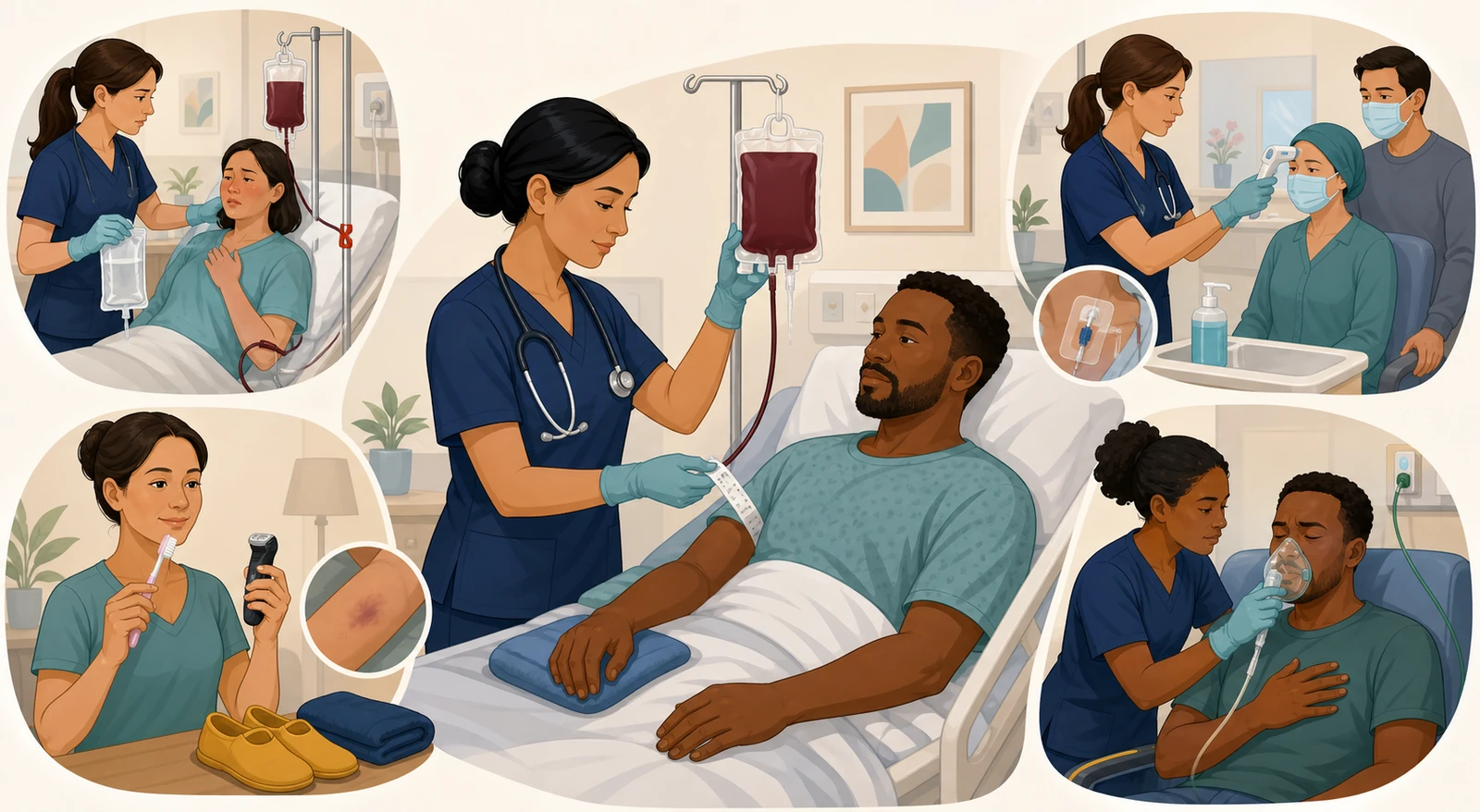
First, check for respiratory distress, chest pain, hypoxemia, hypotension, tachycardia, altered mental status, and active bleeding.
See if the drop in oxygen-carrying capacity is actually causing chest pain, dyspnea, syncope, or shock.
Instead of just the total WBC, connect the absolute neutrophil count with clues like fever, chills, and localized infection.
Look for petechiae, mucosal bleeding, hematuria, melena, and any new headache or neurological changes.
Compare the timing of lab changes with potential causes: bleeding, hemolysis, bone marrow suppression, infection, medications, or transfusion.
Monitor trends in oxygenation, vital signs, bleeding, temperature, repeat CBCs, and coagulation/hemolysis labs.
| Axis | Key Risk When Decreased | Priority Assessment | A Pitfall to Avoid |
|---|---|---|---|
| RBC & Hb | Impaired tissue oxygen delivery | Dyspnea, chest pain, tachycardia, syncope, activity intolerance, bleeding | Don't decide on a transfusion based on the Hb value alone |
| WBC & ANC | Risk for bacterial & fungal infection | Temperature, chills, cough, oral mucosa, skin, lines, urination, diarrhea | A normal WBC count does not rule out infection |
| Platelets | Impaired primary hemostasis | Petechiae, ecchymosis, mucosa, urine, stool, neurological checks | Don't miss active or closed-space bleeding just by looking at the number |
| Coagulation Factors | Impaired stable clot formation | Joints, muscles, surgical sites, persistent oozing, PT, aPTT, fibrinogen | A normal platelet count doesn't rule out a bleeding disorder |
If you see chest pain, dyspnea, hypoxemia, syncope, hypotension, tachycardia, altered mental status, or active bleeding, stabilizing the ABCs and circulation comes first.
A rapid drop from bleeding or hemolysis can be more dangerous at the same Hb level. Consider the baseline Hb, recent changes, amount of blood loss, and any underlying cardiopulmonary disease together.
Connect the MCV, reticulocyte count, iron/ferritin, B12/folate, kidney function, and hemolysis markers with sources like stool, menses, or surgical bleeding.
After treating the cause—iron, vitamins, or transfusion—reassess vital signs, symptoms, Hb trends, and watch for any new transfusion reaction.
PRBCs are a blood component that bolsters oxygen-carrying capacity, not a treatment to make the numbers look pretty.
The need for transfusion isn't based on the Hb value alone. It reflects a combination of bleeding, symptoms, hemodynamics, cardiopulmonary disease, the risk of poor oxygen delivery, and the goals of treatment. You don't judge a stable chronic anemia and an acute hemorrhagic shock in the same way.
| What to Check | Nursing Action | Reason |
|---|---|---|
| Temperature & Vital Signs | Immediately report any fever based on the patient's individualized education plan and repeatedly assess for signs of sepsis. | Antipyretics can mask a fever, which may delay evaluation. |
| Portals of Entry for Infection | Gently check the oral cavity, skin, central venous catheter sites, lungs, urinary tract, perineal area, and any diarrhea. | Infection is possible even with minimal pus or redness. |
| Reducing Exposure | Perform hand hygiene, avoid sick visitors, and follow care guidelines for lines, oral care, skin care, and site-specific protective protocols. | This reduces exposure to pathogens from routine contact and hands. |
| Food Safety | Cook meat, fish, and eggs thoroughly, and follow proper food storage, washing, and cross-contamination prevention. | Proven safe handling practices are more critical than a blanket "sterile diet" order. |
| Minimizing Invasive Procedures | Avoid rectal temperatures, suppositories, enemas, and any unnecessary breaks in the skin or mucous membranes. | Even microscopic injuries can become a portal of entry for infection. |
Neutropenia does not automatically mean a private isolation room and a sterile diet are applied for every patient.
The basics are hand hygiene, avoiding sick people, line care, and food safety. Decisions about a protective environment, masks, visitor restrictions, and dietary restrictions depend on the ANC, type of treatment, transplant status, and institutional policy.
Check for petechiae, large bruises, and bleeding from the gums, nose, or an increase in menstrual flow.
Look for blood in the urine or stool, black/tarry stools, vomiting blood, abdominal pain, back pain, and changes in blood pressure and pulse.
Immediately report any new, severe headache, vision changes, confusion, drowsiness, or one-sided weakness.
Implement the use of a soft toothbrush, an electric razor, wearing shoes, and fall and collision prevention measures.
Avoid rectal temperatures, suppositories, enemas, and unnecessary IM injections and invasive procedures.
After drawing blood or giving an injection, apply direct pressure for a sufficiently long time and report any continued bleeding.
Medication Review: Check for over-the-counter drugs and supplements like aspirin or ibuprofen that can affect platelet function or bleeding risk. However, a nurse should not independently stop prescribed antiplatelet or anticoagulant medications; instead, immediately confirm with the prescriber while considering the lab values and any signs of bleeding.
| Classification | Key Point | Priority Action |
|---|---|---|
| Hemophilia A | Deficiency in factor VIII function | Recognize bleeding early and rapidly prepare the prescribed factor or non-factor therapy. |
| Hemophilia B | Deficiency in factor IX function | Check the bleeding site and severity along with the treatment plan, and contact the specialist team early. |
| Joint & Muscle Bleeding | Pain, warmth, swelling, limited movement | Protect the affected area and ensure early factor treatment is not delayed. |
| Head, Neck, or Abdominal Bleeding | Can be life-threatening even if it looks minor externally | Do not delay emergency assessment and factor administration while waiting only for test results. |
Exam Connection: In hemophilia, the platelet count is usually not the primary abnormality. In Hemophilia A/B, a defect in the intrinsic pathway can prolong the aPTT, while the PT may be normal. However, always evaluate other factors in a real patient, such as medications, liver disease, or the presence of inhibitors.
Review the patient's individualized pain plan, do not delay prescribed analgesics, and simultaneously check oxygen saturation, respiratory status, chest pain, fever, and neurological status.
Check for infection, dehydration, hypoxia, and cold exposure. Administer prescribed fluids while considering the patient's cardiopulmonary and renal status. Also, avoid excessive fluid administration.
If new chest pain, fever, cough, tachypnea, dyspnea, or a drop in oxygen saturation occurs, immediately request oxygenation and a specialist evaluation.
Oxygen is titrated to hypoxia. The use of incentive spirometry, antimicrobials, and transfusions depends on the clinical picture, prescriptions, and the hematology team's plan.
If pain suddenly changes to chest pain, fever, and difficulty breathing, do not dismiss it as the "same pain crisis."
Acute chest syndrome can worsen rapidly. Quickly connect any new oxygen requirement, respiratory rate, lung sounds, or change in consciousness with the prescribed imaging and lab tests. Do not routinely give oxygen to a patient without hypoxia, and do not give the same rate of IV fluids to every patient.
Safety checks before transfusion
Giving an antihistamine beforehand won't prevent a patient-blood mismatch or a hemolytic reaction.
Even if a premedication is ordered, it can never replace accurate patient and product verification plus close observation during the early minutes. A life-threatening reaction can happen after just a small amount has gone in.
If fever, chills, hives, shortness of breath, chest pain, back or flank pain, hypotension, anxiety, or a change in urine appears, stop infusing the product.
Assess the airway, breathing and oxygen saturation, circulation, level of consciousness, skin, lung sounds, and fluid status, and call for emergency help.
Keep the vein open with new tubing and 0.9% sodium chloride, following your institution's protocol. Don't flush the original blood tubing.
Notify the prescriber and the transfusion service or blood bank, and repeat the patient and product identification plus the clerical check.
Don't throw away the bag and tubing. Send them for investigation along with blood and urine specimens according to your institution's procedure.
Never restart the same unit without explicit approval from the transfusion service protocol.
| Suspected reaction | Key clues | How to distinguish | Initial connection |
|---|---|---|---|
| Acute hemolytic | Fever, chills, back or flank pain, chest pain, hypotension, dark urine, bleeding | Possible ABO or clerical mismatch; risk of hemolysis, kidney injury, DIC | Stop, ABCs, notify blood bank; clerical check, hemolysis workup, and monitor urine output |
| Febrile nonhemolytic | New fever, chills, rigors | Must rule out hemolysis and bacterial contamination first | Stop, assess, report; management follows protocol |
| Allergic | Localized hives, itching | Check that there's no shortness of breath, angioedema, or hypotension | Stop, airway assessment, report; whether to restart depends on protocol approval |
| Anaphylaxis | Stridor, wheeze, angioedema, hypotension | Rapid airway and circulation threat | Stop, emergency response; epinephrine and prescribed anaphylaxis protocol |
| Septic reaction | High fever, rigors, hypotension, nausea, rapid shock | Possible contaminated component, especially with severe systemic toxicity | Stop, sepsis response; patient and product cultures, prepare broad-spectrum antimicrobials |
| TRALI | Acute hypoxemia and bilateral pulmonary infiltrates during or within 6 hours of transfusion | No evidence of circulatory overload or left atrial hypertension | Stop, oxygen and ventilatory support, emergency report; don't automatically give diuretics |
| TACO | Dyspnea, orthopnea, crackles, hypertension, JVD, edema, positive fluid balance | Fluid overload and cardiovascular clues within 12 hours of transfusion | Stop, sit upright, oxygen; prescribed diuretics, fluid management, and a slower plan for future transfusions |
Both TRALI and TACO can make a patient short of breath with worsening lung sounds after transfusion, but the treatment direction is different.
Hypertension, JVD, edema, a positive fluid balance, and a response to diuretics point more toward TACO. In contrast, if acute hypoxemia and bilateral pulmonary infiltrates develop during or within 6 hours of transfusion without evidence of circulatory overload, suspect TRALI. Before you can tell them apart, the priority is still stopping the transfusion and stabilizing oxygenation and hemodynamics.
| Component | Main Function | Common Misconceptions to Avoid |
|---|---|---|
| PRBCs | Boost oxygen-carrying capacity | Not used for simple volume expansion or automatically for every low Hb |
| Platelets | Boost platelet count & primary hemostasis | This product does not correct clotting factor deficiencies |
| Plasma | Replenish multiple clotting factors | Not used for nutritional support or simple volume expansion |
| Cryoprecipitate | Replenish fibrinogen & certain clotting proteins | Not a one-size-fits-all product for every bleed or hemophilia case |
Scenario 1 · Post-Chemo Fever
A patient with a low ANC complains of chills and a new fever. Do not give an antipyretic first. Check vital signs, mental status, lines, lung sounds, and urinary clues, then report immediately so the febrile neutropenia/sepsis protocol is not delayed.
Scenario 2 · Thrombocytopenia & New Headache
A patient who had petechiae now shows a sudden, severe headache and drowsiness. This is not a simple request for pain relief—prioritize a neurological assessment and emergency reporting for possible intracranial bleeding.
Scenario 3 · Sickle Cell Pain Shifts to Chest Symptoms
A patient on pain management develops new fever, cough, chest pain, and dropping oxygen saturation. Don't view this as just an extension of the pain crisis—suspect acute chest syndrome and connect them to oxygenation support and emergency evaluation.
Scenario 4 · Back Pain & Dark Urine Right After Transfusion Start
Shortly after starting PRBCs, chills, back pain, hypotension, and dark urine appear. Since this is a likely acute hemolytic reaction, stop the transfusion immediately and initiate ABCs, 0.9% saline IV line, blood bank reporting, and a clerical check.
Scenario 5 · Transfusion Patient with Only Hives
Pruritus and hives have appeared, but there is currently no wheeze, angioedema, or hypotension. Still, prioritize stopping the transfusion and assessing the airway, then report. The nurse does not just give an antihistamine and restart it on their own.
Scenario 6 · Dyspnea with Hypertension & JVD
After a transfusion, crackles and orthopnea appear along with increased blood pressure, JVD, and edema. With clues of fluid overload gathering, suspect TACO and connect to stopping the infusion, upright positioning, oxygen, prescribed diuretics, and fluid management.
Scenario 7 · Acute Hypoxemia Without Overload Clues
During a transfusion, acute hypoxemia and bilateral pulmonary infiltrates develop, but there is no JVD, hypertension, or positive fluid balance. Report the possibility of TRALI, prioritize stopping the transfusion and oxygen/ventilatory support, and do not automatically choose diuretics.
Scenario 8 · Bag Abnormality Before Connection
The product bag appears damaged, and abnormal color and clumping are observed. Do not connect it to the patient. Isolate it and follow transfusion service procedures for exchange and investigation.
Hb = oxygen, ANC = infection, platelet = bleeding
Report fever immediately, hand hygiene, food safety
Prioritize head, neck, abdomen, and persistent bleeding
Screen repeatedly for acute chest syndrome during pain management
Verify patient and product, start slow and stay close to observe
Stop → ABC → NS IV line → Report & investigate
Evidence Base: Independently written in August 2026, grounded in the Reduction of Risk Potential and Physiological Adaptation categories of the 2026 NCSBN RN Test Plan, the FDA-recognized 2024 AABB Circular, the CDC 2026 Hemovigilance Protocol, NCI resources on neutropenia, bleeding, and nutrition, CDC hemophilia resources, and ASH sickle cell guidelines.
NCSBN 2026 RN Test Plan · FDA Blood Components Guidance · AABB Circular of Information
CDC NHSN Hemovigilance Protocol · NCI Infection and Neutropenia · NCI Nutrition in Cancer Care
NCI Bleeding and Thrombocytopenia · CDC Hemophilia Treatment · ASH Sickle Cell Disease Guidelines
Content Boundaries: In the local feedback materials, only the repeated study topics of transfusion reactions, anemia, sickle cell disease, hemophilia, and leukemia/neutropenia were identified. Actual exam questions, answer choices, correct answers, screens, patient information, source images, and tables were not copied or reproduced; all explanations, case examples, clinical judgment sequences, tables, and illustrations were newly written and created.
This material is a summary for nursing exam study and does not replace actual patient diagnosis or treatment orders. In clinical practice, follow the latest lab tests, prescriptions, blood bank/transfusion service procedures, your institution's febrile neutropenia, bleeding, and transfusion reaction protocols, and the judgment of the hematology/oncology team.
다음 이론을 계속 학습하려면 로그인하세요.
로그인하고 계속 학습필기노트, 하이라이터, 메모는 잘 쓰고 있어?
내보내줘운영진이 검토할게요!
마이페이지에서 차단한 회원을 관리할 수 있어요.