컨텐츠 내용을 수정할 수 있습니다
Instead of trying to name the hormone first, we connect body temperature, pulse, blood pressure, consciousness, serum sodium and osmolality, and urine output and concentration to identify life-threatening endocrine crises first.
Core goal: We make decisions by following this sequence: Check ABCs and consciousness → Classify the crisis by temperature, pulse, and blood pressure → Check blood glucose, Na/K, and osmolality → Connect urine output and concentration → Implement emergency orders → Re-evaluate the same indicators.
Thyroid storm and myxedema coma are opposite extremes of metabolic rate, an adrenal crisis collapses the circulation, and DI and SIADH move water and sodium in opposite directions. If you read the patient's physiological direction first rather than memorizing names, the priorities become clear.
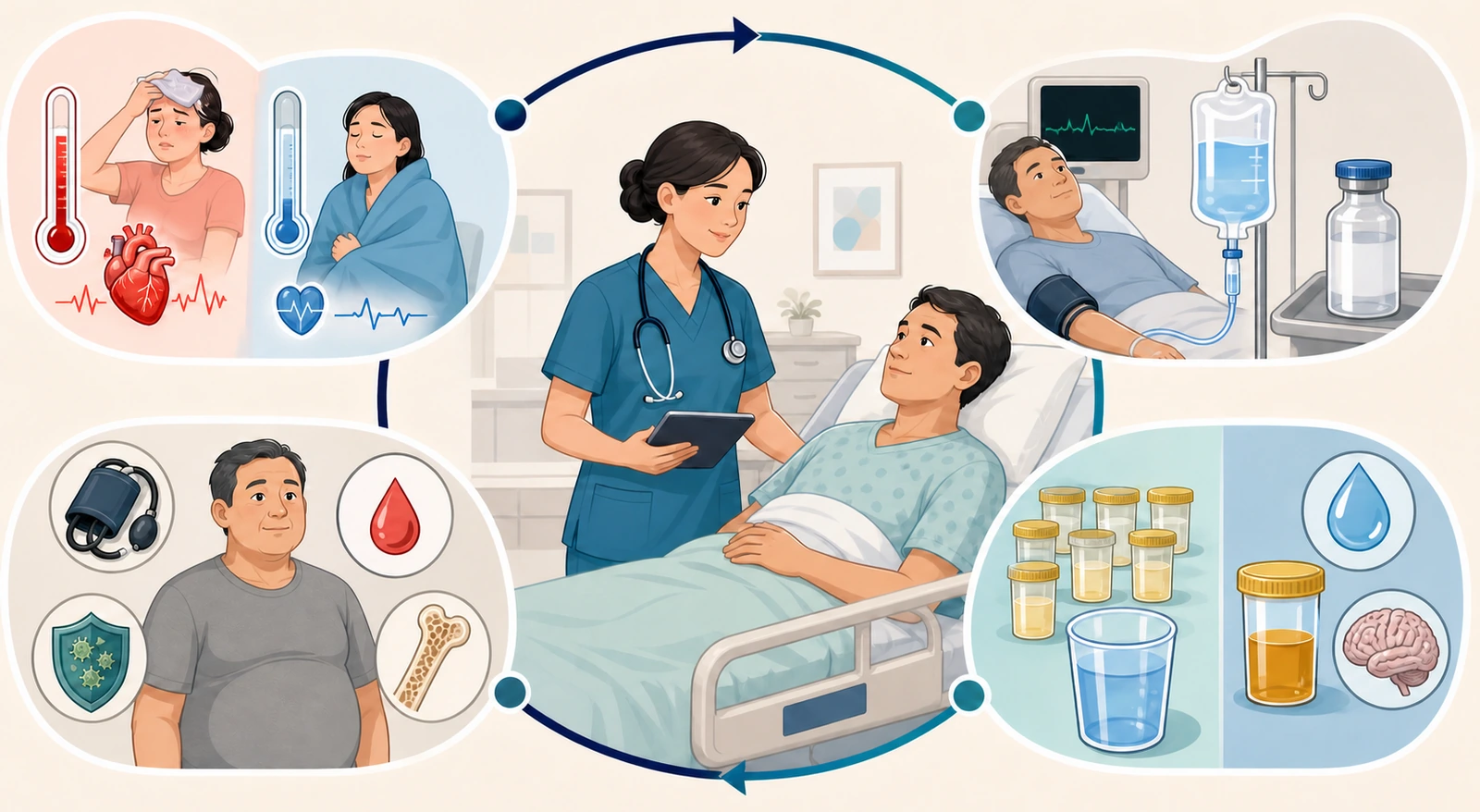
Check airway protection, respiratory rate and depth, oxygenation, pulse, blood pressure, perfusion, and any confusion, drowsiness, or seizures first. Do not delay emergency care while waiting for hormone test results.
High fever, severe tachycardia, and agitation point toward a thyroid storm risk, while hypothermia, bradycardia, hypoventilation, and decreased responsiveness increase the risk for myxedema coma.
Unexplained hypotension, shock, vomiting, dehydration, and hypoglycemia should make you suspect an adrenal crisis. Conversely, chronic cortisol excess raises the risks of hypertension, hyperglycemia, infection, and thrombosis together.
Large amounts of dilute urine with rising serum Na point toward DI, while low urine output with inappropriately concentrated urine accompanied by hypo-osmolar hyponatremia points toward SIADH.
Check for infection, surgery, trauma, medication withdrawal, pituitary/brain surgery, or new medications, and after the intervention, re-measure the same vital signs, consciousness, Na, and urine output.
An endocrine crisis is not a situation where you confirm it with a single lab value and then treat it.
If there is severe instability, hypoventilation, shock, seizures, or a rapid change in consciousness, start emergency help and high-level monitoring first. Draw any necessary blood samples just before treatment if possible, but do not delay airway or circulatory support or time-dependent orders while waiting for results.
| Assessment Axis | Thyroid Storm | Myxedema Coma |
|---|---|---|
| Metabolism & Temperature | Hyperthermia, diaphoresis, heat intolerance | Hypothermia, cool, dry skin |
| Cardiovascular | Severe tachycardia, dysrhythmias, hypertension followed by hypotension, possible heart failure | Bradycardia, hypotension, decreased cardiac output |
| Neurologic & Respiratory | Agitation, delirium, seizures, coma | Drowsiness, confusion, coma, hypoventilation, CO₂ retention |
| Associated Clues | Vomiting, diarrhea, abdominal pain, tremor | Hyponatremia, hypoglycemia, edema, decreased bowel motility |
| Common Triggers | Infection, surgery, trauma, withdrawal of antithyroid drugs | Infection, cold exposure, sedatives, missed thyroid hormone |
Don't just lower the tachycardia number; watch for heart failure, hypotension, chest pain, changes in consciousness, and the temperature trend together.
Implement cooling measures and prescribed antipyretics, and look for precipitating factors like infection. Do not arbitrarily choose aspirin, as it can affect thyroid hormone protein binding.
If antithyroid drugs and iodine are prescribed together, confirm the order to administer iodine after the antithyroid drug. For beta-blockers, check for heart failure or shock status and the prescription conditions together.
Administer prescribed steroids, fluids and electrolytes, oxygen, and heart failure treatments, and evaluate the response using temperature, pulse, blood pressure, and consciousness.
Don't determine the direction of the crisis based solely on whether TSH is high or low.
TSH interpretation is not straightforward in central thyroid disease, severe non-thyroidal illness, or drug effects. In an emergency, look at free T4/T3 together with the clinical picture, triggering factors, and organ function, and proceed with treatment based on clinical suspicion.
| Axis | Clues to Look for in Adrenal Crisis | Actions to Connect Immediately |
|---|---|---|
| Circulation | Hypotension, orthostatic hypotension, shock, tachycardia, dehydration | Call emergency, establish IV line, monitor ECG, BP, and perfusion, administer isotonic saline as ordered |
| Metabolic | Hypoglycemia, weakness, confusion | Check point-of-care blood glucose, administer prescribed glucose if needed |
| Electrolytes | Hyponatremia; hyperkalemia possible in primary adrenal insufficiency | Check Na/K, renal function, and acid-base status, monitor for arrhythmias |
| Gastrointestinal | Nausea, vomiting, abdominal pain, diarrhea | Assess intake/output and fluid loss, check aspiration risk |
| Context | Infection, surgery, trauma, persistent vomiting, abrupt steroid withdrawal | Verify medication history, steroid card, sick-day plan, and treat the triggering cause |
Watch for recovery of MAP, peripheral perfusion, consciousness, and urine output. Adjust fluid volume according to cardiac and renal status.
Repeatedly measure to ensure hypoglycemia is corrected and does not drop again.
Track the direction of levels, the rate of correction, and ECG changes together.
Treat infection, missed medication, vomiting/diarrhea, or surgery/trauma, and establish a recurrence prevention plan.
| Effects of Cortisol Excess | Nursing Assessment | Risks Not to Miss |
|---|---|---|
| Metabolic & Cardiovascular | Blood glucose, blood pressure, weight/edema, K | Diabetes, hypertension, hypokalemic arrhythmia |
| Immune | Don't just wait for fever—check for wound, respiratory, and urinary infection clues | Infection signs may appear subtle or worsen rapidly |
| Skin & Musculoskeletal | Thin skin, bruising, wounds, muscle strength, pain, fall risk | Delayed wound healing, osteoporosis, fractures |
| Thrombosis & Mental Health | Unilateral leg swelling, chest pain, dyspnea, insomnia, depression, psychosis | Venous thromboembolism, acute mental status changes |
There is no one-size-fits-all intervention like 'give lots of fluids' for Cushing's syndrome. Individualize orders based on fluid volume status, Na/K, blood pressure, and cardiac and renal status. Long-term steroids can trigger adrenal crisis if stopped abruptly, so tapering must strictly follow the prescription.
| Assessment Axis | DI / AVP Deficiency | SIADH |
|---|---|---|
| Core Problem | Cannot conserve water | Excessively conserves water |
| Urine | Large volume and dilute; low urine osmolality and specific gravity | Low volume and inappropriately concentrated; high urine osmolality |
| Serum | Na and osmolality trending upward | Hyponatremia and hypo-osmolality trending |
| Fluid Picture | Thirst, dryness, weight loss, hypotension, tachycardia | Usually weight gain without obvious peripheral edema; neurological symptoms depend on the rate and degree of Na decrease |
| Immediate Danger | Hypovolemia, hypernatremia, altered consciousness | Cerebral edema, headache, vomiting, confusion, seizures |
For a patient whose thirst mechanism is intact and who can drink safely, ensure access to water. Decreased consciousness, dysphagia, or restricted water access puts them at risk for rapid hypernatremia.
Evaluate for hypovolemia and hypernatremia, and stabilize the circulation first with the prescribed fluids. A severely ill DI patient should be managed in a high-acuity observation setting.
After giving the prescribed DDAVP for central DI, check whether urine output drops sharply and whether the serum Na is falling too quickly. Avoid both accidental omission and double dosing.
During fluid resuscitation, measure serum Na frequently, and reassess I&O and Na together because water conservation can change abruptly after DDAVP.
Routinely restricting fluids in a DI patient is dangerous.
On the other hand, drinking more water than needed while DDAVP is active can cause hyponatremia. Individualize the fluid plan based on consciousness, thirst, volume status, Na, urine output, and the prescribed DDAVP schedule.
If severe neurologic symptoms are present, treat it as a hyponatremia emergency and prepare for airway management, seizure safety, and high-acuity monitoring.
For moderate-to-severe symptoms, a 3% hypertonic saline bolus may be used according to institutional guidelines. Repeatedly check the serum Na and neurologic response during administration.
If Na rises too quickly, there is a risk of osmotic demyelination. Cross-check the target rise and the criteria for stopping or readjusting against the orders and guidelines.
Identify any causative drugs, CNS or lung disease, and pain or nausea. In stable chronic SIADH, treating the cause and fluid restriction are common first strategies, but do not apply salt, diuretics, or vaptans uniformly to every patient.
The patient with the lower sodium number is not always the first priority.
A patient with a rapid Na drop plus seizures, decreased consciousness, or abnormal breathing may be more urgent. For chronic, asymptomatic hyponatremia, manage the cause and the correction rate safely rather than trying to normalize the value quickly.
The examples below are newly created scenarios to practice your clinical judgment flow and do not reproduce actual NCLEX questions, answer choices, or correct answers.
A patient with a history of Graves’ disease develops a high fever of 40°C, severe tachycardia, restlessness, and diarrhea after an infection. They have not been able to take their antithyroid medication for several days.
Judgment: Suspect thyroid storm first. Continuously monitor ABCs, ECG, temperature, blood pressure, and consciousness; prepare cooling measures and emergency orders; and verify the administration sequence of antithyroid drugs and iodine.
A patient with long-standing hypothyroidism becomes very drowsy after pneumonia and shows a temperature of 34.5°C, bradycardia, shallow breathing, and hypotension.
Judgment: Suspect myxedema coma. Prioritize supporting the airway, ventilation, and circulation, and link passive rewarming, IV thyroid hormone and empiric steroid orders, and evaluation for hypoglycemia, hyponatremia, and infection.
A patient who abruptly stopped long-term steroids presents with vomiting, profound weakness, hypotension, and hypoglycemia, and does not respond adequately to fluids.
Judgment: Suspect adrenal crisis and carry out emergency orders for hydrocortisone and isotonic saline without delay. Repeatedly check blood glucose, Na/K, ECG, urine output, and perfusion response.
After pituitary surgery, the hourly urine output increases sharply and becomes very dilute, with thirst and a steadily rising serum Na.
Judgment: This points toward central DI. Check fluid volume status and the patient's ability to drink, adjust fluids first, then administer DDAVP as prescribed while closely monitoring urine output and Na response.
A patient being treated for a lung condition develops headache and confusion followed by seizures, with hypo-osmolar hyponatremia and concentrated urine confirmed.
Judgment: Suspect SIADH with symptomatic hyponatremia. Secure the airway and seizure safety, administer hypertonic saline as prescribed, and perform frequent Na and neurological reassessments while preventing overcorrection.
1. Among airway, breathing, circulation, and consciousness, which function is breaking down right now?
2. Are the temperature and heart rate too fast or too slow?
3. Is there unexplained hypotension, hypoglycemia, vomiting, and steroid discontinuation?
4. Did you also check for infection, thrombosis, hyperglycemia, and fracture risks associated with cortisol excess?
5. Is the urine copious and dilute, or scanty and concentrated?
6. Do the directions of serum Na, osmolality, and urine concentration align with each other?
7. Did you reassess the same Na and urine output after fluids, DDAVP, or hypertonic saline?
8. Are you correcting triggering factors such as infection, surgery, trauma, medication discontinuation, or brain surgery?
Official Standards: NCSBN, 2026 NCLEX-RN Test Plan · Society for Endocrinology, Adrenal Crisis Information · Society for Endocrinology, Arginine Vasopressin Deficiency Information · Society for Endocrinology, Emergency Management of Symptomatic Hyponatraemia · Endocrine Society, Treatment of Cushing's Syndrome · American Thyroid Association, Guidelines & Statements · American Thyroid Association, Myxedema Coma Clinical Summary
Local feedback only identified topics that learners repeatedly confused. Actual clinical care varies depending on institutional protocols, prescriptions, onset speed, fluid status, cardiac and renal function, and individual patient history.
Content Boundary: The local feedback materials only identified recurring learning topics. Actual exam questions, answer choices, correct answers, screens, patient values, tables, and illustrations were not copied or reproduced; all example situations, sentences, judgment sequences, tables, and images were newly created.
다음 이론을 계속 학습하려면 로그인하세요.
로그인하고 계속 학습필기노트, 하이라이터, 메모는 잘 쓰고 있어?
내보내줘운영진이 검토할게요!
마이페이지에서 차단한 회원을 관리할 수 있어요.