컨텐츠 내용을 수정할 수 있습니다
Instead of relying on SpO₂ or wheezing alone, you'll learn to connect the dots between a patient's ability to speak, level of consciousness, work of breathing, air entry, and changes from their baseline to distinguish a COPD exacerbation from an asthma emergency.
Core Goal: Think through this sequence: Check ventilation and work of breathing → Differentiate COPD vs. asthma exacerbation → Titrate oxygen to match the prescribed target → Intervene with inhalers → Reassess those same items.
Oxygen shouldn't be delayed for a patient who needs it, but it also shouldn't be fixed at the same concentration for everyone. Always look at the patient's baseline status, target oxygen saturation, air entry, level of consciousness, and ABG trends together.
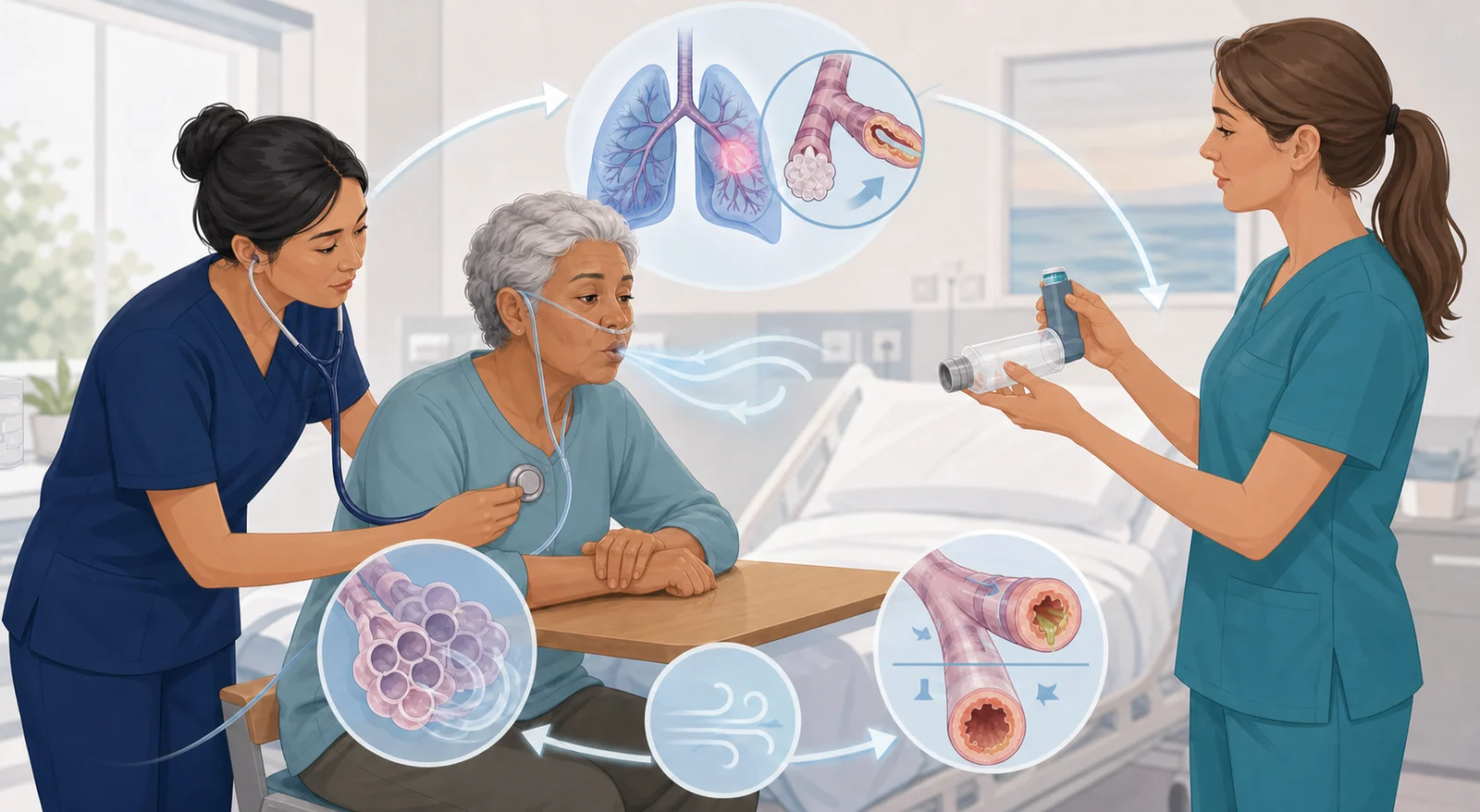
Check if they can speak in full sentences, phrases, or only single words, and note if their speech suddenly becomes more clipped.
Observe for anxiety, restlessness, new-onset confusion, or drowsiness, which can signal progressing hypoxemia or hypercapnia.
Observe the respiratory rate and depth, use of accessory muscles, nasal flaring, chest wall movement, and signs of fatigue.
Compare bilateral breath sounds and air entry to differentiate the context of wheezing, diminished sounds, silent chest, or crackles.
Check the SpO₂ signal quality and trend, and if needed, evaluate ventilation with an ABG and the overall clinical picture.
Don't assume asthma has improved just because the wheezing suddenly disappears.
If the patient is struggling to speak, has minimal air entry, is becoming drowsy or confused, and their chest is going quiet, this could be a sign of severe airway obstruction and impending respiratory failure. Call the emergency team immediately and don't delay preparing for treatment and advanced airway management.
| Assessment Item | Usual Baseline | Warning Signs of Exacerbation |
|---|---|---|
| Dyspnea | Their usual activity level and the time needed for recovery | More shortness of breath with the same activity, or dyspnea occurring at rest |
| Cough & Sputum | Usual amount, color, viscosity, and ability to expectorate | Increased cough/sputum volume, a change in color, or difficulty clearing it |
| Work of Breathing | Their usual respiratory rate, posture, and use of accessory muscles | Tachypnea, increased accessory muscle use, fatigue, or weakening respiratory effort |
| Oxygenation & Consciousness | Their usual SpO₂ and prescribed oxygen, baseline ABG values | A drop below their baseline, new confusion/drowsiness, headache, CO₂ retention, or acidosis |
| Systemic Condition | Eating, sleeping, and activity tolerance | Changes like fever, chest pain, edema, or unilateral decreased breath sounds that suggest other causes |
Even if it looks like a COPD exacerbation, you need to consider other possibilities. Pneumonia, heart failure, pulmonary embolism, pneumothorax, and arrhythmias can all mimic a COPD exacerbation or occur alongside it. Actively look for clues like sudden unilateral chest pain with decreased breath sounds, edema with crackles, or pleuritic pain with a clotting risk.
Help them sit upright and lean forward with their arms supported if needed. Rather than forcing a position, check if their breathing actually becomes easier in it.
Guide them to inhale slowly through the nose and exhale even more slowly through pursed lips. The focus is on prolonging the expiratory time to reduce air trapping, not on holding their breath or blowing out forcefully.
Verify the inhaler/nebulizer device and the prescription, and titrate the oxygen to match the target range. Compare air entry and work of breathing before and after administration.
Assist with effective coughing, position changes, and any prescribed airway clearance techniques. Before encouraging fluid intake, first check for restrictions like heart failure, renal failure, or dysphagia.
Alternate activity with rest and cluster your nursing care to reduce fatigue. Reassess their speech, consciousness, respiratory rate, accessory muscle use, breath sounds, SpO₂, and any ABG changes.
Saying “you shouldn’t give oxygen to COPD patients” is dangerous.
Hypoxia must be treated. However, if there’s a risk of hypercapnia during an acute COPD exacerbation, use controlled oxygen and titrate it to the prescribed target range while repeatedly checking the patient’s consciousness, breathing, and ABG. A commonly used target range may be suggested in clinical practice, but you don’t automatically apply a single number to every patient.
| Device | Key Features | Nursing Checks |
|---|---|---|
| Nasal cannula | Relatively comfortable for talking and eating; can be adjusted from low concentrations | Skin on the nose and ears, dryness, tubing connection and actual flow rate, target SpO₂ |
| Venturi mask | Delivers a set oxygen concentration relatively accurately | Check that the specified adapter and flow rate match; ensure air entrainment ports aren’t blocked |
| Simple mask | Can be used when a higher concentration than a cannula is needed | Minimum flow rate to prevent rebreathing, mask seal, skin, and risk of anxiety/aspiration |
| Reservoir mask | Used when high-concentration oxygen is needed in emergencies | Check that the reservoir bag doesn’t fully collapse during inspiration, connections and valves, and prepare immediately for advanced care |
Suspect an exacerbation if the patient can only speak in phrases or single words rather than sentences and cannot lie down. Being unable to speak or drink is even more urgent.
Look at tachypnea, accessory muscle use, wheezing, and decreased air entry together. A reduction in breathing effort after severe fatigue may not be an improvement.
Drowsiness, confusion, or cyanosis are warning signs of a life-threatening exacerbation. Don’t mask observation by suppressing anxiety with sedatives.
After prescribed rapid-acting bronchodilators, controlled oxygen, and systemic anti-inflammatory therapy, reassess whether symptoms, SpO₂, air entry, and PEF are improving.
A silent chest, drowsiness, confusion, cyanosis, or being unable to speak are warnings that require immediate escalation of care.
While starting treatment, simultaneously prepare for emergency transport, intensive care, and the potential need for an advanced airway. Don’t just keep repeating inhalers if there’s no response, and don’t leave the patient alone.
A dry powder inhaler generally doesn’t use a spray button and the slow inhalation technique of a pMDI. You breathe out away from the device, then seal your lips around the mouthpiece and inhale quickly and deeply. Do not attach a spacer. Check the product-specific instructions and prescription for the exact steps.
Teach-back: Instead of asking “Do you understand?”, have the patient demonstrate the whole process from start to finish with their own device. The nurse directly observes breathing out, lip seal, inhalation speed, coordination with actuation, breath-hold, and cleaning/oral care, and corrects technique on the spot.
| Role | Key Question | Safety Point |
|---|---|---|
| Reliever | Which device is prescribed to be used, and when, to relieve symptoms right now? | Check if a lack of response or increased use is a sign of an exacerbation, and report according to the action plan |
| Controller | How is the medication that reduces airway inflammation and long-term risk used every day? | Don’t stop it just because there are no symptoms; check if it contains an ICS and address oral care |
| COPD maintenance | What is the individual purpose of the long-term bronchodilator and any additional medications? | Not every COPD patient automatically needs an ICS; check the prescription and exacerbation history |
| Device check | What is the actual device among pMDI, DPI, soft-mist, or nebulizer? | Preparation, inhalation speed, and cleaning methods differ for each device, so verify with a product-specific demonstration |
The examples below are newly created scenarios to practice your clinical judgment flow and do not reproduce actual NCLEX items, answer choices, or correct answers.
A COPD patient who was placed on oxygen because they were more short of breath than usual is gradually becoming drowsy, and their breathing is shallow. The SpO₂ reading is near the target, but their responsiveness is slowing down.
Judgment: Don't just remove the oxygen unconditionally or feel reassured just because the SpO₂ looks normal. Immediately reassess the airway, breathing, and level of consciousness, check the device and flow rate, and report the possibility of ABG findings, hypercapnia, and respiratory acidosis so you can prepare for respiratory support.
A patient with an asthma exacerbation now has barely audible wheezing, but they can only speak one or two words and appear drowsy.
Judgment: First, suspect a silent chest with very little air movement rather than improvement. Immediately call the emergency team and simultaneously prepare the prescribed acute treatment and advanced airway management.
Without exhaling first, a patient presses their pMDI twice in a row and inhales rapidly.
Judgment: Instead of just repeating the instructions, perform a device-specific teach-back. Have the patient demonstrate the steps themselves: exhaling fully, one single actuation, inhaling slowly and deeply, holding their breath if possible, and following the prescribed interval.
1. Is the patient speaking in full sentences and awake?
2. Is accessory muscle use and respiratory fatigue increasing, or suddenly decreasing?
3. Is there bilateral air entry, and is it not a silent chest?
4. Is the current SpO₂ a reliable signal, and how does it differ from the patient's baseline?
5. Besides a COPD exacerbation, is there a possibility of pneumonia, heart failure, PE, or pneumothorax?
6. Does the oxygen device and flow rate match the prescribed target, and is it actually connected?
7. Have you differentiated the inhaler type, usage technique, and the roles of reliever vs. controller?
8. After the intervention, did you reassess speech, consciousness, work of breathing, air entry, and SpO₂?
Official Standards: NCSBN, 2026 NCLEX-RN Test Plan · GOLD, 2026 GOLD Report and Pocket Guide · GINA, 2026 Summary Guide for Asthma Management and Prevention · NHLBI, How to Use a Metered-Dose Inhaler
This patient-first, independent study flow was built upon NCSBN's ventilation and oxygenation management, GOLD's COPD exacerbation assessment and differentiation, GINA's severe asthma warning signs, ICS-inclusive treatment, and inhaler education, and NHLBI's pMDI usage principles. Oxygen targets, medications, dosages, and device settings should be applied according to the patient's condition, prescription, the latest guidelines, and institutional protocols.
This material is an educational summary that independently reconstructs learning topics repeated in local feedback. It does not restore or reproduce actual NCLEX questions, answers, choices, exam screens, original tables, patient data, or source images. In actual patient care, follow the latest clinical guidelines, institutional protocols, and the judgment of the attending healthcare team.
다음 이론을 계속 학습하려면 로그인하세요.
로그인하고 계속 학습필기노트, 하이라이터, 메모는 잘 쓰고 있어?
내보내줘운영진이 검토할게요!
마이페이지에서 차단한 회원을 관리할 수 있어요.