컨텐츠 내용을 수정할 수 있습니다
Here’s how to think through safety, life threats, acute changes, and the risk of deterioration as one connected flow — so you can identify which nursing action needs to reach the patient first.
Core goal: Don’t just memorize ABC as a sequence of letters. You need to be able to explain, “Which problem, if I delay even a few minutes, will cause the greatest harm?”
Use Safety to stop immediate harm, ABC to quickly find physiological threats, and then Unstable vs Stable to compare how fast things are changing and how likely they are to get worse.
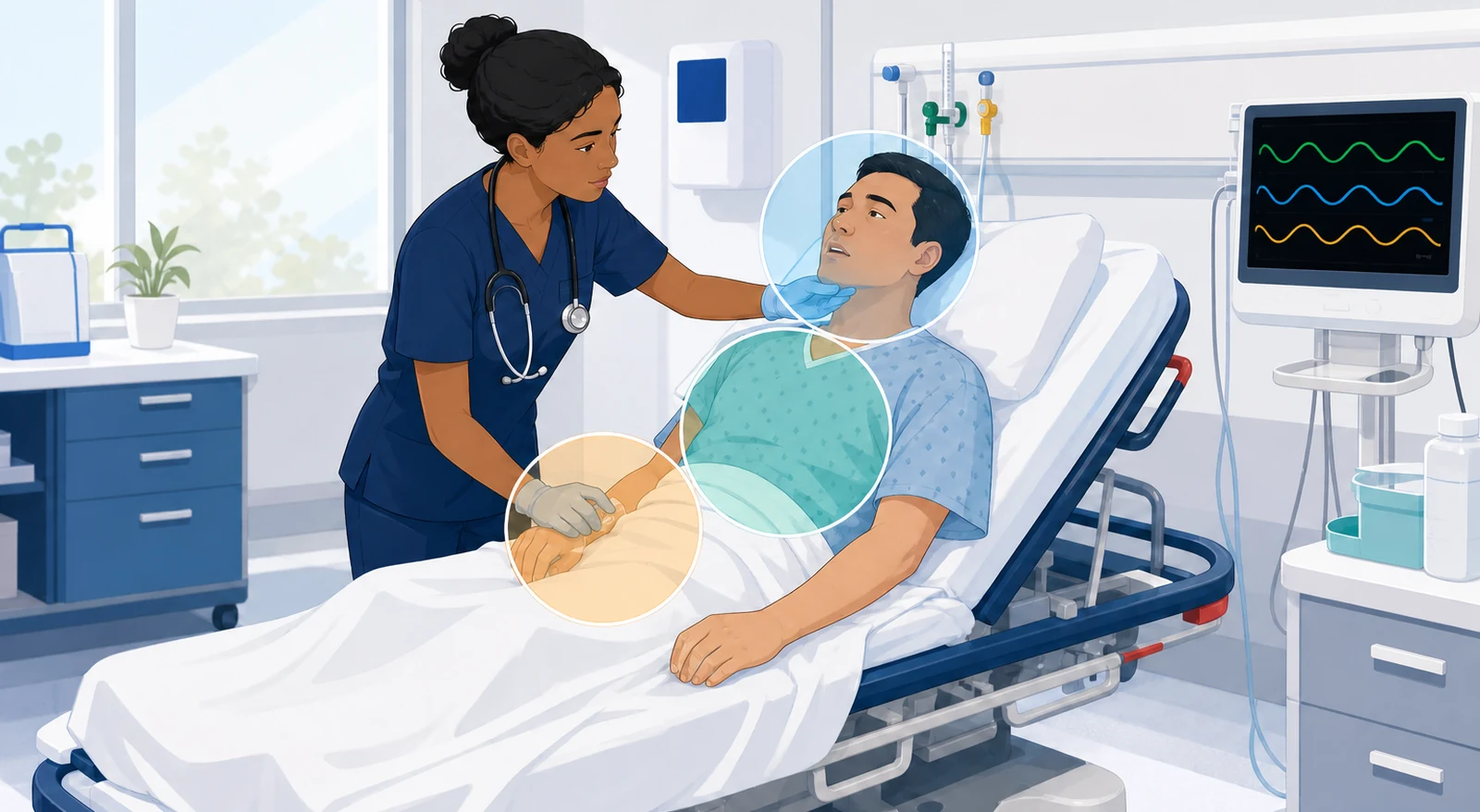
Priority-setting isn’t about applying one rigid formula. If you quickly scan the situation three times before looking at the answer choices, it becomes much easier to tell the difference between a clue that simply stands out and one that signals real danger.
Is there an active threat happening right now to the environment, the patient, or the nurse?
Is there an immediate threat to the airway, breathing, or circulation?
Is there a change that is new, unexpected, and rapidly getting worse?
Safety isn’t less important than ABC — it’s the starting point that makes assessment and intervention possible in the first place. Walking straight into a hazardous environment or ignoring an ongoing source of harm can increase injury for both the patient and the healthcare team.
Check whether electrical hazards, fire, toxic substances, violence, infection exposure, and equipment risks are under control.
First, halt dangers that are happening right now — like a patient about to fall, equipment connected incorrectly, or an ongoing exposure.
If the situation is too much to handle alone, activate your facility’s emergency response system while keeping yourself safe.
Once safety is secured, recheck the patient’s ABCs and response.
“Getting to the patient quickly” is not the same as “approaching safely.”
If the scene itself is dangerous, rushing in without protective measures and backup support is rarely the right answer. However, once the danger is controlled, don’t delay the patient assessment that’s needed.
ABC is a rapid-assessment lens for making sure you don’t miss a life threat in an acute situation. Don’t look at each letter in isolation. Instead, connect what you see: the patient’s speech, their work of breathing, their skin and level of consciousness, and the trends in their vital signs.
| Area | Clues to check quickly | Changes that raise the priority |
|---|---|---|
| Airway | Ability to speak, airway sounds, secretions, facial/neck changes, level of consciousness | Difficulty speaking in full sentences, loud airway sounds, obvious obstruction, or declining ability to protect the airway |
| Breathing | Respiratory rate and trend, chest wall movement, work of breathing, oxygenation, skin color | New-onset dyspnea, rapidly increasing effort, asymmetrical movement, cyanosis, or a worsening trend |
| Circulation | Pulse, blood pressure trend, skin perfusion, level of consciousness, bleeding, and peripheral status | Uncontrolled bleeding, weak perfusion, acute change in consciousness, or a cluster of clues that makes you suspect shock |
Reading tip: Whether the patient can speak in full sentences, whether they’re using accessory muscles to breathe, and whether their skin or consciousness has changed from baseline — these are crucial clues to evaluate alongside any single monitor number.
Unstable doesn’t simply mean the diagnosis is serious or a lab value is outside the normal range. It means there are clues showing that the patient’s current function is breaking down or is likely to deteriorate rapidly.
| Comparison point | Relatively Stable | Clues that suggest Unstable |
|---|---|---|
| Baseline status | Similar to the patient’s known baseline | Newly deviates from baseline or is unexpected |
| Speed of change | No change, or a predictable course | Worsening over a short time, or continues to deteriorate even after an intervention |
| Function | Speech, breathing, perfusion, and consciousness are maintained | Airway protection, oxygenation, perfusion, or consciousness is faltering |
| Time sensitivity | Planned assessment, teaching, and follow-up are possible | A delay of just a few minutes could significantly increase harm |
Don't set priorities based on the diagnosis name alone.
Even with the same diagnosis, stability varies depending on baseline status, current symptoms, recent interventions, and rate of change. The functional change happening in the patient right now matters more than the weight of the disease label.
ABC is useful, but it's not a fixed action sequence for every situation. When an actual emergency algorithm or an obvious life threat is presented, you must apply the order that fits that context.
In a cardiac arrest context, use the C-A-B sequence — start chest compressions first.
The 2025 American Heart Association adult basic life support guidelines direct you to begin chest compressions before ventilation in adult cardiac arrest. Don't pick ventilation first just because you see the letters A-B-C.
Control the bleeding immediately while ensuring scene safety and activating the emergency response system.
Severe external bleeding can be fatal within minutes. Rather than doing a lengthy head-to-toe assessment first when obvious bleeding is present, prioritize immediate bleeding control actions and calling for help according to your role and agency protocol.
When the threat is clear, don't delay intervention with aimless additional assessment.
If cues strongly suggest airway obstruction, start emergency procedures and call for help. Conversely, if the threat is unclear, perform a focused assessment first that could actually change your priority.
If it's a risk the nurse can stop or reduce right now, initiate safety measures and any necessary emergency interventions.
Perform a focused assessment that could change your decision — such as breath sounds, work of breathing, pulse/perfusion, or level of consciousness.
Activate your agency's emergency response system and request the needed personnel. In an emergency, possible interventions and calling for support can happen simultaneously.
Recheck ABC, symptoms, and trends, then update your priority.
The situations below are newly created to illustrate the judgment flow and do not reproduce actual NCLEX items, answer choices, or correct answers.
A patient who was conversing just moments ago suddenly speaks only in short words, and their chest wall movement and work of breathing are noticeably different from before.
Judgment: More than a single number, change in speech + increased work of breathing + acute change raises the instability level. Rather than scheduled teaching or charting, immediately focus on assessing respiratory status and initiate necessary safety measures and support procedures.
One patient has a known chronic abnormal finding but is at their current baseline and appears comfortable. Another patient is becoming pale and less responsive compared to their usual state.
Judgment: Assess the patient showing new perfusion/consciousness changes first — not the one with the more striking diagnosis name or an old lab value.
A patient with unsteady gait is trying to stand up alone at the bedside, and nearby equipment lines are positioned where their feet could get tangled.
Judgment: Interrupt the harm that's happening right now before addressing long-term fall prevention education. After making the patient and equipment safe, assess the cause, function, and prevention plan.
1. Before approaching, is there an ongoing safety risk to the scene or patient?
2. Among airway, breathing, and circulation — is any function collapsing right now?
3. Is this cue a new change from the patient's baseline?
4. For whom would a few minutes' delay cause the greatest harm?
5. Has an obvious emergency algorithm or exception situation been presented?
6. Is there a plan to recheck ABC and response after the action?
Official Standards: NCSBN, 2026 NCLEX-RN Test Plan · American Heart Association, 2025 Adult Basic Life Support Guidelines · American College of Surgeons, Stop the Bleed Resources
This summary is based on the NCSBN's clinical judgment and safety-focused framework, the AHA's adult cardiac arrest C-A-B sequence, and the ACS's principles for responding to life-threatening bleeding. The "three-scan" approach and 10-second check aren't official terms—they're study frameworks I put together independently to help you apply these concepts.
This material is an educational summary that independently reorganizes learning topics that came up repeatedly in test-taker feedback. It doesn't recreate or reproduce actual NCLEX questions, answers, or exam screens. In clinical practice, always follow the latest professional guidelines, your facility's policies, and the judgment of the healthcare team.
다음 이론을 계속 학습하려면 로그인하세요.
로그인하고 계속 학습필기노트, 하이라이터, 메모는 잘 쓰고 있어?
내보내줘운영진이 검토할게요!
마이페이지에서 차단한 회원을 관리할 수 있어요.