컨텐츠 내용을 수정할 수 있습니다
Even in long passages, here's how to spot the most critical clues and tell the difference between the first action and the next step for the most urgent problem.
Core goal: Instead of memorizing answer phrases, you need to be able to explain, “Why is this problem the most dangerous right now?”
First and Priority start from the current clues, while Next starts again from the action already taken and the newly observed response.
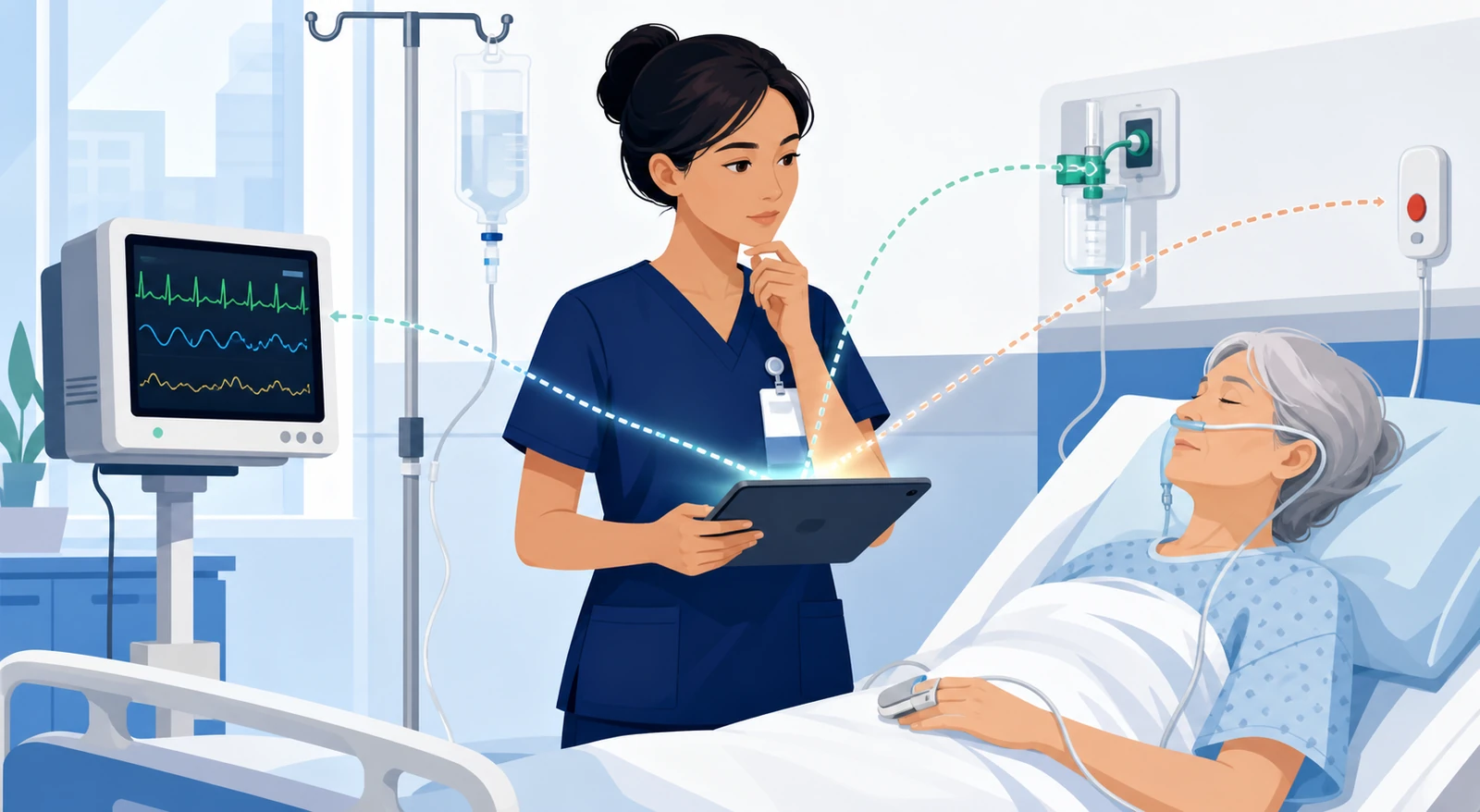
Even in the same situation, the answer changes depending on when the action is being asked about. Before looking at the options, summarize the question's timeline in one line.
| Expression | What it's asking | What to check as you read |
|---|---|---|
| Priority | The highest-priority problem, client, or action right now | Urgency, potential harm if delayed, likelihood of current deterioration |
| First | The single step to take first right now | The assessment, safety measure, or intervention immediately needed based on current clues |
| Next | The step that follows after a previous action | The action already taken, the patient's response, new clues, unresolved risks |
The NCSBN describes clinical judgment not as a single gut feeling, but as a repeating, multi-step process. Priority questions should also be solved within this flow.
Identify relevant information from the history, vital signs, assessment findings, lab trends, and environment.
Connect the cues to each other to determine if they match the current clinical picture and what changes are underway.
Set priorities by considering urgency, likelihood, degree of harm, time constraints, and the complexity of the situation together.
Define the expected outcomes and formulate nursing actions that can address the highest-priority problem.
Implement the action that directly addresses the highest priority, within the nursing scope and current situation.
Compare the observed response to the expected outcomes and readjust hypotheses and plans based on new cues.
Important: These six steps are not a one-time, straight-line procedure. When the patient's condition changes after an action, you go back to recognizing cues and updating priorities.
The following four questions are a study frame to help you quickly apply the NCSBN clinical judgment structure in the exam room. They are not an official NCSBN acronym, but a checklist order to make sure you don't miss anything in the current situation.
Is this a problem where a few minutes' delay significantly changes the outcome?
Is this the problem that would cause the greatest damage if no action is taken?
Are there clues that are new, unexpected, and rapidly worsening?
What are the patient's baseline status, recent interventions, resources, time constraints, and nursing scope?
| Area to check | Relatively stable clues | Clues needing priority attention |
|---|---|---|
| Pattern of change | Similar to baseline and predictable | New, unexpected, and changing rapidly |
| Physiological risk | No signs of immediate functional impairment | Suspected airway, breathing, perfusion, consciousness, or significant safety risk |
| Time sensitivity | Planned assessment and teaching are possible | Potential for harm increases if delayed |
| Direction of action | Assess, teach, and evaluate according to plan | Focused assessment, immediate possible safety measures, necessary interventions, and reporting/support requests |
Don’t jump to “unstable” based on just one number.
You need to connect the reliability of the measurement, the patient’s baseline, their symptoms, the trend, and any recent interventions. On the flip side, even if the numbers look normal, a sudden change in mental status or severe work of breathing are red flags that need to be assessed first.
Find the most dangerous change happening right now.
Choose the problem that will cause the most harm if delayed.
Pick the action that directly reduces that problem first.
“Always assess first” is not an absolute rule.
Depending on the situation, securing immediate safety or reducing a life threat may come first. Conversely, if the risk is unclear, you shouldn’t rush into an intervention without confirming the necessary cues.
“Next” questions try to trap you into jumping to a new action without checking whether the previous step was effective. Separate what was already done from the response that followed as you read the scenario.
Mark off completed assessments, interventions, and reports.
Check the response, trends, and any new risk cues.
Re-select the highest unresolved priority.
Picking an answer just by looking at the letters A-B-C
The ABC framework is a screening tool to ensure you don’t miss critical physiological threats. A new, rapidly worsening risk can be more urgent than a chronic cue that matches the patient’s baseline, so you must check the whole context.
Memorizing that “Acute always beats Chronic”
A new change is an important signal, but if its severity and time-sensitivity are low, it may not be the immediate priority. Conversely, a patient with a chronic condition needs an urgent response if an acute exacerbation is happening now.
Always picking the option to contact a provider first
Reporting and requesting support are important, but also look for actions the nurse can immediately check or safely carry out. In an emergency, intervention and calling for support can happen simultaneously.
Choosing an action that was already done
In a “Next” scenario, start by crossing off completed actions. You need an option that evaluates the current response or addresses the next unresolved risk.
The examples below are brief, newly created situations to illustrate the judgment flow and do not reproduce actual NCLEX items.
A patient who was just talking suddenly speaks only in short sentences, their work of breathing visibly increases, and their oxygen saturation trend is dropping.
Judgment: The cluster of new respiratory changes matters more than a single number. Rather than general teaching or routine charting, the priority is to immediately perform a focused respiratory assessment and start necessary safety measures and emergency support procedures.
A patient with an unsteady gait is trying to get out of bed alone, and the call bell is out of reach.
Judgment: Rather than long-term fall education, you need an action that first reduces the fall risk happening right now. Secure immediate safety, then assess the environment and cause, and supplement the prevention plan.
You performed a nursing action to relieve respiratory discomfort. The patient says they feel a little better, but their work of breathing is still increased.
Judgment: Don't stop at just hearing "I feel better." Compare the expected outcome with the actual response, reassess for any remaining risk cues, and then decide what additional interventions or support requests are needed.
1. What is the question really asking for—Priority, First, or Next?
2. What is the new, unexpected, and worsening cue?
3. Which problem would cause the greatest harm if delayed?
4. Does the action you chose directly address the top-priority hypothesis?
5. Are you repeating an action that has already been done?
6. Is the outcome you’ll evaluate after the action clear?
Official Source: NCSBN, 2026 NCLEX-RN Test Plan · NGN Talks: Clinical Judgment Model Transcript
The official 6 steps and priority considerations are summarized based on the materials above. "Urgency, Harm, Change, Context" and the 10-Second Check are not official names but frameworks independently developed for study application.
This material is an educational summary that independently reorganizes recurring study topics from test-taker feedback. It does not reconstruct or reproduce actual NCLEX items, answers, or exam screens. In clinical practice, always follow your institution's guidelines and the judgment of the healthcare team.
다음 이론을 계속 학습하려면 로그인하세요.
로그인하고 계속 학습필기노트, 하이라이터, 메모는 잘 쓰고 있어?
내보내줘운영진이 검토할게요!
마이페이지에서 차단한 회원을 관리할 수 있어요.